Is that like 20% of your nw or investment account?
May be the same though 
Is that like 20% of your nw or investment account?
May be the same though
Yeah well, just answering in a more general context of attractive yielding currency vs. CHF and traction to high %.
I haven’t “invested” in USD cash for the yield but once I had them in cash I kept them (yielding in MM) (small) part of my cash position, thinking it’s currency diversification, fine… #fail.
Yes, it’s nearly 20% of NW.
(I count an emergency fund as part of NW too.)
Just read in the NYT that some passive index ETF did have to change their label this year to “non-diversified”, because they brake the 5% rule of the SEC for having the “diversified” label. Interesting…
The AI tells me “market” (indices) have become more concentrated than ever, breaking the records of the 60’s."
There goes the ETF argument of diversification…
BTW: I use diversification for risk reducing, mainly in my divi strategy. In my momentum strategy I double down sometimes, do exactly the reverse of diversification. But I do it knowing that I can stand the risk, and I doubt that the ETF folks know what risks they are taking.
On my side, things are looking good regarding the Japanese bet I made in December. Up 20% YTD.
Finpension up 0.94% YTD, it might be a good time to put some money onto it, but I need the liquidity right now. The other 3A is basically SMI, so up 2%.
I really thought that BTC would crash more. I kept my leveraged orders for the bottom and bought a bit at 72K while keeping some cash.
All in all, whole portfolio up 10%.

We’ll see how it evolves this month and after the dividends are due on March, expecting a little drop. For now, I’ve survived earnings.
Market sentiment looks positive @ mustachios*
*auto-correct suggestion I liked.
Concentration risk isn’t that much of a problem. And if you invest in something like VT and not just VOO, it’s even less so.
I wouldn’t worry much if you VT and chill.
Ben Felix made a good video about it:
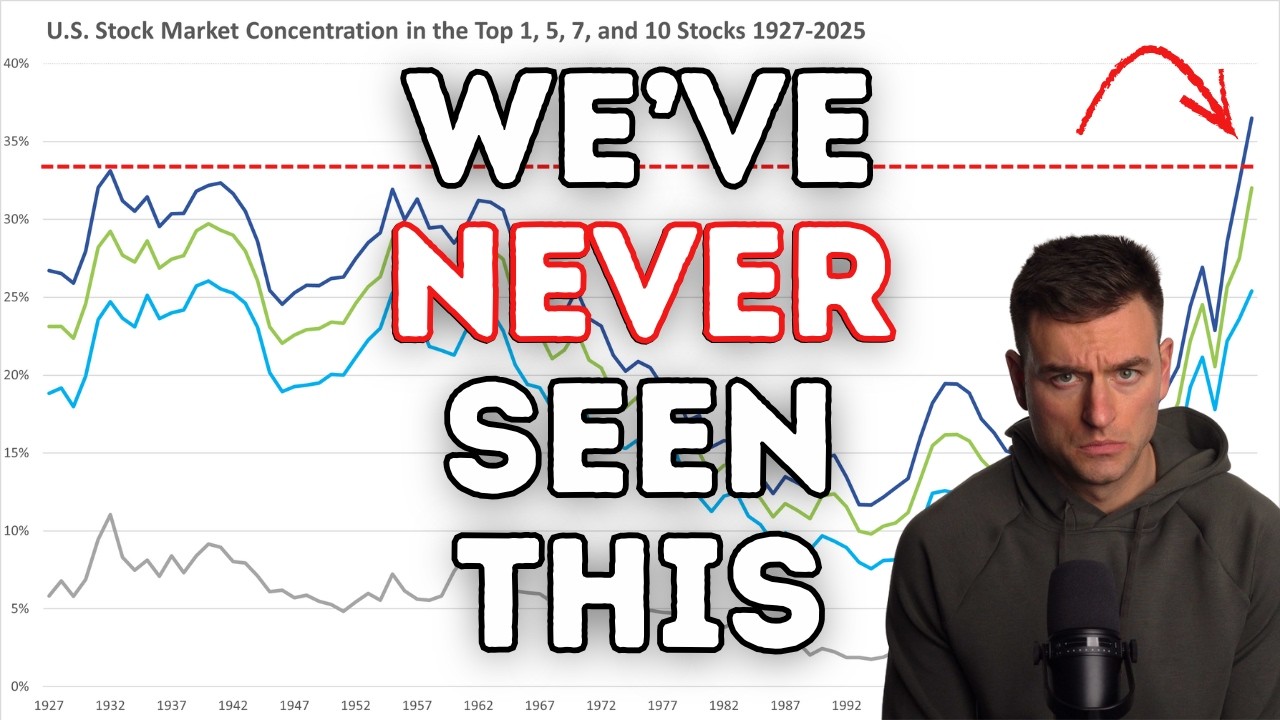
Invest as usual based on a plan made in 2024, now building CHDVD, anticipate I will switch back to VT (VWRL) once I hit ~20% in CHDVD, should be by the end of the year.
Always the same “arguments”, so I have to say the same too:
Broad indices contain a lot of trash. Even a small value or bullshit filter would help. The stock market moves too much money to not attract cheaters. With a broad market index you invite those into your house. I worked hard for my money, why should I give it away to such people?
And you buy a lot of what already did rise in the past and very little of what will rise in the future. For many years (decades?) what did rise in the past was the same that would rise in the future, but long term it is exactly the other way round.
Now, stock picking is against our caveman brain, that is why most stock pickers (and almost all professionals) do even worse than the ETF investors. But it does not mean that you cannot do better…
Because you have the time and inclination to filter out the trash. At this point and with the current size of my portfolio, getting salary income makes me more money than filter out my trash. Also, I can’t expect my mother to filter out her trash of her portfolio with a reasonable effort.
But I’m trying to learn from you, and I’m looking forward to filtering out my own trash once it’s worth dedicating myself to it.
Wow! I make 1-2 purchases per year, incl maybe 1 sell (average is 1/2 a trade per year) for repositioning, thats it
Time is a good argument. Unfortunately I cannot find an ETF that does what I do. The closest would be SCHD that is mechanical too and serves as base for my divi strategy. But my rules are stronger…
If time is an issue, you don’t need to trade much. My biggest winners in the divi strategy are the ones I hold for over a decade. No trading needed in more than 10 years and 10 years ago maybe one Saturday. If time is of essence you should define your strategy with that in mind.
Checked, I had exactly two trades this year: a partial sale after one year in the momentum strategy and a divi reinvestment in the divi strategy, which could easily be automated in Interactive Brokers. Sometimes I don’t have any trade for 3 months or longer. But my momentum strategy needs daily work. My divi strategy doesn’t and with a few small changes once a year would be enough.
Now, a friend of mine does beat the indices since many years. At the moment he uses a very simple strategy: 75% SCHD, 5% O, 20% QQQ (or any other Nasdaq 100 product). He re-balances every 7 months to avoid seasonality and spends the rest of the year travelling around the world. One hour in 7 months is not that bad, just think about how long it took you to make that money.
Another important issue is errors. Everybody, really everybody, including me, suffers from errors and they are expensive. That is an argument for ETF. But at least they should be aligned to a mechanical index, SP500 is not mechanical.
You argue that indices contain “trash” and that a simple filter would be helpful. However, this assumes that you can identify the “trash” in advance. But the data suggests otherwise. According to Professor Hendrik Bessembinder’s famous study, the vast majority of stocks are indeed “garbage” in the long run. Between 1926 and 2016, 58% of common stocks failed to outperform Treasury bills. Just 4% of the best-performing stocks accounted for the entire net wealth creation of the stock market over that century.
In a broad index, fraud is a rounding error. In a concentrated portfolio, however, fraud is a catastrophe. If you hold VT and a company like Wirecard or Enron goes bankrupt, you lose a tiny percentage of your portfolio. You aren’t “giving them money.” You are buying a slice of the global economy. “Cheaters” are the cost of doing business in a public market. The index protects you from them through extreme diversification. If you pick a stock and it turns out to be fraudulent, you lose your hard-earned money. If you invest in VT, however, the fraud is mathematically irrelevant to your financial future.
You don’t just buy the top. VT owns small and mid-cap stocks, too. When a small company starts to succeed, the index automatically captures its growth. You ride the elevator all the way up.
While this is true over very long cycles (decades), it is dangerous to bet on it. Value traps, or companies that appear cheap but are actually failing, are real. The index avoids value traps by not overweighting failing companies just because they appear “cheap.”
The argument for VT isn’t that it offers the highest possible theoretical return. Rather, it offers the highest return per unit of risk taken and effort expended.
There are various well known standard methods to “identify trash”. I like Peter Lynch’s method, but that is too much work for me. He checked the parking lots of the companies he invested in. If they were full of merchandise he sold. 
I think it depends on the company type you want to filter. Small companies that buy growth do so often to cheat. They appear to be growing, but in reality they just spend a lot for almost nothing. At the moment circular orders are a popular action; you buy from me on credit, I buy from you on credit. You can compare several numbers in the reports to identify warning signs.
Cannot remember a book I did read last year that went into details about trash or cheating companies. Will search for it…
Yeah, but what are 500% of 0.00something%?
And avoids big wins by not over weighting rising companies just because they are still cheap.
Effort yes, but return per unit of risk definitely no. At least not long term.
And if you prefer pictures to books, instead of youtubers you could watch those very entertaining shows and learn some.
I think the actual season of Industry is about a cheating big financial company like wirecard. Very interesting:
https://www.imdb.com/title/tt7671070
There was a danish show once that I enjoyed, I think the English title was “follow the money”. Too much drama, but I did learn a lot by just watching the tricks this company used.
That’s why you are retired and I am not! 
I am yet to conclude if your numerous statements about you beating indices by a huge margin are because of:
Regarding your investment approach, I truly appreciate the systematic or mechanical aspect of it, and I even admire your ability to invest with leverage over long periods without worrying about potential significant losses (up to 60, 70, or 80%).
What is a little annoying, however, is your myopic attitude in many cases - if not putting down people who present you with thoughtful arguments.
He’s reporting in USD, I’ve never seen him bragging about his XX% gain in USD vs. Y% gain in CHF in a direct mathematical mistaken comparison. Expecting XX% will make the Z% currency loss negligible is his bet, when you believe in something better be convinced.
I am very sorry, that was never my intention. My English is a bit rusty but that is no excuse.
Now for the over performance: if measured in “unit of risk” (which is almost impossible for the future, but there are some parameters) I probably only gain a little to the indices because I try to avoid obviously bad companies. Of course sometimes I miss a big gain and sometimes I get a cheater anyhow, but I’m sure that there are much less than in the indices.
The performance of my divi strategy is probably worse than the indices but takes much less risk, so the risk adjusted performance is OK for me. I can live off that strategy.
Now the momentum strategy is a complete gamble. I had some money left that I could afford to lose all. I take a lot of risk there and the performance is (was) incredible, even better than my decade-long tests. But that means it could be pure luck! And that can turn any moment. Anyhow, I already quadrupled what I thought I could lose and maybe take out some to pay back my mortgage. But then, I probably won’t get a new mortgage at my age and with only AHV as fix income.
I don’t think many people who want to FIRE can stand the risk of such a strategy. A loss of 80% or more is almost sure at some point in the future. But lucky for all of us, nobody knows when…
Actually it is worse. I switched much of my debt to CHF. So if I report in USD the loss in currency of that debt is already contained.
It is a question of cash flow. Nobody knows the future of exchange rates, but we know the difference in interest. For debt this is cash flow every month. But in total there would have been a big loss last year and YTD.
I am afraid I have to come up with a mechanical strategy for currencies too. The exchange of debt currency was probably my first non-mechanical trade in over a decade. And it is losing…