Well I am not travelling to US unless I have some really important work related travel.
What’s the point of facing harassment when the goal is to spend tourism dollars. There are other places to spend the money 
Well I am not travelling to US unless I have some really important work related travel.
What’s the point of facing harassment when the goal is to spend tourism dollars. There are other places to spend the money
The data are clear: diversification reduces risk while not harming returns much…unless you get mag7 ripping it for 10 years straight!
That said I am still overweight US myself by 20% above MCW, but given it’s no time to sell it’s also possible to just add more ex-US, if one’s portfolio is not massive.
Well. I think we need to start checking if MCW World ETF is really the best strategy or not. Specially talking about people who are not US residents.
And I was wondering where exactly this strategy came from when most people don’t really invest in global market weight ETFs. As per data, most investors have significant home bias (Europe, CH, IN, Canada, Japan, Australia etc) but on Reddit, I keep seeing VT & Chill.
I have a feeling that VT & chill was mainly introduced for US residents to help them diversify abroad (where it makes sense as it still have 60% US exposure) but somehow got adopted by some other foreign investors too
Did Europeans (on social media) just copy paste strategy for US investors assuming it works for them too?
Precisely. Policy has become arbitrary, with foreigners being blamed by the powers that be for the country’s problems. There is little commitment for due process, it is doubtful that even Supreme Court rulings have much weight these days. Meet an entitled-feeling border agent, you may spend hours in immigration. Have the orange one getting up with the wrong foot on the day you land, you may be sent back, or worse, for little reason. Admittedly a small risk but why would one want to take it?
After forecasting a 5% dip for inbound travel to the US this year in February, travel forecasting group Tourism Economics has revised its projections, telling CNN Travel that it now expects that figure to almost double to 9.4%.
Summer hotel bookings from European travelers for Accor properties in the US are also down a whopping 25%, CEO Sébastien Bazin said in a recent interview with Bloomberg TV. Accor hotel brands include Fairmont, Ibis, Novotel, Mercure and Raffles.
Jean-François Rial, CEO of France’s leading luxury tour operator Voyageurs du Monde, said that ever since Trump’s inauguration in late January, bookings for US travel among his wealthy French clients have dropped a “colossal” 20%. “In the 30 years I’ve been in this business, I’ve never seen anything like this for any destination. It’s huge,” he told CNN Travel.
But what has been the variable that was optimised ?
Returns or Risk?
Would be great if you can share some data because all global research I found is always talking about home bias. No one actually says buy a world ETF with all the companies. Not even Boggle or Ben Felix. In fact Bogle was not even asking for international stocks
Most of the recommendations are to diversify internationally. Which means people should not ONLY invest in domestic stocks. But it never says to simply extrapolate the S&P 500 theory to Globe. As referenced in Ben Felix‘s recent video, the research have optimal base case for 65% allocation to international stocks
Sort of. It took 10 years until Germany was allowed to start up a military again*, after the country was completely beaten in WW2.
A slim majority for a differently-leaning US presidential candidate would not constitute the same base.
*and “helped along” by the cold war.
With this analogy, US first needs to lose the trade war and then pay reparations and then world can trust them.
Yeah I can buy that 
Yes, but reddit and fora like this one are probably a very tiny minority. I’d expect that most people don’t tinker, have active management/big fee “advisors”, pick stocks either because “It’s yuge” or “I drive by Dunking Donuts and it’s always full” (that’s Peter Lynch, this is a joke I inserted), and little knowledge. Then you add performance chasing on top and I’d expect (no data, just feels) that most money went to “VOO/QQQ and chill”. Probably anyone who read The Simple Path to Wealth also VTSAXs and chills based on the tired “reasoning” that US companies make a lot of revenue abroad. But again, I would expect most investors to be far from VT+chill, the original Bogleheads forum quote is “VTI and chill”. Those slightly more advanced/scared add VXUS and bonds.
The annoying thing is that despite all the theorycraft, those who DID go QQQ and chill have probably compounded ahead of the Bogle 3 fund portfolio (VTI+VXUS+BND) by light years.
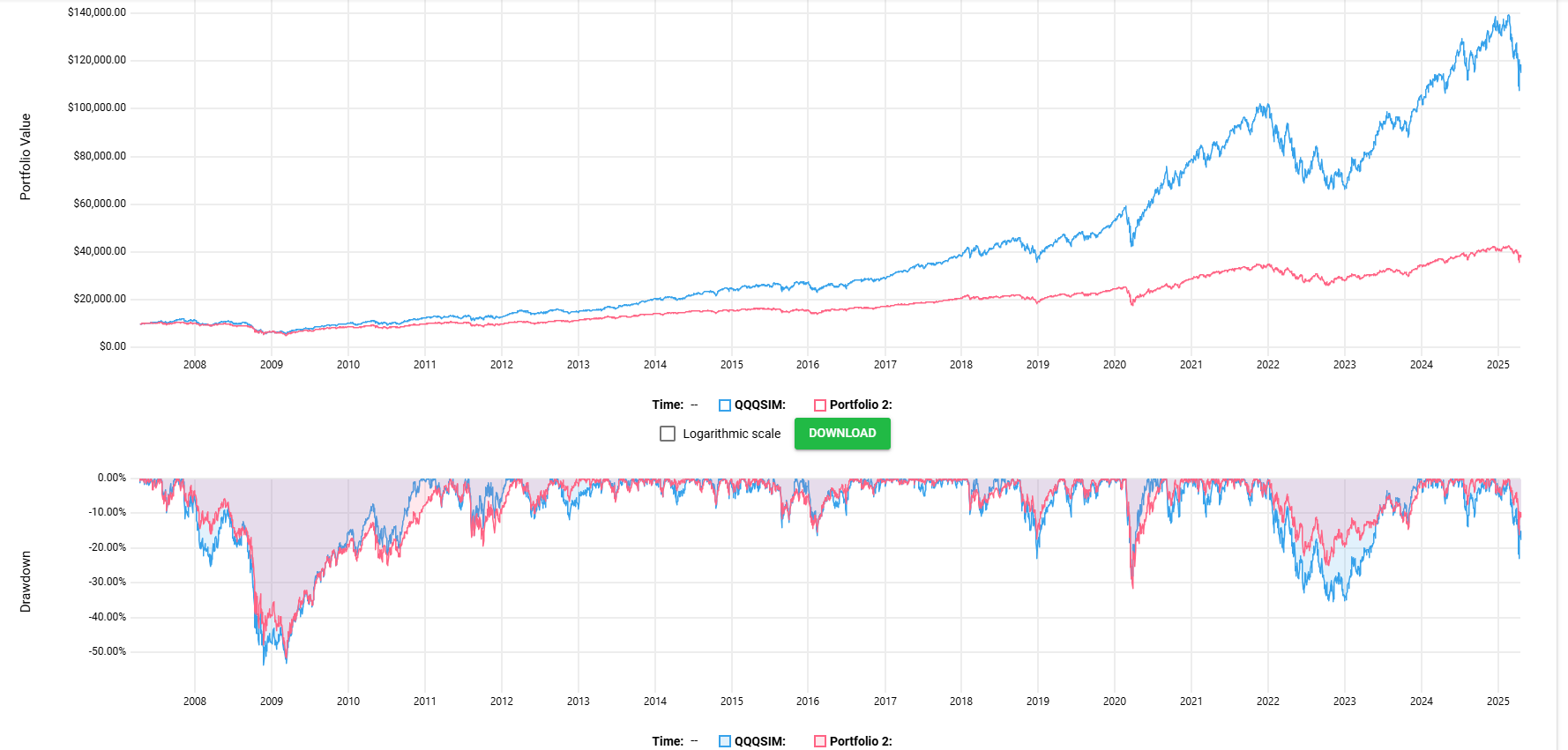
This is QQQ vs VTI+VXUS+BND (70/20/10), the good obedient kids got no protection from volatility and HALF the CAGR… I mean, 7.5% CAGR is great, but 14.5% is insane, at this point the “good boy portfolio” will basically never catch up to the “naughty boy portfolio”.
As you said
I think - most likely- Outperformance of Big tech led investors to QQQ. Outperformance of QQQ drove performance of VTI.
And because of the above two facts, whatever historical chart you will make for global investing, a higher weight to US will always win, and thus VT & chill became the preferred approach for Europeans too. This is why I think the paper shared by Felix is interesting because it doesn’t only look at history but is doing different types of simulations to build the concept for how a 100% equity portfolio should look like
I don’t really think that anyone (Dalio, Bogle, Lynch, UBS, JPM , Felix) actually ever proposed VT (or alike) as an investment for non-US investors
Yeah, and by a point on it becomes a self-fulfilling prophecy and the insufferable “'murica fack yea” mooks can’t be made to shut up!
Bogle was talking to US investors mostly (as is Buffett). If you take his “buy the haystack” approach you can extrapolate it to mean “buy VTI”. In other interviews he’s said he’s personally not for ex-US “but if you have to do it, no more than 20%”. Bogle DID advocate strongly for bonds, though. That said, Bogle’s arguments against ex-US were “Britain’s parliament looks weird, French are lazy, Japanese are old, we are the most entrepreneurial nation with the best systems in place, and Coca Cola sells bottles everywhere” which aren’t particularly strong!
Felix in an old interview with MrRIP from this forum, and in other places including a convo I had with him on reddit has said “VWCE is a good start”. I think his personal portfolio is 30% Canada though, with US, global, and factors making up the rest.
My issue is that once you deviate from “buying the haystack” it becomes a slippery slope. For example one may say “developed markets are where it’s at, emerging market should have emerged by now”. But then miss Korea? Taiwan (some indices). India? Where does it stop? and what weight do you assign manually? So while “VWCE/VWRL/SSAC/VT and chill” may be a “good start” I’d argue that it may also be a good middle, and end too
Ok, a few countries have good stock markets but I personally don’t quite understand home bias when it comes to stocks - or at all to be honest. The Greek market outperformed the US for several years in a row now, as did the NIFTY 50 (by a mile vs VOO), yet I have no money specifically allocated to Greece, India, or any other country ex-US, not even Switzerland and I live here!
This convo may belong in the portfolio thread
One other -: didn’t reduce US stocks exposure by selling but planning to reduce through future constitutions into ex-US
Other, degen, I want to buy US stocks low, with leverage.
Yes. That’s true. Most people might believe they are over exposed to US but might not know where they can tilt and hence just leave it like as it is i.e MSCI ACWI
I am trying to restrict my US exposure to about 45% for time being. That’s first objective. (currently about 50%)
I’m still aiming to increase my allocation to Swiss equities (SLICHA) to reach an allocation of (80/20 or 70/30). For the moment, VT still represents 82% of my allocation, so I’m going to keep buying SLICHA until I reach my desired allocation, a strategy I’ve been pursuing since last year.
On the other hand, I’m hesitating whether to sell VT and convert it into VWRA, or whether, once I’ve reached my allocation, to buy VWRA and sell a few shares of VT each month to convert them into VWRA.
I still have time to think about it.
I’m also thinking of buying a gold ETF like the one at Raiffeisen to make up 5% of my IBKR portfolio.
A little provocation, but fitting this thread: everyone adjusting their portfolio(s) as a result of the Orange Swan is an active investor.
Bogle would shake his head.
To add insult to injury:
All in jest, frens, relax …
But…. Bogle would already be upset as people are ignoring his advise to ignore international stocks
Isn’t there like a Bogle type person from Europe? It would be interesting to hear from them. Tired of listening from Americans talking about how great it is to invest majorly in America
#active index investor
Fun fact: Bogle was a lot more active than he preached, as is Buffett. Or to paraphrase Munger “index investing is good only if you don’t know what you’re doing”.
Insprired by @Abs_max my new hashtag is going to be
# passive stock picker

Oof … Ouch! … aren’t those punches below the belt line forbidden in forum boxing?
Well, it’s true though innit? Charlie didn’t mince his words!
It’s true but it doesn’t slice the way some might interpret. That “only” is a pretty big one. Most of us, most of the time, don’t really know what we are doing. Acknowledging that isn’t a sign of weakness and passive investing is good in those situations.
The time not spent in increasing our investing knowledge and studying companies can be spent on other things that might increase our value more (by increasing income) or bring us more joy.
Active investing isn’t a bad word either for those who think they know what they are doing. To each their own.