I am looking for advice on how to store more than USD 500k in cash.
I will soon receive a large amount (larger than 500k USD) which I am planning to invest doing a DCA in VT. I would like to invest this sum over a year or two.
I am not interested in hedging to CHF as this sum will remain in USD.
What solution would you recommend to store the cash?
I am comfortable keeping the first tranche of 150k USD in my IBKR cash account but I am seeking for more safety for the remaining part in case something bad happens to IBKR.
My current main option would be 150k on IBKR cash account, and 350k on BNDW.
A shorter duration bond ETF would probably fit better my interest or a money market fund but I have difficulties understanding the tax implications for a Swiss resident.
Thank you very much in advance for your help and suggestions.
BOXX etf if you are adamant in keeping it in USD. I‘d literally just park the whole 500K in there.
Basically tax-free short term bond-like exposure. As the return comes from box-spread option trades, that behaves like short term USD bonds. Also super safe as the coubterparty is the OCC.
Absolutely not go for BNDW. Big duration risk, and some credit risk.
If you really want USD exposure (note: VT isn’t really USD), I’d do BOXX. But if your home currency is CHF, I’d switch to CHF and convert as needed before investing.
I know this is not the question but i still wonder when hearing DCA‘ing a lump sum over 2 years..
I invite you to reflect on these thoughts:
are you considering VT as an investment with a positive return expectation (over the long run)?
would you consider yourself a buy and hold investor that keeps invested for the long run?
If you would have gotten the 500k two years ago and by now invested the whole sum (by DCA) - would you feel comfortable leaving it invested?
if you DCA the 500k over the next 2 years and the just after the last investment the market would crash 40% - would you remain calm as it can happen when investing in VT?
If you answer all of those with yes, you should consider investing everything at once instead of dca ing.
If not - you should ask yourself if investing 500k in VT is the right level of risk/volatility for your risk profile.
Even though it’s technically the same thing, psychologically it’s very different.
Scenario 1:
Person X invested 500k over many years and market crashes overnight so he loses (on paper) 50%. Their reaction: “Well, I’ve been through ups and downs before, this is just another one.”
Scenario 2:
Person X invests 500k today and market crashes overnight so he loses (on paper) 50%. Their reaction: “What have I done. I just threw 250k away in one day.”
Same end result, completely different headspace, and that’s exactly what determines whether you stay the course or not.
Yes, you’ll be fully invested at the end of DCA either way. But DCA buys you time to build conviction so that when you are fully in, you don’t fold. In a world where people buy insurance to protect from their phone getting damaged, there’s clearly a target group that benefits from that peace of mind.
Thats a very valid point. I guess it comes down why people DCA lump sum. If it helps to get started in the first place instead of waiting for a better time I guess it makes sense to overcome this psychological barrier.
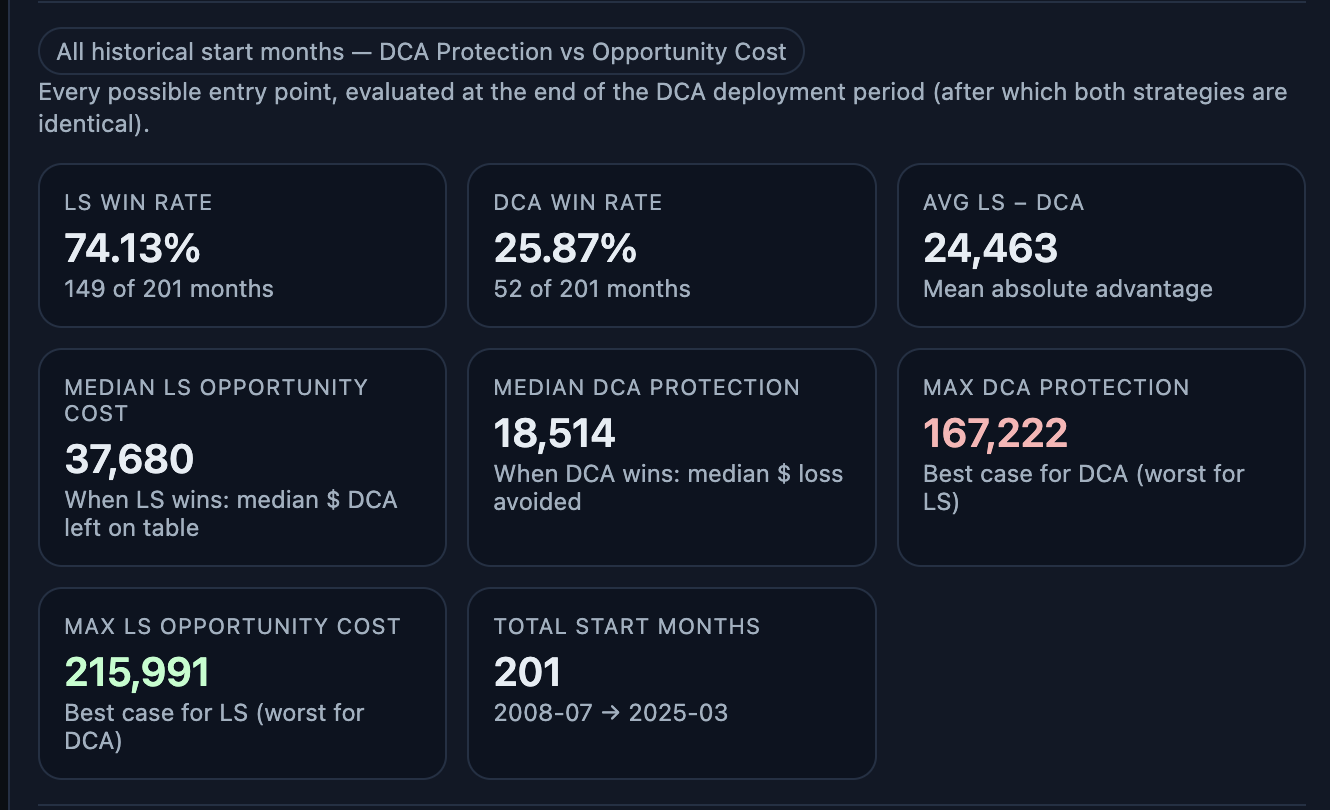
For the fun of it I run a historical simulation looking at the different scenarios Lump Sum v.s DCA (500k, 2 years, monhtly DCA, reinvest dividends, no tax considerations) since VT existence (2008) (honestly I haven’t checked it thoroughly, so let me know if you see issues or I’m missing something)
Interestingly the max opportunity cost (215k) of not investing the lump sum seems higher than the max protection DCA (167k) provided. - Note this is not max draw down but in relation to the end capital after the DCA phase (2 years).
In 3 out of 4 cases Lump Sum Wins with a median opportunity cost of 37k USD. Which is in line with research findings.
That would mean, if you value opportunity cost (missed gains) the same as losses - which would be rational - while not common with human psychology (loss aversion) - Lump Sum seems to be much “saver” ..
All the math goes for a Toss when someone sees a drawdown of 50% for a 500K portfolio.This is assuming 250K is substantial sum of money for the individual.
Personally I think once the portfolio value increases 5X the annual income , investor‘s reaction to severe drawdowns can be quite painful.
It’s much easier when someone started investing and their portfolio is small compared to their annual income.
Of course thats a nasty. OP aims to have 500k invested in VT, then I’d assume he sees himself ready to take a 50% draw down psychologically.. If not the target allocation would not be advisable - regardless of DCA..
After two years and no crash and all goes well so far, there might be a 50% drawdown on 600k and on and on.
Mit dem Lesen und der Teilnahme an diesem Forum bestätigst du, dass du die Forum-Richtlinien gelesen hast und damit einverstanden bist sowie den Haftungsausschluss auf http://www.mustachianpost.com/de/ akzeptierst.