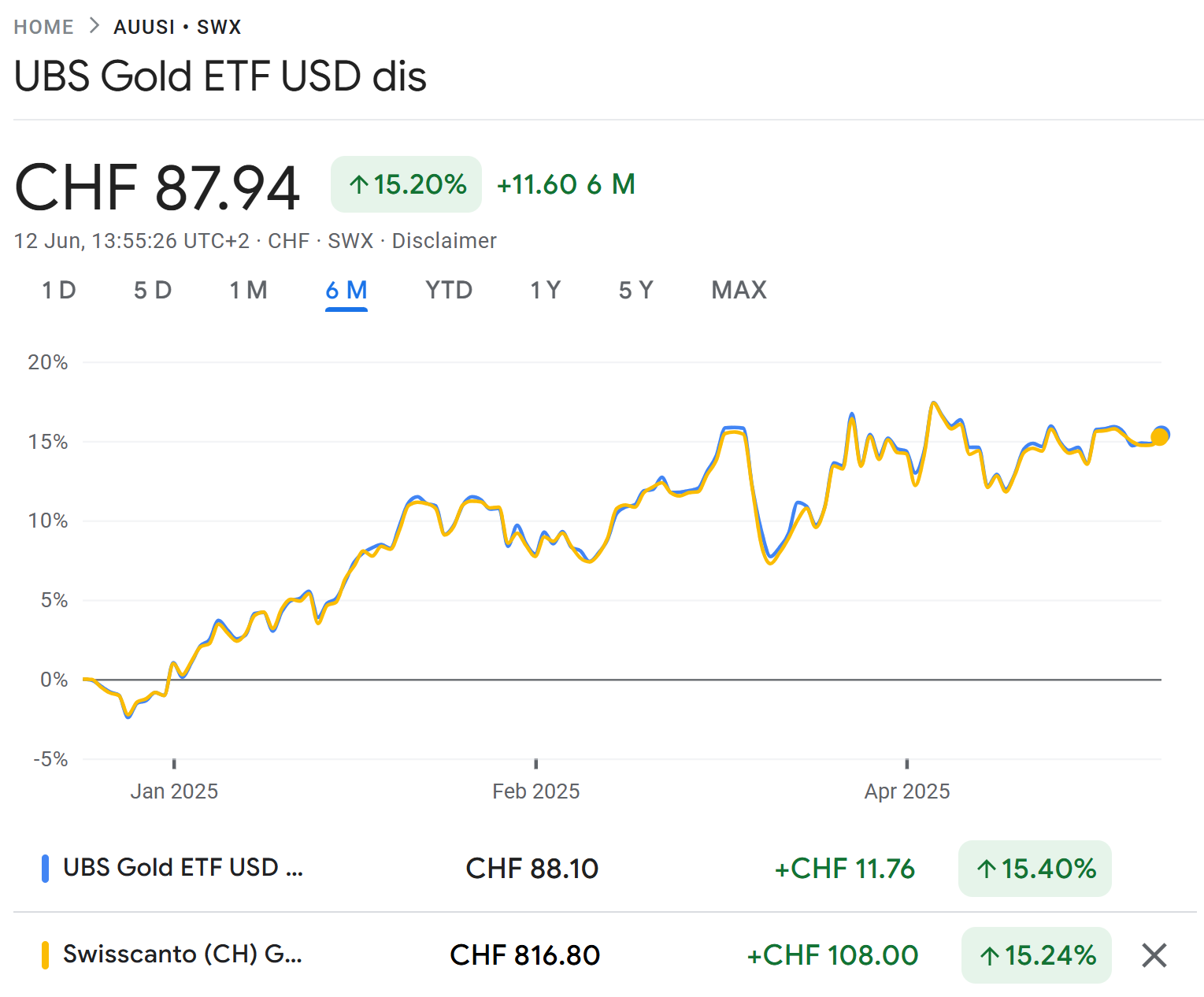
On this point, I’m watching the tension between India and Pakistan, if it escalates into armed conflict it could lead to a further rise in gold. I hope it doesn’t escalate, cynical as I am I can’t feel happy holding an asset raising in value because people are fighting.
I am always confused about Gold
As far as I understand the “real” expected return for Gold is Zero. This makes sense because you can only gain value from Gold by selling it as it is a speculative asset. There is no other cash flow and only way anyone can gain profit from investing in gold is if they can find a buyer who believes Gold price will go even higher. And then this chain continues. This also means that only way for someone to pay more money for Gold coin is that they have earned that money somewhere else (by using a productive asset or contributing to enabling a productive asset).
Does it mean its main purpose is to benefit from rebalancing during times of distress? This means in bad times gold goes up and stocks down and then rebalancing creates ability to buy more stocks
Ramin Nakisa has done a good video on it showing with data that it’s:
not a good inflation hedge
doesn’t beat equities
doesn’t (really) beat bonds
it’s a worse hedge than treasuries
it’s not negatively correlated to equities, but gets close occasionally
Ben Felix has also done a good video which is less negative than Ramin’s, quite consistent overall, and not particularly positive.
Well, the rational approach is this, and it’s based on irrational reasons (ie being a speculative asset). That said it’s bubbled like champagne in the last couple of years and and worked great as a rebalancer in April. Of course that’s just incidental but even Einstein didn’t argue with gravity, or time…
…as long as we’re not moving at the speed of light.
These extremely long-term charts are always interesting, but from an early retirement perspective - where the goal is usually to maintain a relatively stable portfolio for withdrawals over a 30-40 year time horizon and where short- to mid-term fluctuations can have a significant impact - they provide limited insights, or may even lead to overconfidence
Different story if one is just aiming to set aside for the grand-grandchildren, of course
@Abs_max writing here not to off-topic the other thread on historical data. I assume that being a rational, data-driven investor you don’t and won’t have gold. Is this right?
I want to ask why won’t you - not you personally but any data-driven investor.
Is it because fundamentally it does nothing and shouldn’t have any expected returns above inflation? And even inflation-matching returns should only be because as a species we’ve collectively agreed that when fiat’s buying power goes down, gold’s doesn’t?
Is it because it’s price is not tied to any fundamentals, because it doesn’t have any?
Is it because getting some in no brainer times like now is a slippery slope of speculation, market timing and trading?
Any of the above would on its own be a perfectly valid reason, I just want to understand.
Actually I am not completely sure yet.
I come from a country where Gold & Real estate have been preferred assets for many since decades. But India also have a lot of inflation being a developing country and I think this has something to do with choices people make about Gold. And of course there is quite a bit of jewellery usage which kind of make it an easy investment
One can argue if 200 years data say something else but as far as I can remember, Gold prices in India most went up during my entire lifetime and also outpaced inflation.
However being a Swiss investor, I don’t worry too much about inflation. I am trying to understand the role of Gold in a portfolio. Data might say something else but I also think we should try to understand why central banks hold a lot of gold. They are generally smartest minds. That can bring some ideas.
However we also need to differentiate between central banks and retail investors. Our needs and our mandates are different. What might make sense for Central bank might not make sense for retail investor
To be honest - data driven is a bit challenging as new investor. I see big asset classes around me which hardly make any returns but are bought by people globally (Swiss bonds , Swiss MMF etc) . Thus I feel that maybe we (as we live in CH) are not really understanding and appreciating the challenge that inflation brings to life. But nothing lasts forever and who is to say that CH will continue to manage low inflation rates forever
Expected real return of gold is zero.
Expected real return of cash is negative
Expected real return of Swiss bonds is also becoming negative
The quest continues.
For time being, I see Gold as speculative asset, with high volatility but also a real asset. Don’t have any in portfolio
I think most retail is not at all data driven. Then there’s faux data driven who cherry pick whatever validates their chosen narrative, and finally the true dehumanizing data bugs who don’t care that humans don’t live past 150 and only consider the academically optimal maximum return.
Inflation is both hard and simple to understand, very easy to understand in the supermarket (we stopped going to Weil for shopping because German prices were close to Swiss prices in 2024 - I truly believe anyone understands buying 10 eggs with 4 euro vs with 6 euro) and very hard to understand long term. Dunno why people whose currency drops vs the CHF by 10-100000% per year wouldn’t get Swiss bonds to protect their money, this makes perfect sense to me.
Go on, get some gold, it’s gooooooood the dark side of trading and market timing and irrational behaviours beckons, we even have some preppers and tin foil mad hatters in the basement
Big institutional investors have so much money that they have to invest it in any reasonable or even not so reasonable asset, as long as there is reasonable liquidity and “capacity”/volume. As a side note, I think that this will drive the institutional adoption of Bitcoin.
We, retail investors, often have different situations and goals, and don’t have to copy everything big guys are doing.
I disagree when you put central banks together in the pod with „ordinary“ institutional investors. Central banks have a few severe Investment limitations. Namely, they must not:
invest in their own currency
invest in their own country
invest in banks
At the same time, they must invest:
in assets with very high iquidity, that doesnt dry out in times of market distress
in assets with relatively low risk, there is no need to generate more return than the larger of CPI or GDP growth
When you think about this, pqrticularely from the point of view of a larger central Bank (lets say ECB). They can’t invest in EUR nor Europe. They can’t invest in Real Estate (liquidity) and only tiny amounts in Stocks (Liquidity and Risk). That only leaves them with physical, non-industrial Commodities (Futures have a Liquidity Risk they can’t take), Foreign Cash and Highest Grade Bonds/Bills.
There are only so many Foreign Currency Bills/Bonds that come with the required liquidity and are issued from countries with adequate economic and political stability. Gold as a Currency/Commidity with fairly high liquidity and low political/economic risk comes in very handy when they don‘t want to put all their eggs into USD and its derivates, GBP, CAD, AUD… what else is there?
The situation becomes even more severe when you realise that some of the above stted currencies may become hostile or just block your funds.
I agree. I was not suggesting to copy them. But to understand the reasons for why they hold gold. This can advise if it makes sense for us too.
As @TeaGhost also explained, Central bank’s job is different than individual investor’s job and they might have different constraints.
For example -: if currency stability is their role, then it makes sense to keep other liquid assets (store of value) in their pot to allow for buy/sell to keep home currency in check.
For institutions -: i think they use whatever comes to their mind and they can ask for a cut. Private markets, Private credit, Managed futures, Gold, Bitcoin , whatever. Their objective is risk adjusted return but I feel they make things more complex just to keep clients
Given the current yields environment, the bonds are not attractive and cash is more or less better than bonds for CHF denominated assets
This means I am holding more cash than I would like. So I decided to start adding some Gold as replacement of CHF in portfolio. I think I will slowly DCA into it. At this moment the portfolio has less than 1% of Gold.
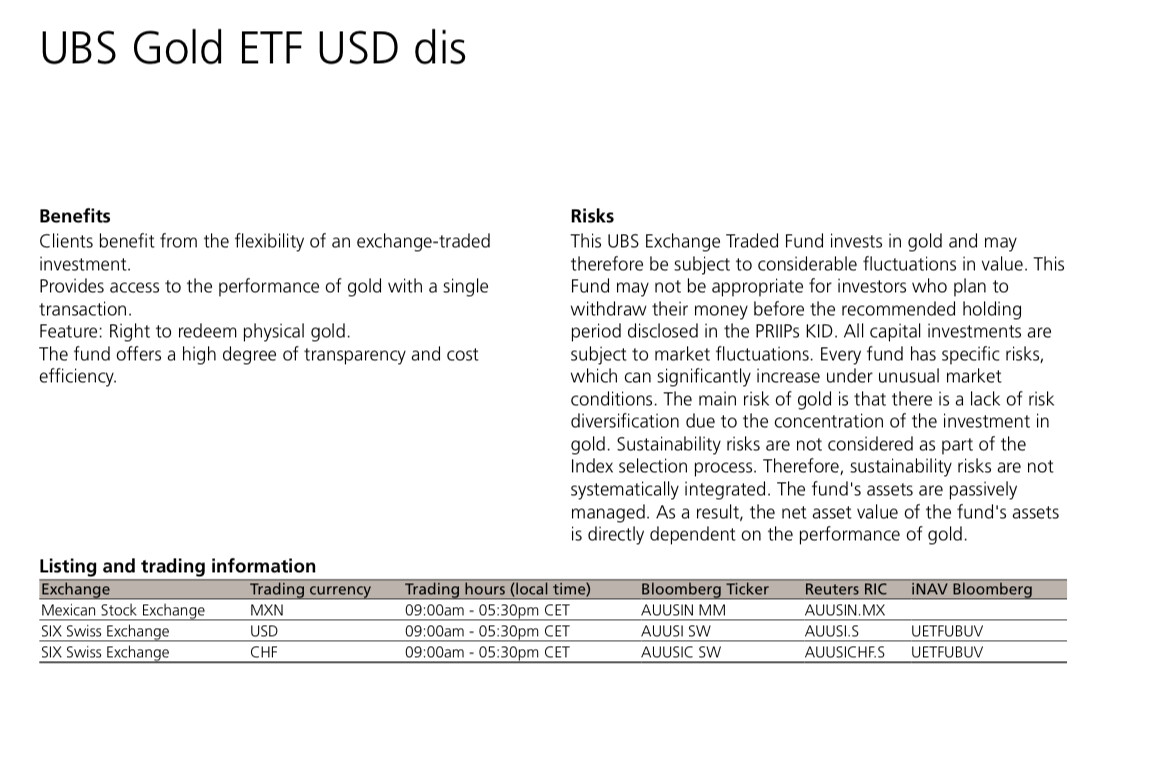
AUUSI (CHF) is preferred approach as I don’t want to go through hassle of physical purchases at this moment.
Assumption -: Gold will act as a diversifier (even though more volatile) for cash. And hopefully atleast maintain its value. Even though CHF is strong currency, it might not remain so forever
I was also diversifying into Silver and Platinum, but had the bulk of my buy orders below the current price. Unfortunately, the price has just been moving up and so they are un-filled.
Any difference to the identical product from ZKB (ETF ZGLD)? Same performance. ZKB allows you to withdraw physical gold when you hold the ETF with them (minimum 12.5kg bar ).
ZKB’s is almost double the TER is I suspect what drove the decision. I always found it funny that these Swiss gold ETFs call themselves distributing. Unfortunately I haven’t been sent any gold dust in the mail to date
Also, @Abs_max welcome to the dark side. You’ll see how nice it is. Next stop: technical analysis and dividends.
I’ve been doing this for a while. 5% of my portfolio is in AUUSI instead of CHF bonds, motivated by the low bond yields. This has been very nice recently but it’s obviously much more volatile and there could be very long drawdowns. So, not exactly fulfilling the stability function of bonds but I accept the risk for 5%.
Mit dem Lesen und der Teilnahme an diesem Forum bestätigst du, dass du die Forum-Richtlinien gelesen hast und damit einverstanden bist sowie den Haftungsausschluss auf http://www.mustachianpost.com/de/ akzeptierst.

 aside for the grand-grandchildren, of course
 the dark side of trading and market timing and irrational behaviours beckons, we even have some preppers and tin foil mad hatters in the basement
  ).
).