Financial institution, mainly pension funds, are one reason for the bubble. But not the only one. I would say immigration, land scarcity (mainly artificial due to some votings) and the good financial general state of Switzerland are the others.
Could not find the total value of all Swiss real estate, but found the average person occupies 45m2, the price per m2 is CHF 8’200 average and we are probably around 9 million people living here. That is 4582009, more or less 3.3 trillion. 2nd pillar in 2022 was 1.066 trillion, grows 8% per year so lets say it is now around 1.25 trillion. I suppose it will start to shrink sometimes in the future. And not everything is invested in Swiss real estate, let’s say 1 trillion. So it is about 30% of all Swiss real estate. That is quiet a lot!
There is a tendency to limit immigration and the birth rate is sinking. So that factor could cool down too.
Now, inflation and general problems in the financial industry and tariffs could hurt the good financial general state of Switzerland. We have not much industry left and almost always are the most expensive place to produce anything.
We still have enough building land but it is limited due to various votings. I don’t think politicians will touch that, so land scarcity will stay an important factor to support the sky high prices.
But only one or two of the four factors (pension funds, immigration, general good financial state and land scarcity) have to change to make the bubble pop. And then it will happen very fast, as the private debt is sky high.
P.S. to the pension fund investments one probably has to add debt, so it may be more. At 50% mortgage it would be 60%. That is scary…
Hmm, difficult question. We are definitively in a boom, 40 years of rising prices. The last part of a boom I would call the bubble, everything speeds up. No idea if we are there already.
I think you can say we are in a real estate boom. The bubble will not be in sight after it pops. And the chances for it to pop are highest when nobody says that we are in a bubble…
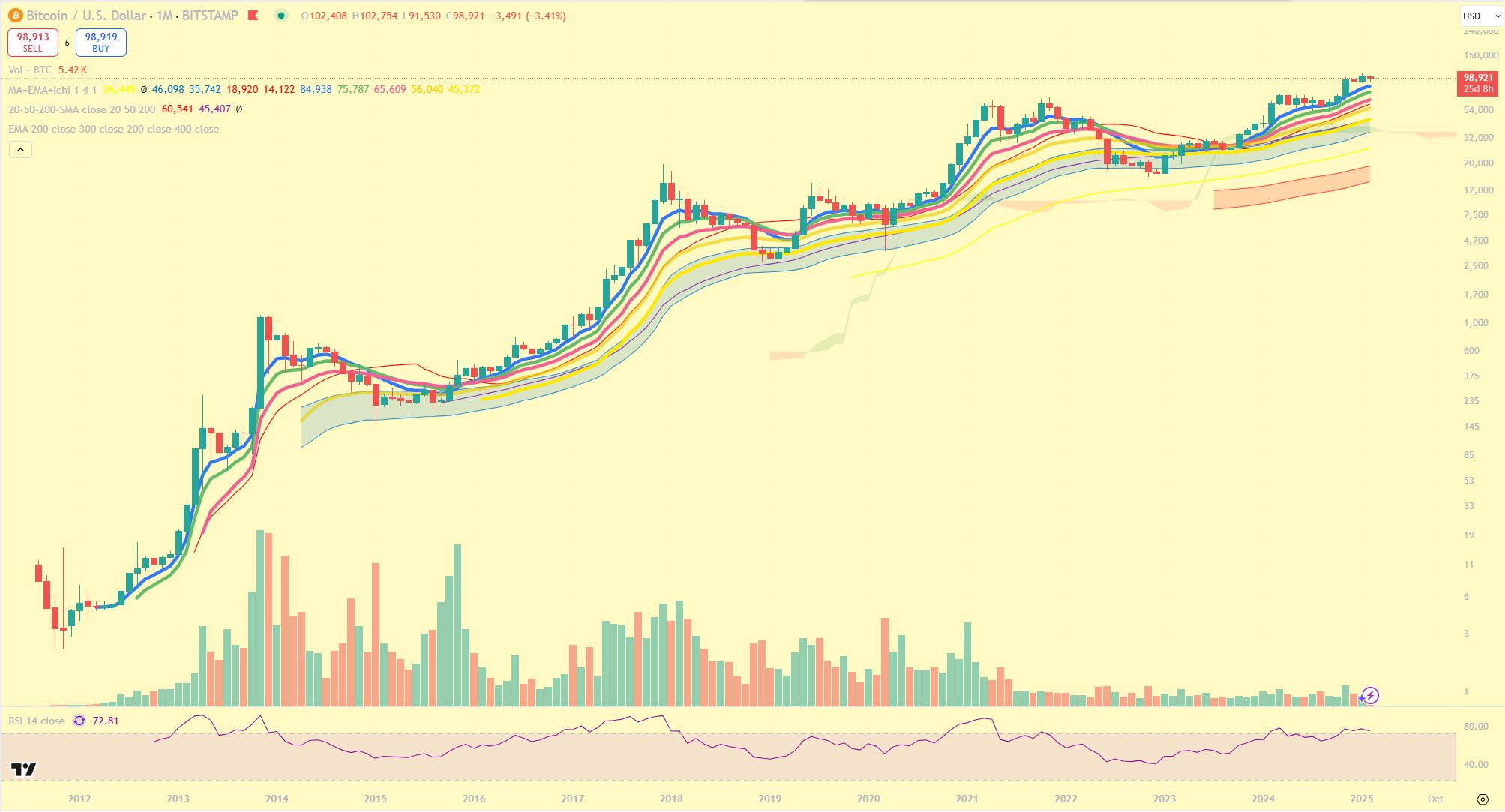
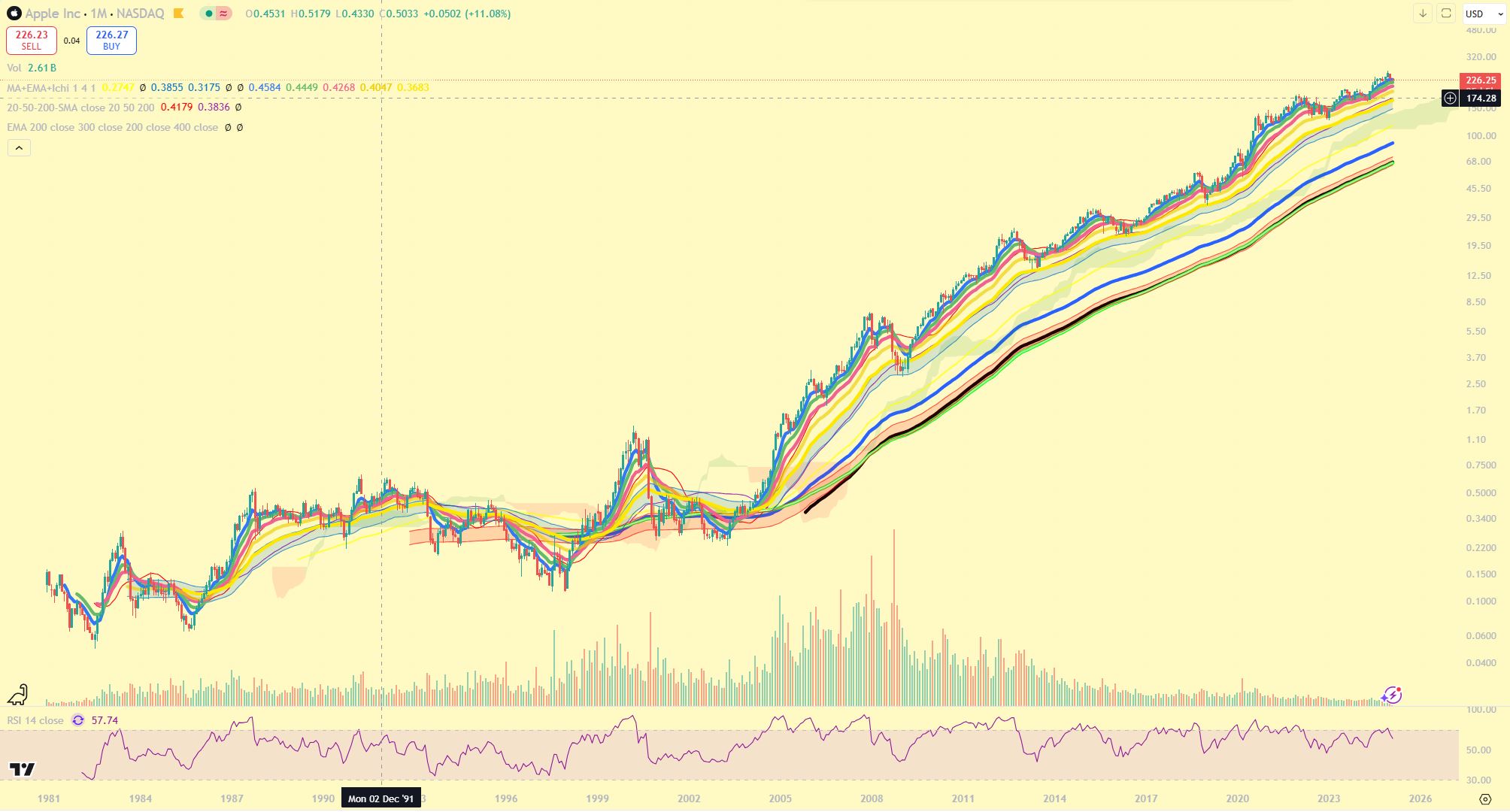
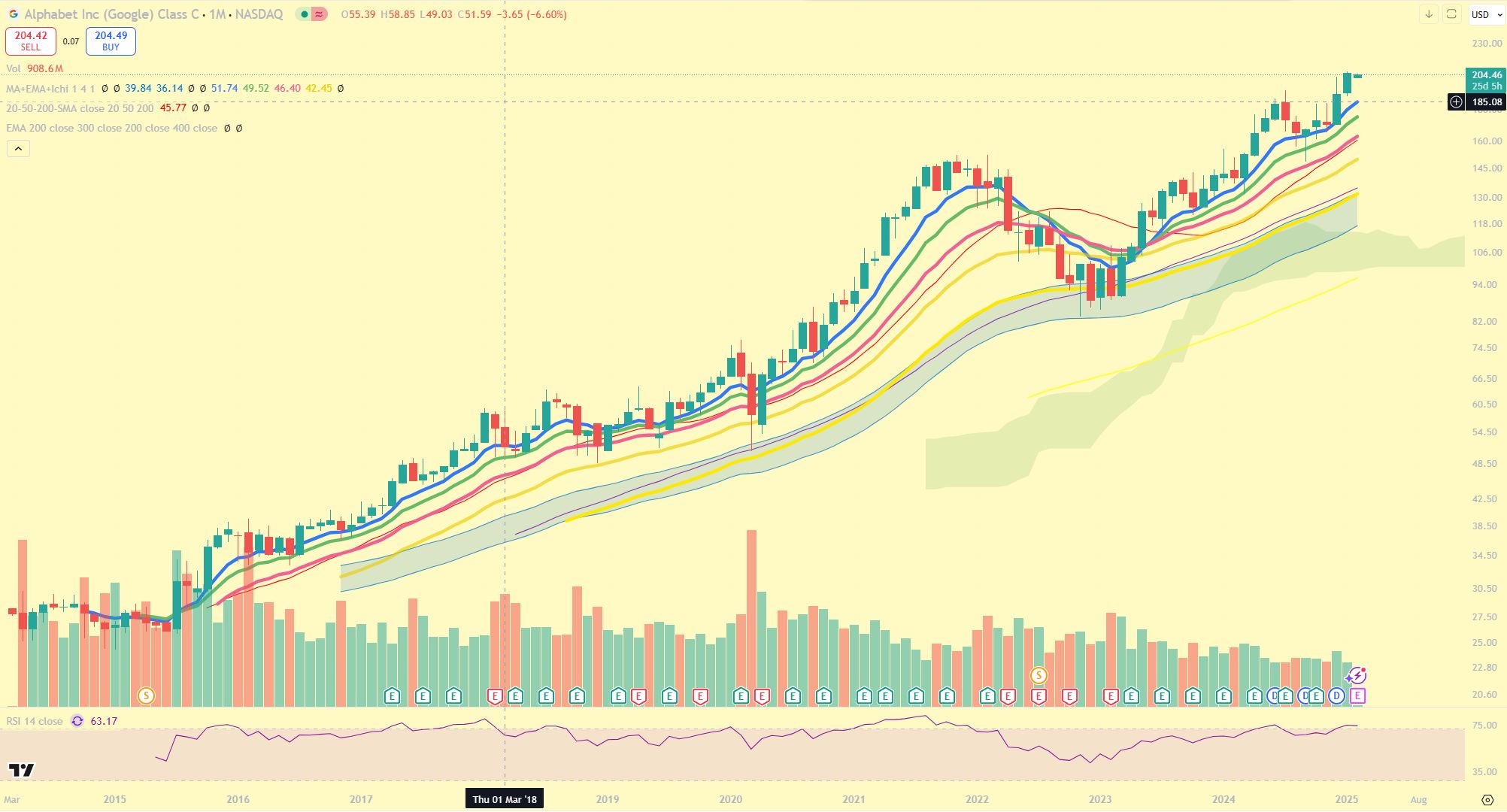
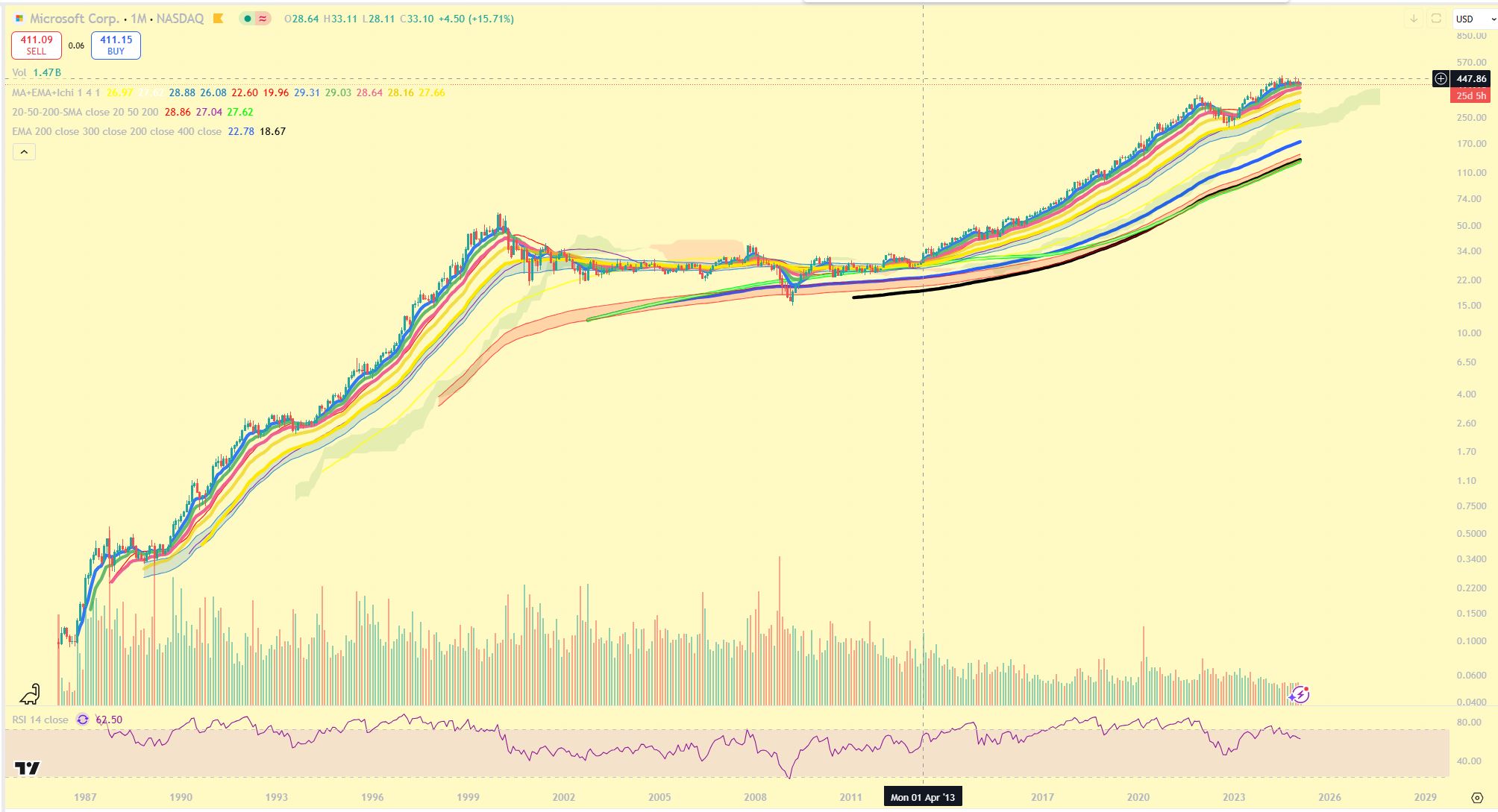
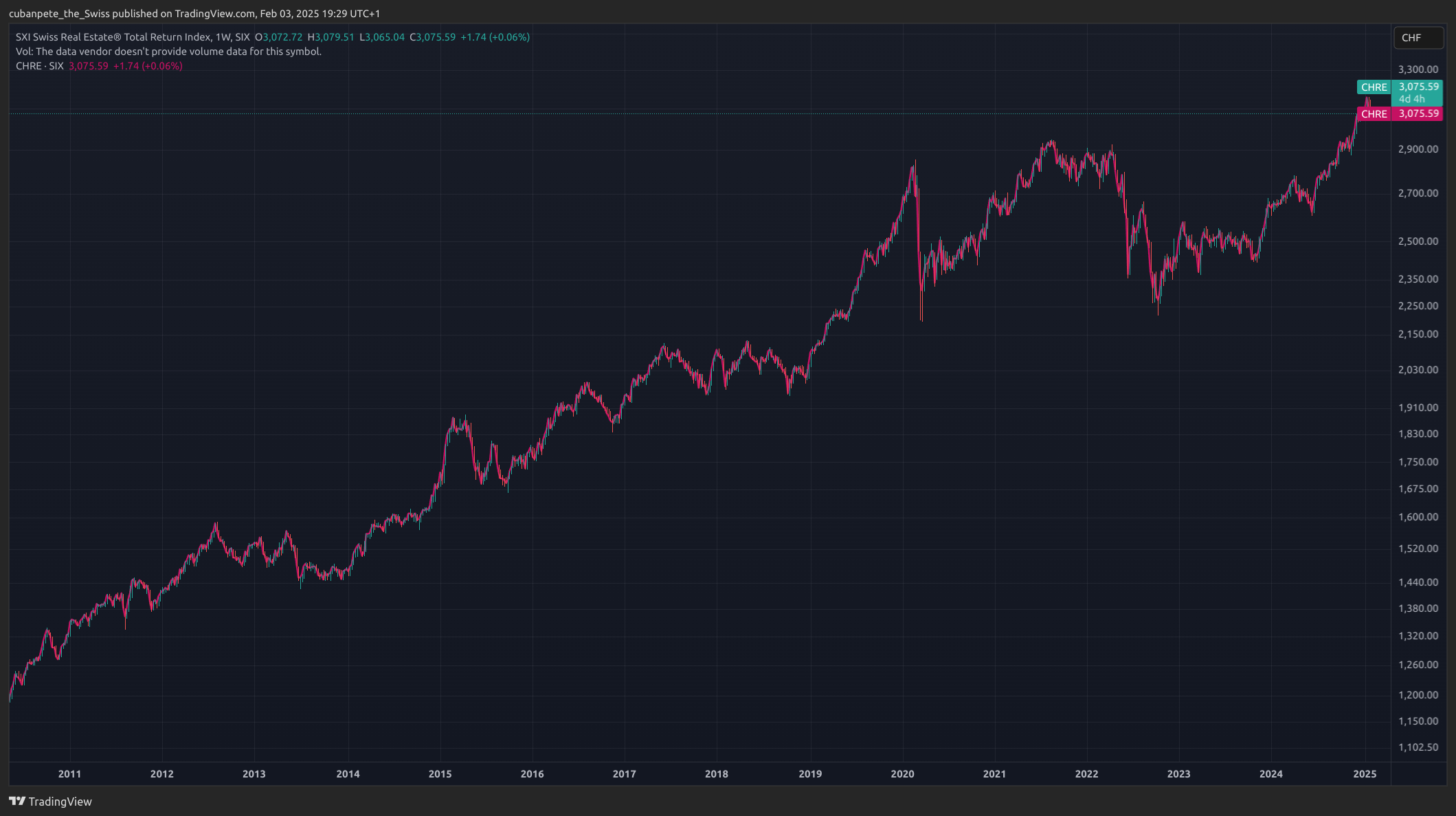
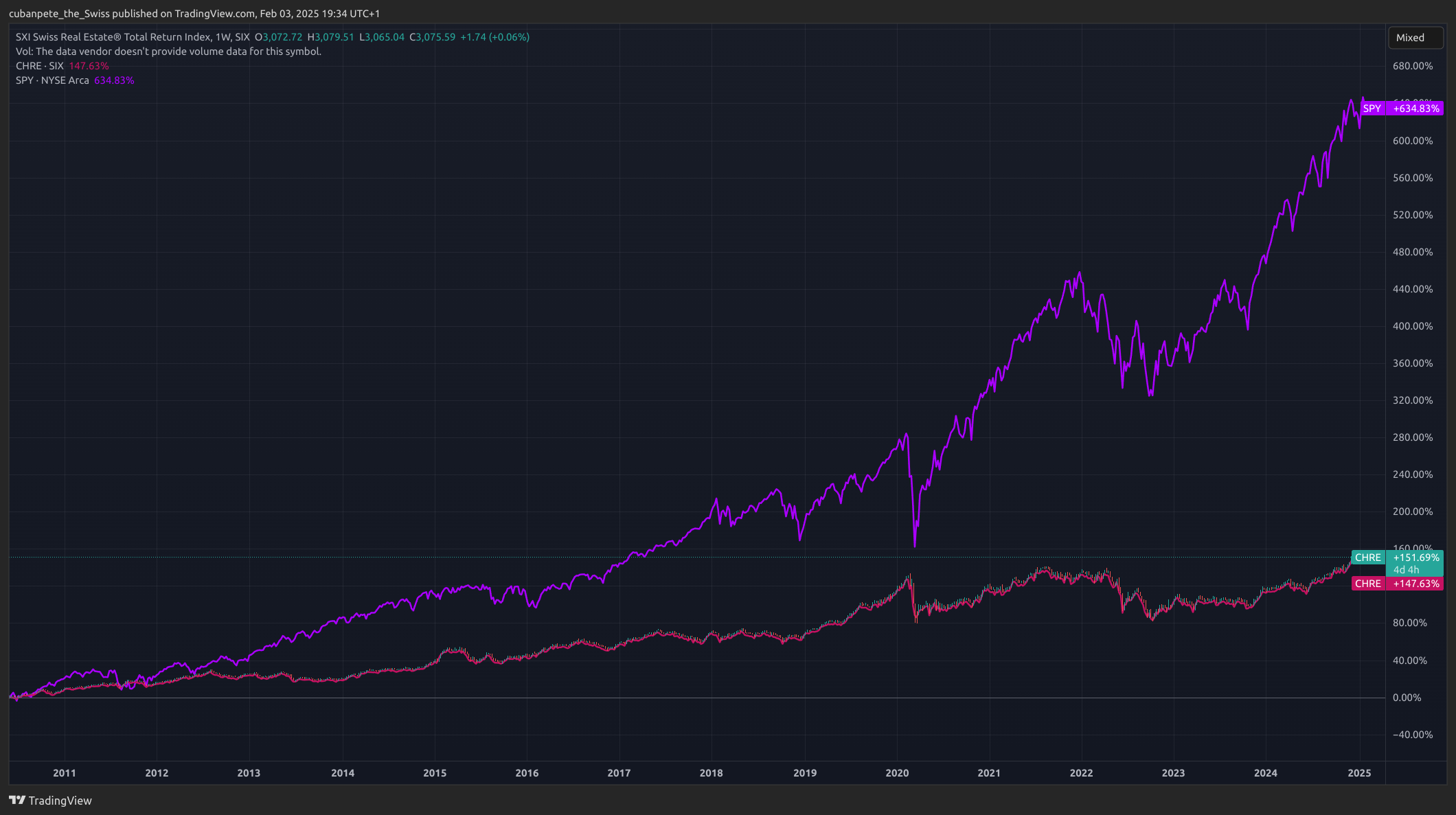
I show some pictures of a longterm logarythmic chart - Bitcoin (who most think that is a bubble), Apple, Google and Microsoft. On a longterm logarythmic chart they all just look very strong and none of them like a bubble. So maybe the Swiss real estate market is just really strong, with constantly additional financial potent people coming to Switzerland and pushing the prices up and up.
Looks nice, but to repeat, comparing apples with apples including returns (that would be saved rent) and with the same leverage, stocks did way better:
On 20% capital many people buy real estate in Switzerland, that is a margin of 500%. Deducting mortgage interest the return would be more or less the same like stocks at 100%. But at what risk?
With 100% margin on stocks you can hardly go bankrupt. With 500% margin on real estate you can… and will if there is a bust. You end up without a home and with debt.
And as I said, even if you go to more than 100% margin on stocks, you can micromanage the risk; you cannot do that with real estate you are living in.
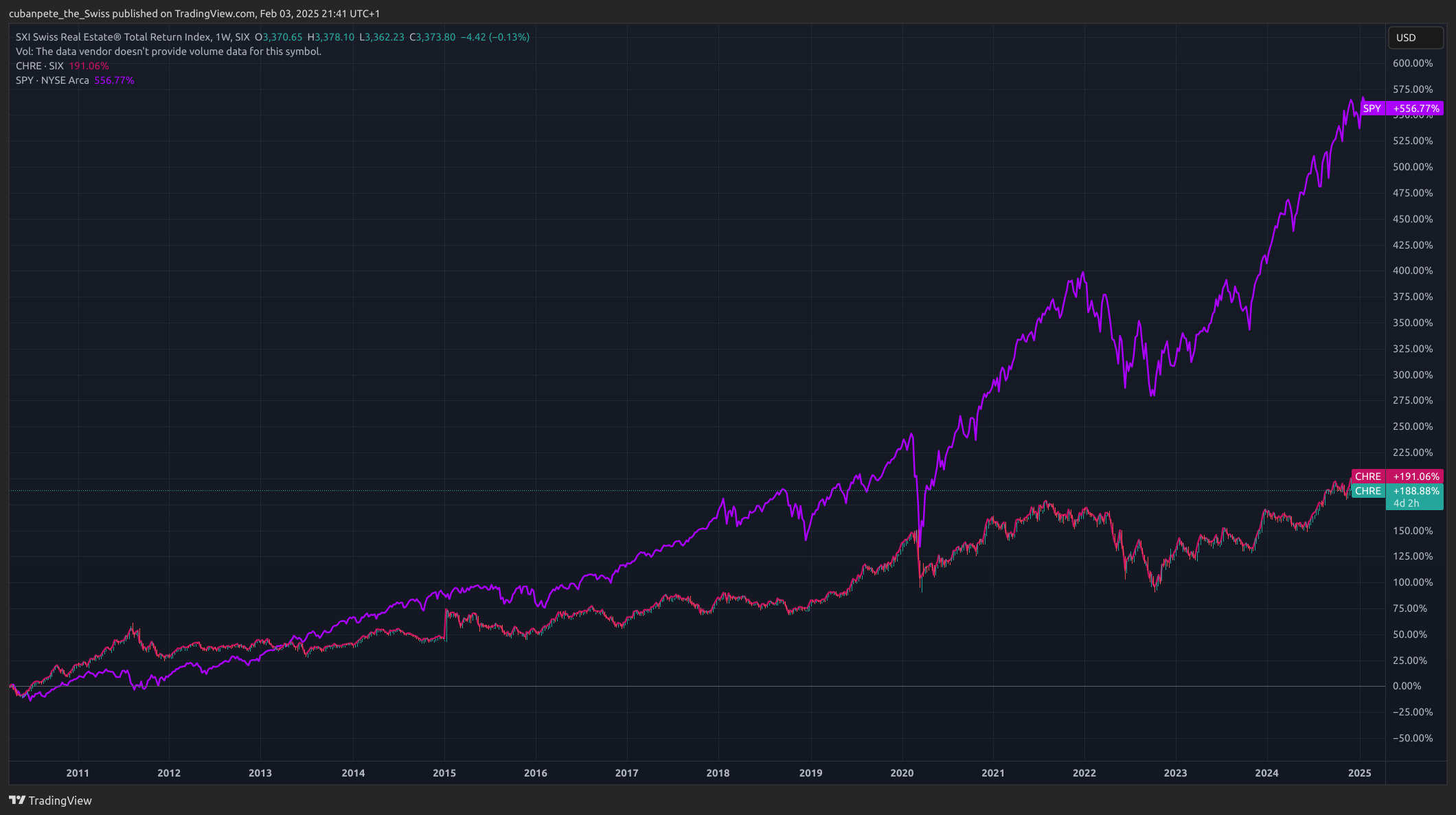
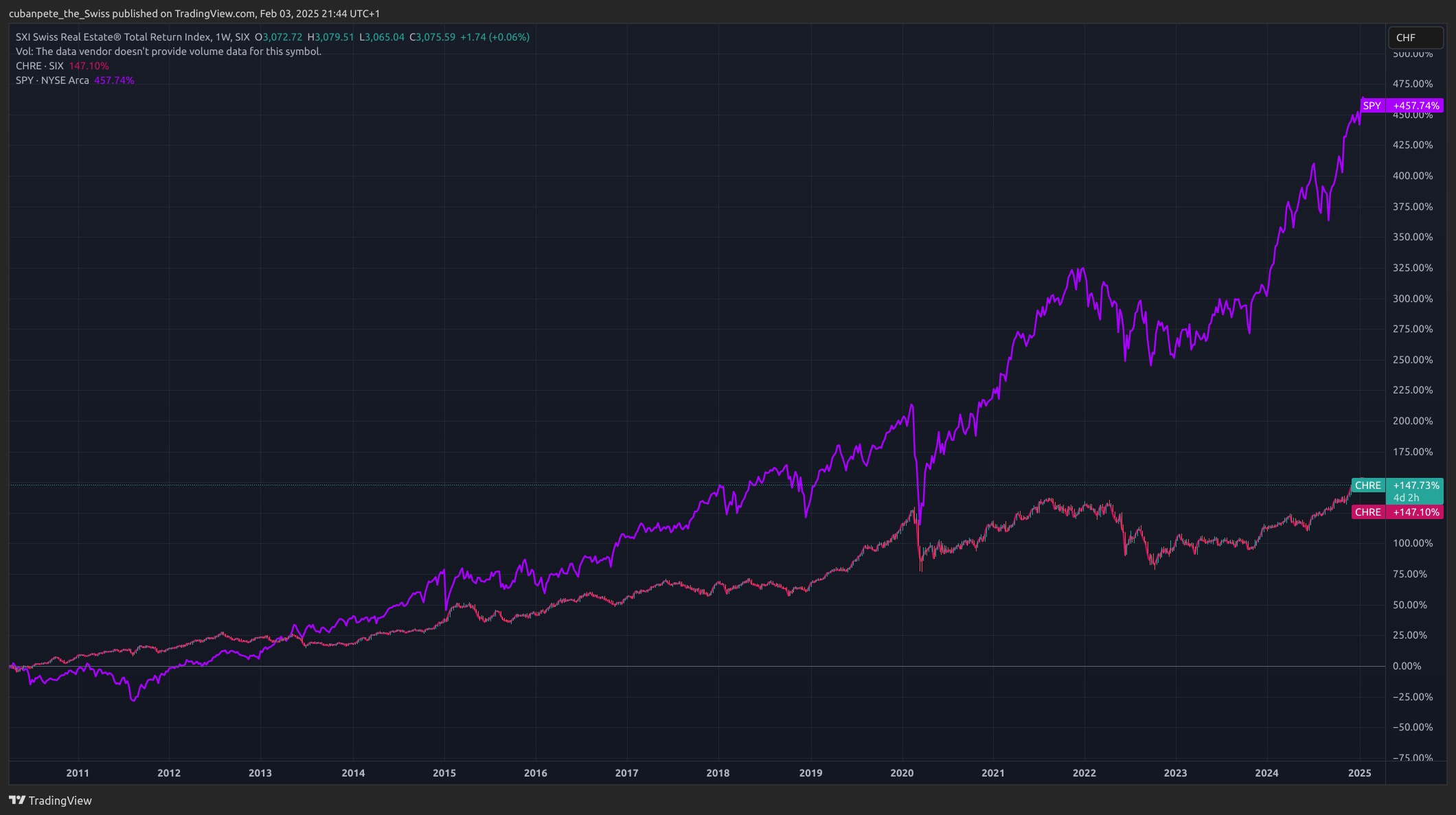
Thanks, for that info. of course you are right. TradingView can compare including different currencies, didn’t know that feature, here it is in USD and CHF:
With 100% margin on stocks using a margin loan on standard terms, your position can get liquidated the moment the market blinks 1%. It is a rather risky position to take.
Of course, way higher leverage can be achieved using futures, options or other products.
I think once the external factor which makes the bubble burst it on the table, some might want to sell quickly while no one wants to buy. AFAIK prices can also sink like a rock because the demand is gone and then no extra supply is needed
Sorry, my English: with “margin of 100%” I meant no debt. A margin of 500% means 20% down payment, 80% debt. Probably there is a better word for that. I remember the word cash margin, which was used as a multiplier, 1 or 100% means all cash, 500% means multiplied by 5 as 100% cash and 400% on debt.
Actually I think with stocks “margin” is the collateral. So probably I should use “margin multiplier”? But then collateral is always 100%, so I left out the word multiplier.
Actually, it’s my mistake: I tried to adapt to your numbers (I use leverage mulipliers myself, that work like your margin % and that I find easier to grasp) and failed to consider that by that logic, 100% margin means x1, so no leverage.
I’m no specialist but by my understanding, margin is the collateral. It applies to the total assets so someone who owns X stocks and borrows X ends up with 2X assets and X collateral (or 2X/2), for a margin of 50%.
OK, in my wording it would be a margin (collateral) multiplier of 2 aka 200% (actual value divided by collateral). In your wording the collateral is compared to the total value in reverse and therefore it would be 50% (collateral divided by actual value). Both are OK for me, but probably somebody can help with the exact wording…
My last job was with oil tanker shipments, involved futures, insurance and regular re-evaluation of margin during the transport time. But it is so long ago, I cannot even remember the correct wording. I think it was like cash margin, (actual value divided by collateral). But it is too long ago, sorry.
My broker, Interactive Brokers, says I have 800% stock trading margin available, portfolio margin. So it seems like they use the same wording as I do.
We are renting a 3 bedrooms 105m2 flat (2004 construction) for 4400 CHF with a double garage included.
Before someone assumes that this a crazy price I would like to mention that prices for 3 bedroom flats in Geneva are pretty much the same (see Champel, St Jean, Saconnex, etc). Especially when you sign first time in 2024.
Having said that we have now started thinking the option to buy something.
However we don’t have the liquid capital required now and we would have to sell a flat we own in Europe to use this as downpayement for the Swiss mortgage. In a best case scenario this would be around 400k euros
According to the UBS calculator our maximum purchase price is
Are you sure you can buy a 3 bedroom (105 m2) apartment in Geneva for 1.55 million? These are quite interesting rental yields (4400 CHF rent on 1.55 million apartment). I always thought Geneva city is like Zurich city where yields are very low
Or are you planning to move to a smaller apartment?
Opportunity costs. Your downpayment, say, 300k CHF, invested in a low cost portfolio that would grow by 4% p.a., would bring you 12k per year, conservatively estimated.
Amortization is not a cost. It is savings that are forcefully directed toward reducing debt.
CHF 1529 for interests means a ~1.5% interests, that can be obtained for the next 10 years but there’s no telling where rates will be in 10 years. Banks usually stress test our affordability by using 5% interests as a test.
Incidental expenses tend to not happen much most years but when they do, do so by potentially big chunks at once. Be sure to provision that.
Taxes and fees should be assessed. Both one time if there are (notary, land register, mortgage creation, withdrawal of pension assets if applicable - some may not apply and there might be others, it varies by canton) and recurring ones (own ownership, which might change this autumn, and the effect on wealth and income tax of the mortgage and the taxable value of the asset).
Co-ownership inside a building might not be frictionless and it’s harder to move away from the hassle once you are a owner. See for example: Problem with neighbor :)
Otherwise, if you can find an appartement you enjoy for 1.5M, that might be a good deal for you. There is an opportunity cost but it’s hard to compare savings on rent vs stock returns due to the different risk profile of both (the appartment may appreciate or loose value too so there’d be fluctuation there too if you’d need/want to sell at some point).
Think about buying in a bigger building (rather than a house or smaller building), it has its drawbacks, sure, but your monthly incidentals will be far lower. Fwiw in Zurich for just 1 bedroom I pay less than 300 a month on incidentals (not including the quarterly EWZ because that is separate always, also as a renter). However, I also got ‘lucky’ in the sense that the contractors including for heating were chosen well, it is EWZ in most cases where the service is something they offer. I know someone in a much smaller building (2 houses, I think 8-10 apartments in total), the building company very likely received kickbacks or something because they have some shitty long ass contract with the heating provider and prices have gone up a lot every year. But overall were also more expensive, not just the heating part. In a bigger building, costs distribute better. So find out, if it’s an older place, what current prices are, and if it’s new, make sure to get an overview of who has been contracted to do what and check their offerings.
Saying all this, I absolutely do not think buying a big place in CH is a good financial decision. As someone else already said yields are typically low, meaning renting is good value versus buying. The amount of capital you put into this one asset is huge and has a big CoC. Also, owning can be a hassle if something bad happens.
Mit dem Lesen und der Teilnahme an diesem Forum bestätigst du, dass du die Forum-Richtlinien gelesen hast und damit einverstanden bist sowie den Haftungsausschluss auf http://www.mustachianpost.com/de/ akzeptierst.