So I discovered running in late 2019, when some of my coworkers motivated me to go for a midday run before lunch.
As soon as I was back in the office, I immediately booked 2-3 slots in my calendar for each week.
It didn’t take long, until I needed to motivate my coworkers to come with me. A few weeks later, I had to go alone most of the time.
2020 and 2021 were weird and incosistent years, mainly because of the pandemic. For most of 2022 I needed to pause due to aftereffects from my covid infection.
Since January 1, 2023, I have started tracking the distance I have covered by running the same 5–6 routes that I measured previously (I didn’t buy a watch till late 2024), and have not missed a single calendar week since then.
I started it before the pandemic. Very irregularly. At first, I could only manage one kilometer, towards the end five kilometers. Not bad, at least. But I quickly got bored. So I bought some sports headphones so I could listen to podcasts, but then realized that in-ear don’t work for me. After a while, I stopped. Maybe someday I’ll be able to motivate myself to go jogging with over-ear headphones.
Every now and then I run for a few months, then I stop again. So very inconsistent for me.
The Apple Watch was a game changer. Heart rate monitoring, tracking time intervals, pace and recovery, recording the route through GPS and listening to music through AirPods, all with this small, lightweight device is (was?) truly incredible.
For interval training, I can recommend Intervals Pro. Highly customizable, and has a great Watch companion app with lots of features, e.g. it can announce interval changes via Siri through your headphones.
I didn’t start with running but with a crazy idea to run the 6-days self-supported Marathon des Sables in the Moroccan desert. That was 2016.
I didn’t think I had it in me but the project manager in me broke the huge goal into manageable chunks: doing 10 km runs, getting used to 20 km, them marathon distance, then back-to-back marathons over the weekend.
With a huge goal like that, discipline became easy. Following a training plan during 2 years, putting in intervall trainings, skipping social drinks for long jogs. I even travellef to places to learn to run on sand and to better tolerate heat. Always training with a weighted backpack.
Then in 2018 I successfully completed the 6-day event. What a blast to be surrounded by far better athletes than myself! I finished somewhere in the 2 quartile.
After that, I found out that I love trails, long distances and hiking. It hasn’t changed since. So, nor more running training for me!
Yes, I started running around 2.5 years ago when our daughter was born and I had some kilos too much (pandemic, eating together with my wife during pregnancy, etc.). I told myself that I want to live a healthier life and be a role-model for my daughter.
Fast forward, I lost almost 20 kg and finished my first half-marathon at the Greifenseelauf last year in 1:56, not that fast, but my goal was just to finish the half-marathon Now, I’m in the best form of my life so far. Just treated myself with a Garmin Forerunner 265 watch (50% sale at Ochsner Sport → GARMIN Forerunner® 265 Music Sportuhr in schwarz kaufen | ochsnersport.ch), which is awesome, highly configurable and extremly accurate GPS tracking.
Now my next goal is to increase my pace and run a half marathon under 1:30 towards the end of next year, which is surely ambitious, but I need ambitious goals to keep myself motivated
I did, but with a Huawei Watch, which was okay at that time, but I felt like I “reached the next level” and the watch was lacking some features and was also not really accurate. In addition, there was no way to export data.
Sure.
So I go running without music.
That way I notice any signals my body sends me, for ex. minor aches on body parts, that I‘ll need to stretch later that day or do strength training on if it‘s a joint.
I also sometimes notice differences in breathing compared to other days - specially when it‘s harder than usual, so I‘ll adjust my training session accordingly.
To me this is only possible when I‘m focused and concentrating while running, therefore music would disturb me.
I do jog from time to time, tho I find it boring. But since I bought an Apple Watch, I just love to see my VO2max go up (went up from 39 to 41 since I resumed jogging) and how that corresponds to my overall wellbeing (dizzyness, shortness of breath, etc).
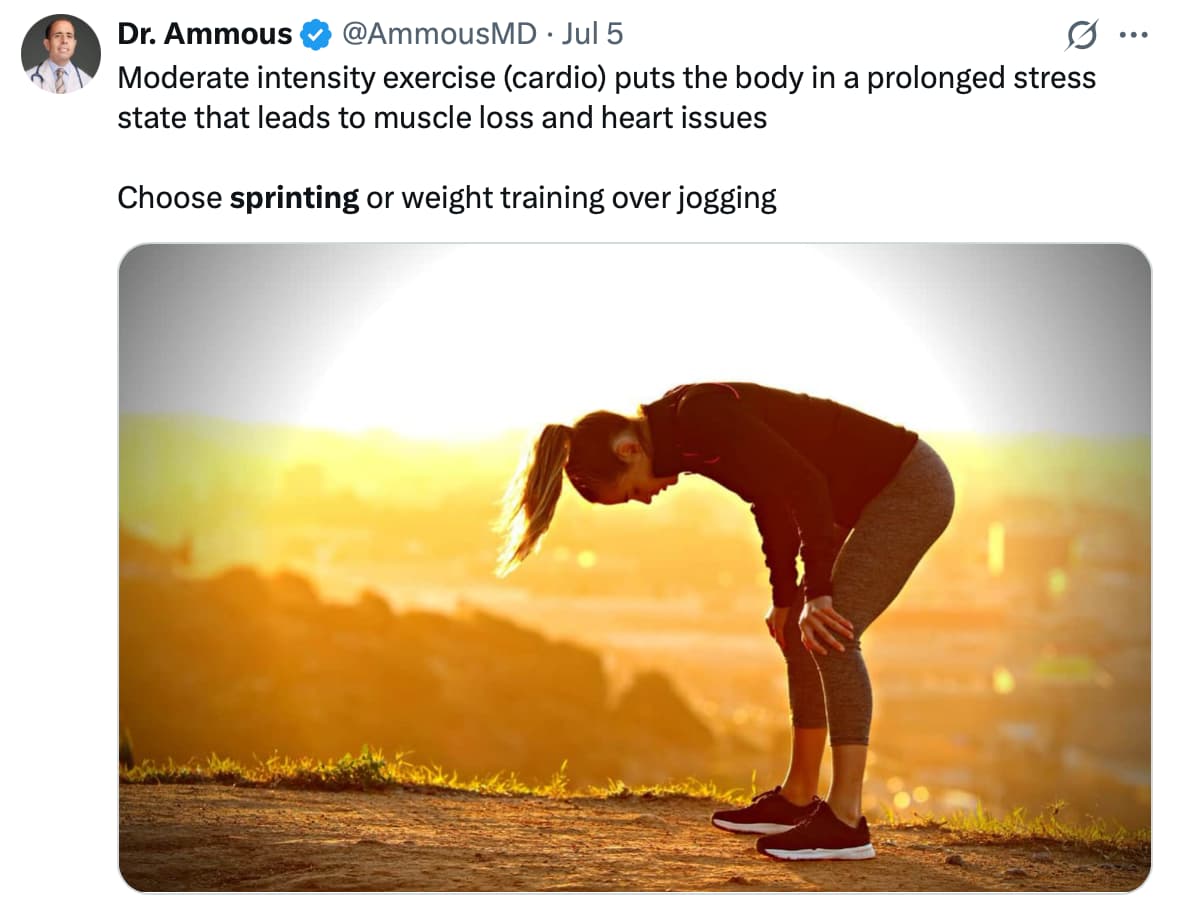
According to some, jogging is long term not so good for you, and sprinting or walking is more suitable to how humans lived their lives before civilization.
That’s why I try to do some HIIT (high intensity interval training), but it’s not so easy to motivate myself to do it. The Norwegian 4x4 protocol is supposedly really good for your VO2max.
It means a 3 min light warm-up
followed by 4 min sprint at 90% max heart rate
then 3 min cooldown, just walk
4 min sprint
3 min cooldown
4 min sprint
3 min cooldown
4 min sprint
3 min cooldown
Do this 2x a week and your VO2max should be going up.
I can recommend the book “Outlive” from Peter Attia MD. I try to follow his recommendations of combining running, weight training and stability exercises. 2-3 easy runs at zone 2, 1 run with the 4x4 interval training and weight lifting 2-3 times a week with 15 min stability exercises at the beginning. This helped me increase my VO2 max from 42 to around 50 currently.
Same here, I just feel way better overall, I’m energized the whole day when I go for a run in the morning. An investment with a really high ROI
I’m a multi sports person. I usually do 4-5 work out sessions per week over lunch. Did 5-6x sports per week before having a baby. I go running, do full body workouts (LesMills Bodypump), high-intensity interval training (HIIT), and core workouts. Did Yoga, biking, swimming, and Pilates before having the baby.
I’m in my early forties and have been doing sports since my early twenties. I never stopped and nowadays I focus on correct form rather than max weights or running as fast as possible. Agree, what Luk_nuts is saying, I listen to my body while running and soaking in nature. I love listening to the noises of the woods - birds, a stream running, wind, etc. - while observing my heart beat, rolling of the foots, pace, and so on.
I use an Apple Watch to record my workouts, but don’t look at the recorded metrics after finishing a workout. I review the metrics every few months to be aware of overall trends and changes.
Just checked for this post out of curiosity. Avg numbers over last quarter:
HRV 70 ms
VO2 max 51
Sleep heart rate 38 bpm
Why am I doing all of this? Helps me to reduce stress, focus, and not being in front of screens all day. I would like to be fit, active, and mobile as long as possible as I get older and older.
I’ll run if there’s an emergency, can’t stand any sort of solo cardio - I too find it insanely boring and can’t understand people who come to the gym and you see that they’ve been jogging/walking/cycling on the machines for 30-60-90+ minutes. Why take the trouble to make it to the gym and pay for it, and then spend so long looking at a wall?!
Weightlifting is my gig and weights are too expensive/bulky to have at home. At the very least you need a bench and squat rack, and they have to be good quality, plus a barbell and plates - the bill for a pretty decent setup would be upwards of CHF1500.
P.S. I get people wanting to be in a controlled environment, with pace they can control etc but still the 10 mins warmup cardio I do feels like a century.
Now that’s interesting.
Do you check them during the workout?
Or do you just go by how you’re feeling during the session, no matter what the data says?
Intervall training certainly helps to get faster.
But endurance - or zone 2 - training is probably just as helpful, as your heart and lungs capacity improves.
While it may sound counterintuitive, running at a slower pace can actually increase your aerobic capacity. Working at a lower intensity means you’ll work longer and strengthen your aerobic system the entire run. Running slower also taxes the body less, so you can do more of it. In fact, endurance training should make up the bulk of your weekly schedule.
→ VO2 Max: What It Is and How to Improve It
Cardio to warm up for weight lifting is a waste of time.
Instead, do one set with a few reps with 40%, 60% and 80% of target weight each. Example: say your goal is to bench press 50kg for a few sets and reps. As a warmup, do 1 set of 5 reps with 20kg, 1 set of 5 reps with 30kg and 1 set of 5 reps with 40kg.
Do these warmup sets for each exercise. Bonus is you’ll know if there’s a problem with that set of muscles way before you do the exercise with the full amount of weight.
Mit dem Lesen und der Teilnahme an diesem Forum bestätigst du, dass du die Forum-Richtlinien gelesen hast und damit einverstanden bist sowie den Haftungsausschluss auf http://www.mustachianpost.com/de/ akzeptierst.
 Now, I’m in the best form of my life so far. Just treated myself with a Garmin Forerunner 265 watch (50% sale at Ochsner Sport →
 %
% 