Please don’t use GPT for maths:
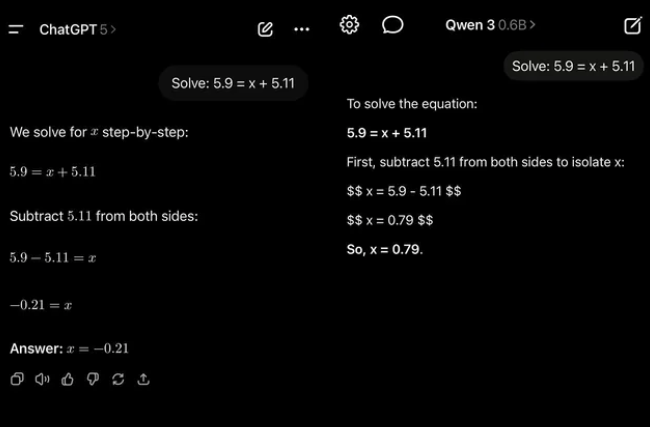
Even a locally hosted 0.6B model that can run on your phone does a better job.
Please don’t use GPT for maths:
Even a locally hosted 0.6B model that can run on your phone does a better job.
The issue with JEPI is that ICTax shows 100% of the distributions as taxable. There is no split income Vs gain.
If the ICTax cannot be corrected that’s a problem and make the Irish version more interesting tax wise
Doe these dividends of the Irish version even have withholding tax?
Most of the dividends should be wht free as they come from the covered calls.
He turned it into a trilogy 
Guy needs to chill it, he’s started sounding like a mad preacher at this point. It’s not that people don’t get it, it’s that some may not want/need the max (paper) return possible.
As I understand it, the issue is not that there is a lower expected return. The main issue is that the upside limitation doesn’t come with any real downside protection. You still earn the option premiums in a downturn, but the upside during the eventual market recovery would be limited despite experiencing mostly the same crash as normal stock holders. It seems like a great option in some market environments but not long-term, even if you’re happy to sacrifice some expected returns for stability.
It’s definitely possible that I’ve misunderstood, though. I haven’t watched all these videos in full.
I’d seen a great video which explained how they (the JEPx CC funds) should perform in various market conditions, and then showed that they did indeed perfom like that in the last 5 years where we got a lot of excitement with snap crashes and recoveries (COVID-19, invasion of Ukraine, “Liberation” day). I don’t remember everything and sadly can’t find it but the gist of it was that:
Based on the above I get Felix’s point, in fact I knew these points before Felix’s first video on CC ETFs, and say that there’s a time, place and person for these. Why he can’t understand this fact is beyond me. What’s funny are people on reddit who buy YieldMax funds and say “ololol I put $5000 in, I got $1000 distributions out and my principal is $3500, free money here I comes”, guess Felix is rightly annoyed at the intense marketing of these products, however going on a crusade titled “they don’t get it” is annoying. Yes, some people don’t get it, some people don’t want to get it. Some people even shoot arrows at missionaries trying to “save their souls”.
I think in his first video he mentioned briefly, potential psychological benefits for some. It should be made though clear (and in most cases it is not) that this comes with high cost - fees & huge upside cap impact.
The criticism he got and addressed was not about the psychological benefits but about the actual returns and downside protection.
Personally I do not really get the psychology of the “income without selling” they offer VS spend dividends and/or sell some stocks. As if it matters if I have 1000 stocks worth 100 CHF each VS 500 stocks worth 200 CHF each. As Ben also clearly shown, I prefer having less stocks and more wealth than constant number of stocks and far less wealth.
But OK as long as one takes the decision by knowing the pros and cons, all fine.
Something that should also be made clear, and many people don’t seem to understand the difference, is that dividends and option premia are totally, absolutely different things. The only similarity they have is that they are paid in cash! With that in mind, I would argue that options premia are a lot more risky than dividends in so many ways, and I’d personally prefer growing dividends, however the catch is the cash pile needed for it to make sense (if an average safe dividend yield moves around 3-4%) is 3X bigger than with options ETFs distributing 8-10%.
That said I expect a competent manager like JPMorgan, and lately Goldman Sachs, to be able to maintain a steady cashflow balanced by not having too many stocks be called away (I haven’t looked into the details of the underlying holdings and their transactions but I’d hope they are smart about it), or have a combined strategy with puts, or a collar, or an iron condor to protect against any major fluctuation - but that would make their yields potentially smaller, closer to t-bills, I guess.
On the second sentence: I don’t understand the strategy of “it’s the same, just sell some stocks whenever you need money”. The psychology part comes from not knowing what the stocks will be like when you want to sell, maybe it’s a protracted bear market and you end up needing to sell a lot more stocks YoY to keep living off them. That’s the time you want to be buying, not selling! That’s the psychology counter argument. Or as Goofy put it, “VT and chill doesn’t feel so chill when you really depend on it”.
I think the difference is extremely simple: wealth vs cashflow, and remains simple when one looks at Ben Felix’s job: he’s a portfolio manager which means his job is to make sure clients’ portfolios are as big and strong as they can be. With this lens then yes, CC ETFs are a bad thing. But saying “they’re not income” is plainly wrong. What’s definitely not income is a big portfolio on the screen.
This is what I don’t get.
When you live from your investments there is no such a thing as “not knowing what the stocks will be like when you want to sell” and “That’s the time you want to be buying, not selling”. You are actually in situation where “You need the cash, you take it”.
I don’t think the CC protects you much from downturns. It just hides the selling part with a huge impact on your returns (which translates to lower cashflows if you do not want your capital to be depleted)
Of course ideally you would like to buy low and sell high but you cannot do much about it unless you own the proper the crystal ball.
I suppose many things can be income in the broader sense. e.g. taking a loan and some how having access to a percentage of it every month 
(Bad) jokes aside, I am not an expert neither in investing nor in psychology so …
I don’t get the “it’s not income” either. It distributes money, who cares if it’s from dividends, bets on future prices (the covered calls) or whatever.
The other part of Felix’s argument is that it performs worse than an ETF on the underlying index. Which would mean a robo advisor with a regular disinvestment function would be the better solution.
I’m in the 0-1 bracket 
Also waiting for the first ones to vote 
Need a 0 option too!
Done
I guess we’ll have to wait for @Mirager to return to his beloved Greece and achieve his JEPX UCITS fantasy.
So in the end, Ben Felix is right.
No, he ain’t, and that’s because his premise if that “they don’t get it” and “it’s not income”, both statements being totally wrong.
It’s gonna be beautiful. Bigly beautiful!

