60% stocks and 40% bonds is a very commonly cited American retirement portfolio allocation
What makes this so popular?
And how can this be emulated in Switzerland? Bonds make no sense in Switzerland with the low interest rates (because CHF ones don’t gain anything, and ones in foreign currencies still gain nothing when converted to CHF plus you pay interest tax on them).
But replacing the bonds with cash and doing 60% stocks, 40% cash sounds completely crazy, e.g. on a 1M portfolio you’d have 600k in stocks and 400k in cash.
If one would want to somehow make use of this investment advice of 60/40 stocks/bonds, what’s the closest thing one can do in Switzerland to benefit from what the goal of this allocation is?
I do lean way more towards the >90% stock allocation myself by the way, however how can you even begin leaning towards this 60/40 advice you hear so often in US financial advice in Switzerland when bonds are not a viable thing?
Corporate bond index. Yielding about 1.5% at this moment for duration of about 4.5 years
SBI aaa-bbb bond index , Yielding 1.14% , duration approx 7 years
Medium term notes issued by certain banks
Saving accounts
Money market funds are not interesting at this moment due to zero interest rate
Indeed the yields are low because of low risk status of these assets. However expected inflation in Switzerland is also low.
Foreign bonds are yielding higher these days even at real basis because of very high debt level in most countries. Investors demand higher interest to hold UK/ US/JP bonds
In principle if you want higher yields with bonds, you need to increase your risk (duration risk, country risk, currency risk or company risk). When there is no risk, there is also not much yield.
—-
60-40 is popular because I believe it’s a good mix of growth assets (stocks) and stable assets like bonds. In past they were not correlated so it helps with portfolio formation.
—-
Over time many other portfolios have become popular, have a look at link below for some examples
—
You can also look at some examples at Frankly. Their factsheets show how Swisscanto build multi asset portfolios. Example of 75% stocks is here
—
90% stocks could be an option if you can manage the volatility that accompanies such portfolio. For example -: can you mentally handle Dot com or GFC type crash? If yes then why not.
I think it also depends on how big is the portfolio relative to annual income.
There is also another option in Switzerland: treating 2nd pillar (LPP) assets as bonds, given that, as employees, we have no control over this service and overall returns are around 1% (the required minimum). Depending on the LPP provider, returns may be higher, but they are always—or in the vast majority of cases—lower than those of the stock markets. To a lesser extent, it is also possible to treat the third pillar (3a) as bonds if it is not invested or if the chosen strategy is very conservative.
Thus, in Switzerland, to achieve a 60/40 strategy, one can do so through stocks and the 3a pillar (an investment strategy with 99% in stocks)—this is the 60 portion—and treat cash and the 2nd pillar (LPP) as bonds—the 40 portion.
-Equity: 3. P (3a Viac World or similar, 3b VALL Etf)
-Fixed income: 1. P (AHV), 2. P (Pensionskasse), Cash (Emergency fund)
Chances are big your fixed income allocation is already high enough without bonds.
I do not like bonds because:
-they offer low (to zero) reward
-there are still cases where in a crash they will go down
-they are more complicated than a basic investor would think
I think 2. P is a way better Investment product than bonds as safe income and I am very happy I only need to manage the equities in my portfolio.
My recommandation: unless you are in a special situation (soon to retire, soon to buy real estate), forget about the bonds, invest all you can/want to save into equities, invest into your career to increase your income (which will improve your 2. P as well).
Have a look at youtube Ben Felix including his view on asset allocation and life cycle allocation.
They have a pos rate, but are still exposed to market price fluctuation. According to my very quick research on justetf, the returns for swiss bonds are neg since 2016.
I do not really understand bonds; Am I missing something?
Potentially real estate, dividends have been fairly stable (but probably more impacted by bond yield than purely real estate dynamics). Plus direct funds are not taxable.
Since interest rates are already 0, there’s indeed much bigger risk that it loses value than gains it. (the upside is limited, while there’s still a lot of headroom on the downside).
Brokerages like IBKR still have negative rates above 100kCHF cash approx -0.4-0.6%. Depending on your strategy investing in short duration bonds has a place. 3year corp bonds have about 1% yield
You need to remember why we go 60/40 to begin with. The ultimate merric is the recovery time it takes after a major drop. 60/40 signifficantly beats 100% stocks on this side. And when you go to extreme, Japan like cases you can even conclude that sometimes, you need a decent percentage of non-stocks to even recover from a drop at all.
ultimately, the non shares part is not about performance. Some people think it was about negative correlation. Even if you take that one out of the equation - its all about somewhat not loosing too much year on year on your non-stocks part… so that when you need it, it allows your total Portfolio to recover from a manor loss.
so what to do? As a Swiss investor, it makes little sense to go money market. So you can rather use a bunch of Bank accounts or term deposits with Swiss banks. If you want additional risk (vs. Money market) on your non-bonds, you can go in the direction of corporate bonds and if you want some ultra long bonds for duration risk. A combination of 1/3 Bank Accounts, 1/3 Corporate Bonds and 1/3 15+ Years Bonds gives both fairly decent return and probably even some re-balancing bonus (always gedge bonds, unless you go hogh yield or EM currencies). If you just want to pile up Bank accounts, you can as well just go into several Bank accounts and take good deals for term deposits as they arise.
Particularely, if you hold such 60/40 Portfolio - its easy to get a self funded “lombard loan” against it. Your credit cost is just what your Portfolio would otherwise generate with Bank accoints, some accounting and your can easily just get 20% short-term loans from your Portfolio without net-net losing any money on interest.
I am a 60/40 investor and other than my list of banks that I hold money with becomes dairly long, I slee well even with a very large Portfolio and manor CHF Bonds/Cash Position.
What makes it so popular is that it combines growth (stocks) with income and stability (bonds). That makes it an ideal portfolio for retirement planning, because you can draw a pension from the income portion while growth in the stock portion helps to compensate.
In Switzerland, a 60/40 portfolio is not a bad portfolio, but it’s a bit more complicated. Because paying into both a social security pension fund (AV/AVS) and an occupational pension fund (pillar 2) is obligatory in Switzerland, those fixed-income products have to be accounted for in the 40% bond component.
In the US, many people receive a gross salary. So if they use a 60/40 portfolio, they simply allocate that part of their income (that in Switzerland would go to pillar 1 and 2 contributions) to the bond component of their portfolio. The end result is very similar to what you’d get if your AHV & pillar 2 benefits made up 40% of your assets, with the remaining 60% being made up of stock investments.
People in the US still receive social security (similar to AHV), and no one includes that in ther 40% of the 60/40.
The 60/40 is to be seen as a standalone portfolio. It happens to sit on a good part of teh efficient frontier.
It’s also to be rebalanced back to 60/40 periodically. Which you cannot do with AHV or pillar 2 assets. You can’t sell pillar 2 assets to buy stocks when they are down.
And this is the main feature of a 60/40 to have a combination of largely uncorrelated assets, while the 40% is mainly there to dampen volatillity by reducing the stock alocation and at the same time using the (historically mostly) negative correlation during equity crashes (bonds tended to go up during these times).
It’s also psychlogial thing and being able to stomach equity volatility. If you include your AHV/pillars in teh 40. Your portoflio will be mostly equities, which most people can’t handle during severe crashes.
True. I would argue, though, that would be accounted for in correct financial planning when relevant.
But you can refrain from making a pension fund buy-in and place that money in the stock component to maintain the 60/40 ratio. Likewise, you can choose to allocate capital to a buy-in instead of stocks.
I agree that the inflexibility of Swiss pension fund benefits is a negative compared to bonds (e.g. no room to shift existing capital to stocks). Also, they only become useful for regular income after retirement. For the purpose of portfolio stabilization, though, Swiss pension fund do at least as good a job as bonds, as there is zero CHF fluctuation.
For that reason, my personal opinion is that if one aimed to mimic the 60/40 allocation based on its use in the US, one should account for pension fund benefits. Of course, there’s no reason why one couldn’t use a different variation (with a separate asset class for pension benefits, for example).
And if you 600K portfolio drops 200K during a crash. None of what you can do with buy-ins, makes any dent whatsoever.
Again no real rebalancing possible and it’s a separate account. You will see full stock volatiliyt in your broker portoflio.
Also no negative correlation possibility.
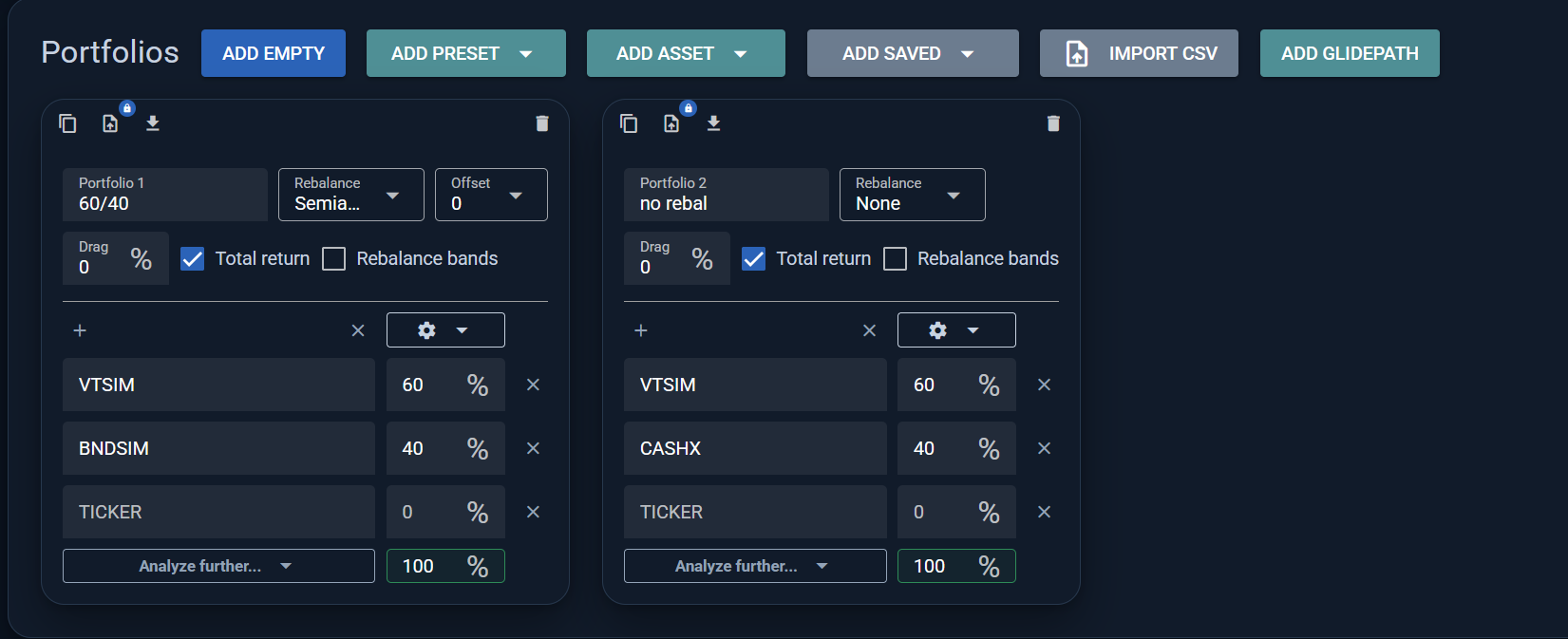
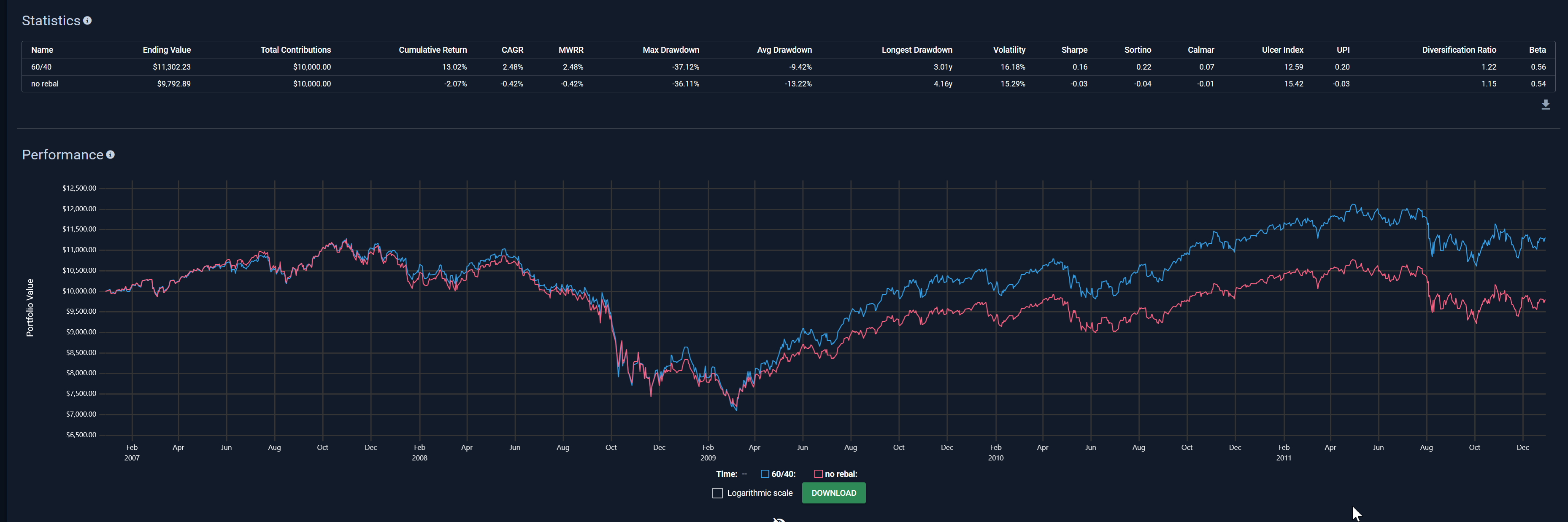
What this could mean in something like a 2008 situation:
Very interesting. So rebalancing played a huge role during/after the crash and apparently you cannot do it (or is very difficult) with the pension.
But is there any other option for Swiss (CHF) investors?
On top of the pension, allocate a significant % in bonds just for relabalancing even though their returns nowdays are close to 0.x% ?
BTW how the graph above looks like in CHF? Could it be that during a us/global stock crash CHF/USD goes up → perhaps further increasing the crash? (hmm or the opposite )
Unless you are quite early in the accumulation phase, the monthly/yearly contributions will be a relative small percentage of the whole portfolio. Probably not enough for rebalancing a 50% crash.
If you are in decumulation …
Mit dem Lesen und der Teilnahme an diesem Forum bestätigst du, dass du die Forum-Richtlinien gelesen hast und damit einverstanden bist sowie den Haftungsausschluss auf http://www.mustachianpost.com/de/ akzeptierst.
 )
)