3. pillar, is it worth it, how to optimize my portfolio + withdrawal?

Hey,

I am looking at the taxation of 3. pillar at withdrawal and I was wondering if it’s really worth it? Are there calculators for this where I could compare?

1, Sure, I save about 1.6-2k a year (depending on canton) by reducing my taxable income, and the withdrawal tax is much lower than the marginal tax rate, BUT the money invested also compounds quite significantly during the time, which is also taxed, so I think it comes out quite close in the end? Given the large selection of index funds inside the 3. pillar, I will not mention the potential loss on returns, since I could basically have the same selection of funds, both Swiss, US etc. as with IBKR, so the returns should not be effected by using finpension.

On top of the money being ‘locked’ and who knows what changes will be legally in the future that could potentially increase the withdrawal taxes. So I am a bit skeptical about this, if it really is worth to do?

2, Most of my normal investments are in US stocks, tech ETFs, so a generally higher risk portfolio, I assume since there are no CG taxes on these, and there is technically a capital gain tax on 3. pillar withdrawals it would be reasonable to keep the lower risk, lower return parts of my portfolio in the 3. pillar if I decide to open one, right? Unless I am missing something. I will probably have the ‘home bias’ in the 3. pillar, so mostly the SMI, or other Swiss ETFs, maybe some bonds. Would this make sense? Or Should I keep the same ratio inside and outside of the 3. pillar?

3, Can I separate accounts within finpension any time? Or it’s better to have 5 accounts from the start? Would this even matter if I were to leave the country before retirement age and withdraw the money then?

4, How does finpension handle this from the technical aspects, if I open 5 accounts? Is it like having more accounts at IBKR, and I can switch with the same login? Or completely separate? Would I need to create 5 different bank transactions to send to each account or I can allocate it within finpension once I send it all out?

1 Like

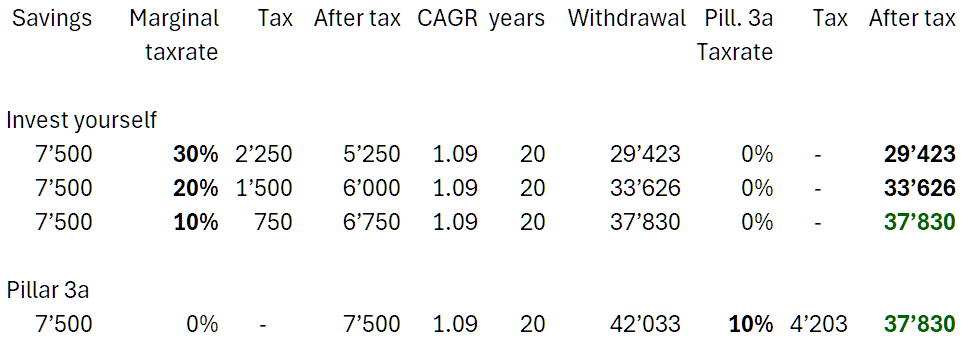
With regards to income tax savings due to contributions and withdrawal taxes, the only thing that matters in the end is that the withdrawal tax rate is (significantly) lower than the marginal income tax rate when contributing.

While you will pay withdrawal taxes also on the profits, you also earn investment return on the extra capital you were able to invest due to tax savings (7k invested in 3a would have to be compared to 5k invested outside 3a if you save 2k in taxes). If the withdrawal tax rate wasn’t progressive, this would exactly even out and there would be no concern at all. The withdrawal tax rate progression acts as a form of capital gain tax but it’s typically fairly mild. Compare your marginal income tax with the worst withdrawal tax rate you can expect and as long as the latter is still significantly lower, 3a should be worth it.

3a comes with higher fees than good ETFs at inexpensive brokers, however, with VIAC, finpension or TrueWealth, you can normally more than compensate this by not having to pay dividend or wealth taxes on 3a investments (you can even completely avoid US WHT).

There is a risk but as has been seen in recent discussions, there is heavy resistance to significant increases to 3a taxes. I think 3a contributions are much less at risk than pillar 2 contributions.

As mentioned above, the capital gain tax effect in 3a is typically mild. 3a is not the best place for something like Bitcoin’s past performance but for broad stocks funds I would rather differentiate between high and low/no dividends. See Splitting the world: creating tax-advantaged global stocks portfolio using funds in 3a account for a whole thread on this. That said, I myself actually use the same strategy (to the extent possible) in 3a and outside as I don’t consider the effect to be large enough to be worth the additional balancing complexity (especially as VIAC/finpension don’t allow manual trades, which makes manual balancing painful).

You can’t split existing accounts. I’d suggest to open 5 accounts right away. There are other reasonable approaches but I think it’s simple enough to directly start with 5 accounts.

If you withdraw all of your pillar 3a accounts in a single tax year, it wouldn’t matter.

Yes, a single login to access all accounts.

The former, you have to send contributions to the right account.

6 Likes

I was wondering the same, thanks for asking this question. I didn’t even think about the capital gains tax aspect.

Great, thanks for this point!

I also (kind of) like that Pillar 3a is protecting me from doing something stupid with my savings.

And I also see it as a broker diversification, where part of my investment is quite safe from mismanagement or phishing / fraud.

1 Like

If I understood correctly what you are referring to, I don’t think it’s how you described it. The fact that the whole withdrawal amount is taxed does not matter, it would have been equivalent to the taxation at deposit, because your assets grow proportionally.

For example, imagine your marginal income tax rate is 30% and withdrawal pillar 3 is 10% and you invest for a period of time that x10 your investments:

Not adding to pillar 3: you receive 1000 chf, you pay taxes so you invest 700 chf, at the end of the period you get 7k

Adding to pillar 3: you receive 1000 chf, you invest in pillar 3, you get 10k, you pay taxes at withdrawal, you get 9k.

You can extend the investment period as much as you want, but you will still get 30% vs 10% taxation on the same amount.

Two nuances that make the math above not exactly correct:

  • In a taxable account you pay also income taxes on dividends, so these money are taxed twice at your income tax rate, in pillar 3 instead they are taxed only once at lower rate, so this is an extra advantage in favor of pillar 3
  • Pillar 3 taxation is often progressive, so this makes it true that the more capital gains your realized the more you will be taxed, but I think in practice, if your marginal income tax rate is high enough, this will not matter much and pillar 3 will still come ahead
2 Likes

I had to do examples, but I think now I understand your statement :slight_smile:

1 Like

And it’s because the order of a multiplication doesn’t matter, so applying tax first or last will give you the same results.

1 Like

Unfortunately, both taxes are typically progressive, so it’s not that simple.

Nevertheless I think 3a is a no brainer to have.

The other things to take into account are:

  1. the income earned in the 3a will be free of income tax
  2. the value will grow free of wealth tax

example.

Let’s say you put in 100 into 3a, you earn 10% in dividends, so have 110 and when you withdraw you pay 30% tax, so get: 77.

Now let’s say you invested it outside the 3a, then you invest 70 (let’s say 30% tax). you get 7 of income (taxed at 30% gives 5) for a total of 75 (also need to deduct a bit of wealth tax too).

1 Like

here is how I would recommend to think about it

FV = IV (1 + r^N) (1- WT)

FV2 = IV (1- MT) (1+ x^N)

N = number of years

r = effective compounding rate for 3a, accounting for tax free dividends and wealth tax exemption

x = effective compounding rate for „normal investment“ accounting for dividend tax & wealth tax

IV = initial investment

MT = marginal tax rate at time of investment

WT = lumpsum withdrawal tax rate

FV = Final value for 3a after paying taxes

FV2 = Final value in taxable account

If FV > FV2, 3a is worth it

(For simple calc , IV can be assumed to be 1 )

1 Like

Thank you for the detailed response, all my doubts are cleared now:)

And sure, maybe it doesn’t make a big difference to separate the high risk and low risk parts of my portfolio in terms of overall returns, but it would be easier to separate it like this for me, and still end up with a bit more overall due to the taxation.

youve got 10 years to think about it, new rules mean you can now top up missing years going back to this year :smiley:

1 Like

But how would that work for my taxation? E.g I will fill in my tax return this year, and pay the taxes, if I add the 3. pillar amounts for this year in 2035, then how will this be changed in the future?

Good point, tho the management fees are higher in the 3. pillar compared to regular brokers, I guess it still makes up for it with no taxes on wealth and dividents.

The 2025 taxes won’t be reassessed. If you contribute to 3a in 2035 and fill the 3a gap from 2025 also in 2035, you get double the tax deduction in the tax year 2035. Note that you can only fill one gap per year and you can fill gaps only if you also contribute the full amount in the current year (in 2035 in the example).

I.e., the flexibility is limited. If you don’t contribute any 3a over the next 10 years, it takes another 10 years of double contributions to catch up.

I would normally advise against deferring 3a contributions unless you expect your marginal income tax rate to significantly increase (e.g. because you currently only have a student side job), or you don’t have enough savings yet that you can afford to lock in.

3 Likes