Got it.
Most of my US domiciled ETFs are distributing anyways. I also like distribution based ETFs. That’s what I use on IB
Just that Swiss brokers attract higher trading fees and that’s the only reason my holdings on SQ tend to be accumulating
Got it.
Most of my US domiciled ETFs are distributing anyways. I also like distribution based ETFs. That’s what I use on IB
Just that Swiss brokers attract higher trading fees and that’s the only reason my holdings on SQ tend to be accumulating
I thought they are all distributing by law?
100%, it’s for sure another point of inefficiency when you intend to reinvest dividends and use a Swiss broker.
Ahh didn’t know it was the law. But yeah then all of them are by default distributing
Ah because you said “most”.
I look at accumulating funds like this: they constantly buy equities for me without any new money. They make my share of ownership of the world market tiny bit bigger each day.
Distributing funds do the same, though. (apart of the day on which they distribute) 
Is it so? Distributing funds accumulate dividend in a MMF and then pay it out, most often quarterly. They have a little bit of cache drag. If you don’t reinvest dividend, your share of the total market does not chage (also not 100% correct, as lots of companies buy back their shares and some issue new ones delluting your share). But by and large, if you let your money in an acc fund, your share of the total market will grow.
It is all about psychology. This argument works for me wery well. Plus an accumulating fund is less hassle with reinvesting dividends.
While I personally would prefer the simplicity of accumulating funds any given day, psychological comfort is way more important. If seeing quarterly dividends makes someone stay the course and invested during good times and bad, more power to distributing funds and people who prefer them.
Distributing funds buy new shares immediately after receiving dividends, just like accumulating funds.
Otherwise, their performance would be significantly worse over time compared to an ACC fund. In reality, they have the same performance (if you include dividends in the DIST fund).
How do you mean “new money”? The ETF itself increases its holdings by using the money received from dividends to buy more of the underlying shares, therefore the NAV doesn’t drop. The advantage is that they do it much cheaper than a retail investor could ever do.
This doesn’t make sense, otherwise it’d be an infinite money glitch. Distributing funds retain the dividends, AFAIK in a non-interest paying account (not MMF as mentioned above, as that’d give an edge to distributing funds) and distribute them to the shareholders in the fund.
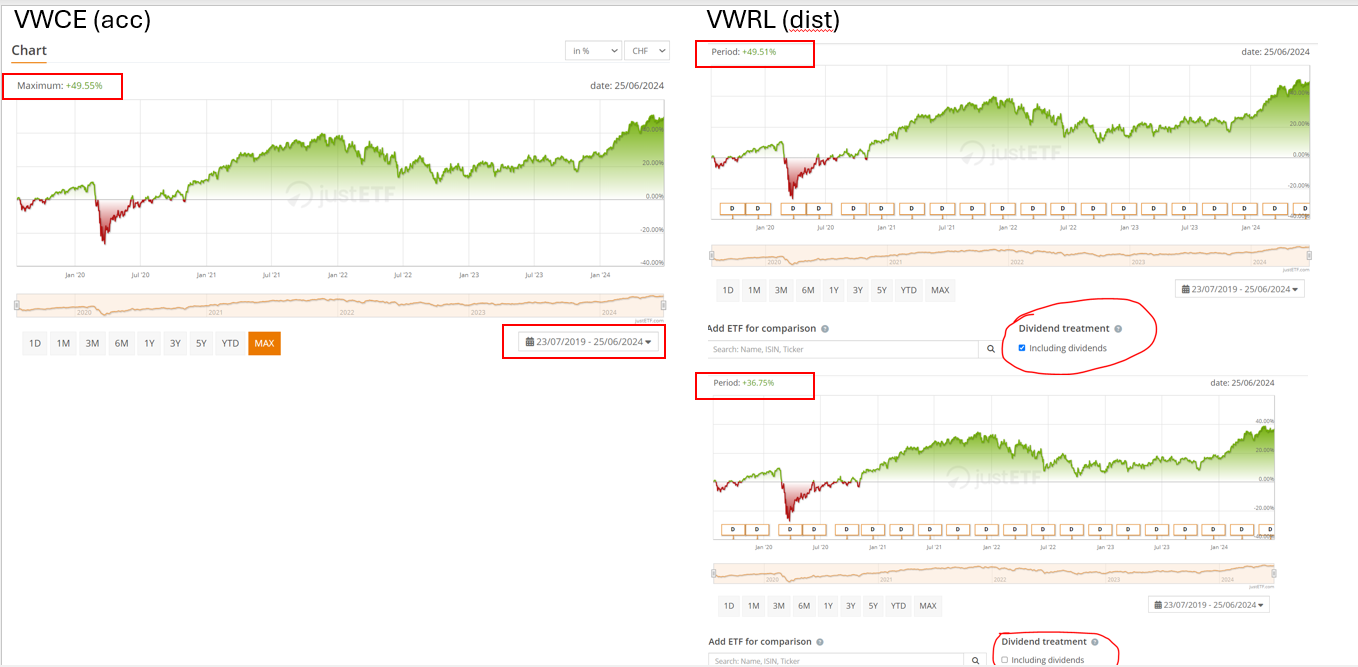
If you check the performance of VWCE vs VWRL at the same timeframe, and play with the “dividends reinvested” tickbox, you’ll see identical performance (before fees) for the two, but ~13% difference without dividend reinvestment.
Edit: demonstrating some mad MS Paint skillz
Right. But it increases your relative % of the total market, you buy more equity, which got a little cheaper due to the distributed dividend.
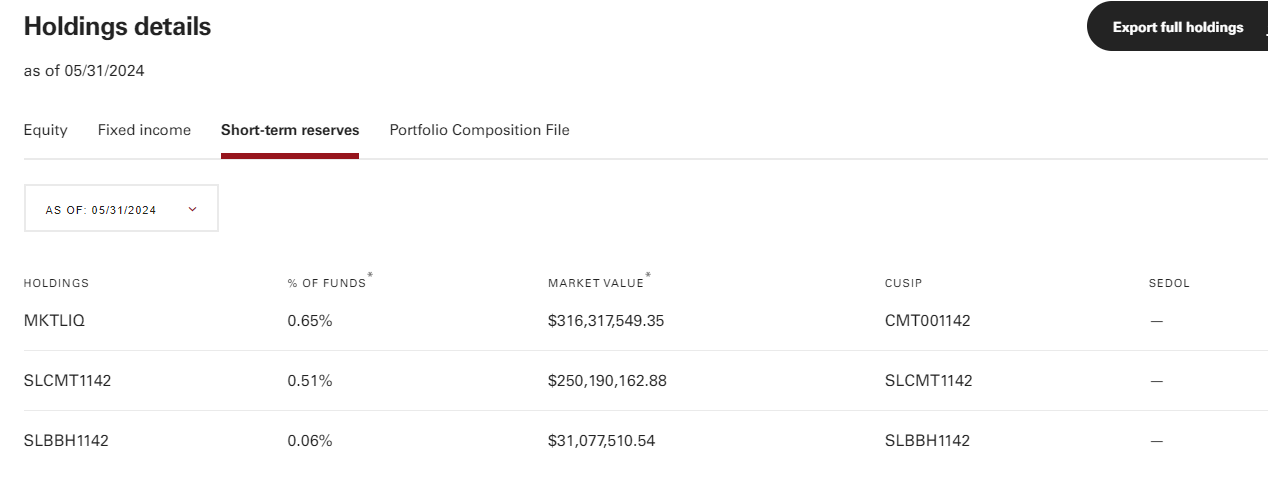
Why should Vanguard hold money in non-interest bearing account? It would be silly to loose interest. VT holds quite some money in MMF, just look at their holdings
Some fund managers play with futures to better match the benchmark, e.g. Northern Trust does it for their fund.
Right, but the end result to the holder of the ETF is that the NAV doesn’t drop. I bought 100 shares of CSSPX 1.5 years ago and sold these same 100 shares on Monday this week. The value is of course different, a combination of appreciation and reinvestment of dividends, but in fact what’s going on under the hood of the ETF makes no difference to me the shareholder.
Are these the dividends paid by companies held in VT? It’d make sense that they would/could hold this money in a MMF before distributing, but I thought they didn’t.
It can’t be a money glitch, if it’s the same procedure as an accumulating fund.
Or maybe I don’t understand your point.
But you get to the same result - the performance of VWCE and VWRL is identical.
→ therefore the dividends VWRL receives can’t be lying around for 3 months, but get invested.
No, their performance is identical a) before fees, and b) if dividends are reinvested. It’s not the same procedure, otherwise there wouldn’t be two funds, their treatment of dividends is literally the only difference between VWCE and VWRL. Edit: VWRL is older and bigger, but mechanically they are identical.
VWRL distributes dividends to the shareholder, who may reinvest them in VWRL, or another security, or use them to pay the bills, or any other use they may want to make of them. You see in my concrete example that VWRL lags VWCE by 13% in the same time period if dividends aren’t reinvested (implicit that reinvestment is back in VWRL).
In my opinion if VWRL investor reinvested the dividends on same day the day the VWCE fund reinvests, the final performance of both VWRL will be a little bit below VWCE due to trading fees. That’s it. For low cost broker like IB, it would not even be noticeable.
It wouldn’t expect that VWCE is disadvantaged in any way.
The main reason these funds exists in two options is to allow people to get dividends/ or not if they like for some reason (cash flow, tax advantages in some countries etc)
This is all true. It was interesting to discuss psychological implications of acc/dist funds. @mirager has a preference for dist funds due to the visibility of dividend flows, it is understandable the pleasure of seeing profit flows generated by your money. I offered an alternative “pleasure”: in acc fund you increase your share of ownership of the total market daily. Might also give some psychological comforts.
For me following is the pleasure list
The main issue with accumulating version is that when it comes to actual retirement , in some jurisdictions, it might be a bit of an issue because the only way to actually have money is to trigger capital gains transaction. In CH , it wouldn’t matter but in other countries it might
Indeed, the psyco discussion acc/dist assumes no real world efficiencies and implications. If your dividend is taxed, but capital gains are tax-free (Belgium?) it would be plain stupid to invest in dist funds.
You confirm everything I said.
Obviously dividends need to be reinvested for this to be true.
My point is that VWRL reinvests the dividends received in the period between two dividend payout days (from ex day+2 to ex day+2) in exactly the same way as VWCE.
Right, do you have a source? It doesn’t make a difference in the end result, but your wording is at least confusing as “reinvests” suggests an accumulating fund.