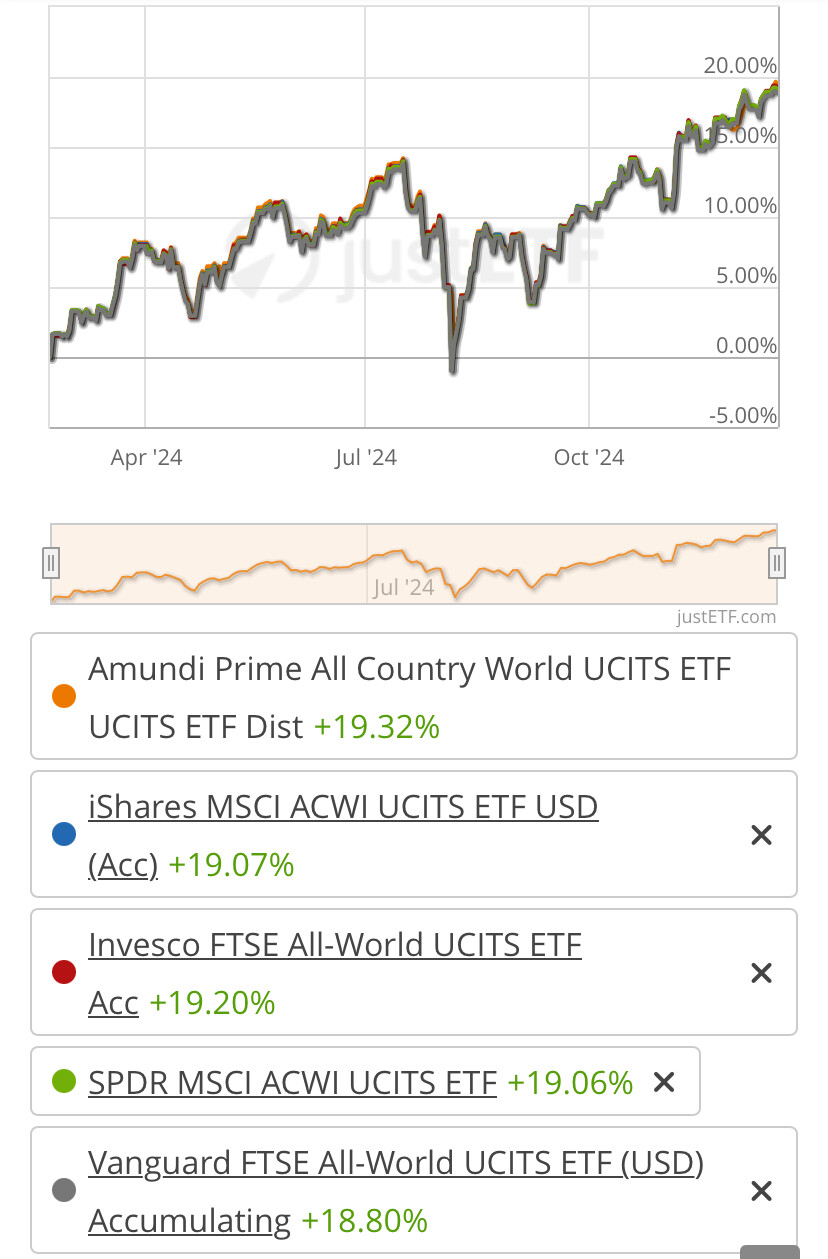
I would say this is the reason. If for example one fund has a higher concentration in large companies (e.g. magnificent 7) and those companies perform better than the rest. The fund doesn’t manage enough capital to own all companies of the benchmark and thus performs better than other fund. Of course this can go both ways: outperformance or underperformance.
Depends also a lot on how the respective execution and tracking of the index is.
Securities lending revenue can also make a noticeable impact (iShares gor example gets a noticeable boost from that, they focus a lot there).
You cannot say that just because the ter is lower, it will perform better, even if it‘s the same index.
And between indices, the index construction plays a role. Maybe the solactive index is just inferior to msci/ftse? (No clue here, but is to be considered)
I for example have not much confidence in Amundi, with their history of changing fund indices/domiciles and closures etc.
That’s what I was getting at with the “unfair” comparison above. One needs to decide if:
they want emerging markets or not
they want small caps or not
they want dividends reinvested or not
With these questions answered, one can then look at the options available. If, say, one wants an accumulating fund that includes EM but no small caps, one has a choice between VWCE, SPYY, FWRA, WEBN and probably more. Within this group of funds that match the criteria, a comparison is well valid in my opinion, even if they track different indices.
Even if three indices meet the above criteria , if they happen to have slightly different underlying companies , then comparing past performance will only tell us how those underlying companies performed based on the weights selected by the index provider.
It would not tell us anything about the quality of index (of ETF) or expected future performance or effectiveness of index manager philosophy.
If we really want to know which index is better , we need to look into different elements on top of performance & make a judgement call
Just out of curiosity I checked the updated numbers
Seems tables have turned a bit.
WEBG is right now the best performance
FWRA continues to beat VWCE
SPDR ACWI catching up to SSAC (fees only changed in August)
I still think that this would keep changing back and forth because of differences in underlying indexes. But the comparison within same indices is showing TER difference as driver.
FWRA has a ter of 0.2, WEBG of 0.07. Both compared to VWRL seems to be fine. Since it’s a diversification issue, I’d prefer a stable company behind them.
WEBG is Amundi, FWRA is Invesco. Which one is better?
I don’t think there’s a significant difference, except for the index they track. But even with a different index and different TER, on JustETF they performed exactly the same since WEBG’s inception (FWRA is slightly older), and both have AuM over $1b.
FWRA’s index includes the top third of small caps (so 90% of total market). WEBG’s index doesn’t; it’s more like MSCI ACWI (85% of total market). I went for FWRA as I wasn’t sure if I should invest in small caps, and FWRA is a compromise as it includes some of them
That’s what I wanted to hear. Comments on companies. So Amundi seems to be worse than Invesco.
I might start to sell ETFs or it will be harder to track stuff.
Both are good. WEBG is cheaper and larger but it doesn’t trade in CHF. So it depends what currency you typically have to invest and which broker you use.
On IBKR, I think WEBG/WEBN will be cheapest.
On Swissquote or Saxo , I believe SPDR ACWI or FWRA could be most convenient as they are accumulative and trade in CHF
That’s what I do, when I use IB, I use WEBG. When I use SQ, I use SPDR ACWI
While looking at world ETFs, I think Amundi (WEBG) is only European fund house while Invesco (FWRA), Vanguard (VWRL), Blackrock (SSAC) and State street (ACWI) are American. Not sure if that makes a difference.
Does that mean that the actual cost of VWRL is basically zero when looking at trackingdifferences.com? How is this even possible with a TER of 0.22%? I mean the TD the last 10 years was almost always 0.0%. Security lending?
These indices assume the worst possible witholding taxes for the countries. So if the index assumes 30% for the US, and you have 15%, you already have a 0.15% headstart on “tracking the index”
It’s misleading because benchmark is not reflecting treaty rates . All UCITS ETFs have this situation where they seem to have essentially no cost because they pay treaty rates for taxes while benchmarks assume higher rates
I know there are lot of articles claiming VWRL is free but in reality it’s not. You can easily see this while comparing performance of FWRA vs VWRL which track same index and FWRA outperforms.
Thanks the both of you.
Yes exactly, there was a post on reddit where somebody claimed that VWRL is actually free considering the TD. I didn’t know that the benchmark is not reflecting treaty rates.
Mit dem Lesen und der Teilnahme an diesem Forum bestätigst du, dass du die Forum-Richtlinien gelesen hast und damit einverstanden bist sowie den Haftungsausschluss auf http://www.mustachianpost.com/de/ akzeptierst.