I can look at the return in CHF, but because USD went down the returns are lower. Wouldn’t that just change where the loss is? (returns instead of currency).
In any case I was told fitures contracts were good. What do you think?
I can look at the return in CHF, but because USD went down the returns are lower. Wouldn’t that just change where the loss is? (returns instead of currency).
In any case I was told fitures contracts were good. What do you think?
Some companies are traded simultaneously on SIX in CHF, on XETRA in EUR, and at NYSE in USD.
The value of the company does not change depending on the stock exchange.
Take novartis.
1Y performance on NYSE: +47%
1Y performance at SIX: +22%
Which one is true? Both.
Which one is worth more? They’re the same thing with the same value, at any time.
There are plenty of articles/pages on the internet that describe with precision what is involved and the specific steps to take in order to execute on it.
If you need to repeatedly ask on this forum, you should really stay away from it.
The expected return of the stock market is the risk premium (roughly 6%) + the risk-free interest rate (roughly 4% in the US and 0% in CH). The expected devaluation of a currency is the difference in interest rates (which is strongly correlated to inflation rates). So in the end you’ll expect 10%/year from the US stock market and 6% from the Swiss stock market and simultaneously a USD/CHF devaluation of 4%.
It’s simplified, but you should get the idea why FX risk doesn’t matter for long-term investors.
Good point. But what is the risk premium these days? Is it still 6% ?
I’d recommend that you chill, make a complete plan for investing, stop chasing overperformance, get a set of diversified ETFs, and stick at it for a long time.
You didn’t have these returns to start from. For someone counting their money in CHF, investment returns in USD (or EUR, Japanese yen, Turkish lira or DOGE) are not relevant. These are just numbers that are shown to you on the screen.
I kind of get it, but am still amazed at how people don’t understand it - and nobody says it, because it is too simple. When you see a price of AAPL, it is expressed not in holy eternal ether (of middle age variety) coins, but in mundane American forking dollars. If you write it like one quotes currency, it becomes straightforward:
AAPL/USD
The number goes up if numerator goes up OR denominator goes down! And when they are both expressed in the same currency, for example in CHF which is relevant for us, USD/CHF comes into play. The rest was already explained.
If you don’t understand and/or don’t want to understand why currency hedging is not relevant for long-term investments, then it might make sense to shift your investment to a CHF hedged ETF: simply so you can sleep well at night. Because peace of mind is important when investing.
There are various ETFs of this kind on the market, from iShares, UBS, Swisscanto (ZKB) etc:
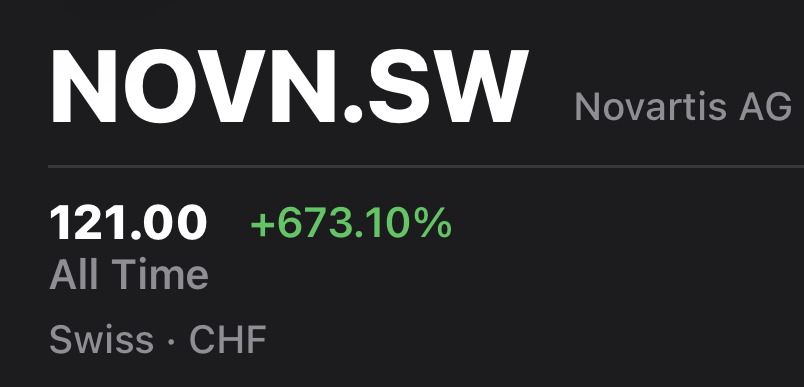
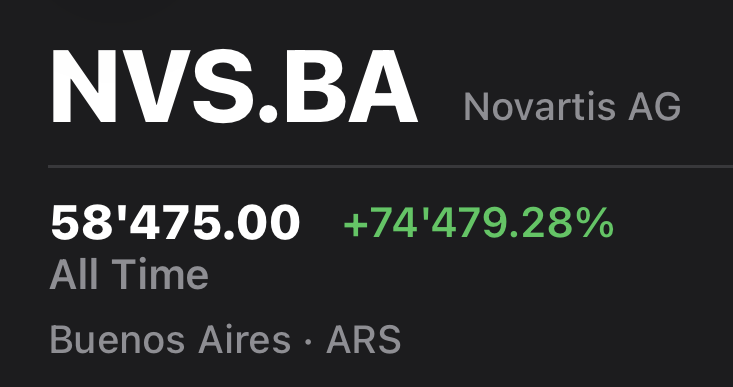
Some intl (Swiss) stocks are traded in Switzerland in CHF, Frankfurt in EUR, NYSE in USD and… Buenos Aires in pesos.
I really recommend the last one for the very best performance. Look at my Novartis again! It beats the CHF one by so much.
Amazing return there and if I hedge the currency correctly, that’s perfect. I don’t want to be a victim of CHF appreciating eating my 5 digit performance!
You win this thread.
We can go home now.
If the dollar continues to weaken against the CHF, dropping from current rate or 0,78 to 0,5 over next 10 years, meaning 1 CHF = 2 USD, the CHF hedged ETFs would probably outperform the unhedged VT ETF. In the previous decade, the USD depreciation was small enough so that VT performed better vs. hedged funds. Looking at the current massive US debt, and the US strategy to further depreciate the dollar, which allows the government to pay off its borrowing costs with “cheaper” dollars, going towards a value of 1 CHF = 2 USD in 10 years does look possible to me.
Well if the FED/SNB rate difference stays at 3-4%, the USD would devalue 26-34% in 10 years. Thus going down to 0.52-0.58. 1 CHF = 1.72-1.92 USD.
I’m betting on USD weakening and Fed cutting. With the recent strengthening of USD on Iran war, I took out margin debt of 500k USD and converted it to CHF to pay down a mortgage at 1.5%.
Margin cost is currently about 4.7% so that’s a 3.2% differential I am paying. I’ll only make money on this if USD weakens and/or Fed cuts.
So you pay an extra margin cost of 19k USD / year? You would need 1 USD to go towards 0,6 CHF in 5 years to be on break even? Bold move…
Yes, extra margin cost would decrease if Fed cuts. Also, cost is slightly lower for tax due to tax deduction at marginal rate (at least for a few years).
But I should have really done this a year ago.
I also see it a partial hedge. I receive USD dividends which will offset against interest margin expense.
The biggest risks I see are SNB intervention and a resurgent US economy.
Wow, you do have balls!
So a portfolio of 50% VT and 50% of FWCA or UBS MSCI ACWI SF UCITS is suddenly not a terrible idea anymore 
I came here in 2007, right at the time of the top of EUR vs CHF ever.
It can go down for a lot longer than you think.