Which companies exactly are not part of Fund? I think Rheinmetal is actually in the fund
The way the information came to my knowledge is that they excluded lockhead martin, due to the due to corporate policies against controversial weapons (cluster bombs, chemical or biological components), even though it is a part of the underlying Solactive index.
Other companies according to Gemini:
- General Dynamics (GD): Excluded due to structural links to components utilized in systems categorized under indiscriminate or controversial munitions frameworks.
- Northrop Grumman (NOC): Filtered out as a primary contractor for systems integrated into long-range strategic and specialized delivery platforms.
- L3Harris Technologies (LHX): Cut due to tactical sub-components and electronic warfare elements mapped directly to restricted defense contracts.
- LIG Nex1 & Poongsan Corp: Leading South Korean defense firms explicitly flagged and excluded for their active exposure to prohibited ammunition and missile components.
I want to repeat that to me the problem isn’t really that ETFs don’t invest in these companies, it’s that Amundi doesn’t transparently say so - if you have no controversial weapons in an ETF representing the global economy, you should merket it as prome global ex. controversial weapons.
You also can’t sell soy steaks, or grass brugers as beef burgers.
2 Likes
You will love the Sammlung Bührle in Kunstmuseum Zürich 
3 Likes
Thanks for sharing
Yeah maybe Amundi can explain this better in their factsheet
Anyhow for me, it’s not much relevant as they have a lot of companies (> 3600) already in fund. And I don’t think their performance will be materially different than one including these exclusions.
Of course there is always a chance that one company with 0.05% weight outperforms rest by 1000% but even then the impact could be small.
FWIW the prospectus:
The Investment Manager integrates consideration of certain
sustainability risks referred to in the section of this Prospectus
entitled “Risk Factors - Sustainable Investment Risk" by excluding
the securities of companies involved in the production or sale of
controversial weapons as defined in “Replication Methods for
Passively Managed Sub-Funds”. The Sub-Fund takes into account
principal adverse impacts of investments on sustainability factors
in its investment process as outlined in more detail in section
“Sustainable Investing” of this prospectus.
(that’s basically excluding “Antipersonnel mines and cluster bombs” as well as “Chemical and biological weapons”)
I doubt you’ll miss anything investment wise by excluding those 
I just think this is a bit dishonest… Let’s just say we get a large scale war between the US and Russia - Lockhead Martin might blow up to 5% of an MSCI world - and now you lost all this performance (on top of the war that’s going on), just because a moralist Frenchy decided you can not invest in US weapon manufacturers, but Rheinmetall was okay. I personally don’t think any of these claims are valid and this screams of EU moralist nonsense - the US also accuses Switzerland of forced labor to justify it’s tariffs, so there’s that.
I’m sorry if I am annoying with this, but imho Amundi is not offering an index ETF here --they’re offering a modified version of an index ETF with elements of an ESG tilt. If you don’t care about that, you should still care about the correct open declaration. I just checked the fact sheet - it’s not in there, it’s only in the prospectus as @nabalzbhf pointed out.
Maybe I’m a bit of a “Tüpflischisser” here, but I do find this very important and I don’t like shady practices and this seems shady to me personally.
3 Likes
What I am trying to say is that for me it’s okay if they are being moralist.
I only care about buying 3600 companies at low TER. If for any random reason they exclude few companies like LMT and LMT blows up to 5% of the index then it’s fine . It’s just bad luck
But I totally get it that you might want to invest with another ETF for this reason.
2 Likes
My apologies! I though that conversation ended when assumptions about the price of legal work were corrected, by many.
The bottom line is that it costs a good 15k of lawyer’s fees to unfreeze your 115k portfolio.
Want to avoid that?
Just pour 115k into BNP’s ACWI via Degiro, for a flat fee of 2€, in Swiss francs with zero currency exchange fee, zero custody fee and no L1 drag.
And you’re set for life 
…until you retire and maybe sell, again for a flat fee of 2€.
Pure speculation on your part. Give me evidence that lawyers really need to be involved.
Also, I have not yet seen a convincing total cost of ownership comparison for your claim (‘My point is that we do have European providers, abiding by European laws and values, that can also be better and cheaper than US providers.’).
On one hand, you have lawyer fees and forex fees, on the other you have none, only a tiny, predictable transaction fee. What do you want more?
Many recommended not investing energy in discussing a difference of a few cents (one way or the other) and I can only agree with that.
I’m sure one of the financial influencer could get someone to fill out an example 706-NA and form 8833.
I don’t think it’s this complicated esp if anyway you’re under the exemption limit.
If you care about your heirs you could probably prepare one in advance.
(And I also doubt the US cares a lot about enforcement, the new treaties eg Germany/France exclude securities from having to file anything)
Edit: and if you use a non US broker, and don’t have the shares registered in your name (the default), I also strongly suspect they’ll tell you what you should do knowing that nobody will care that you don’t. If you have a good account relationship that’s nothing you can likely get an answer about it in person/over the phone.
1 Like
I am curious, why is SSACCHF not mentioned in this thread as an alternative ETF?
Again, I’m still missing evidence or testimonials for your claim.
How does your suggestion eliminate forex fees? Investing in a CHF ETF with underlying world index has forex fees as well, I would claim even more than a USD ETF.
Again, I’m still missing credible numbers on this claim.
Courtesy of @Strabor : Interactive Brokers forces investors to pay 40% U.S. inheritance tax
Happy to explain how an USD fund traded in CHF works:
- The fund keeps its books and strikes its NAV in USD. The CHF quote you see on the exchange is that NAV converted at the prevailing spot rate, refreshed continuously.
- The conversion is done by the market makers quoting the line. They hedge their own FX exposure and build the cost into the bid–ask spread, as a slightly wider spread. For a major pair such as USDCHF, it is practically zero.
For reference, large funds on SIX trade at a 3 bps total spread on typical rebalancing days.
Here is the source - see page 4.
I’d assume that, for people still comfortable with UCITS from US providers, SPDR ACWI became a better deal from a TER perspective.
1 Like
Thanks, yes these are testimonials. They are another example that we have a different understanding of things
The link contains two testimonials: one from a Belgian person and one in Russian language. To me, this does not feel closely connected to my situation. Out of all the worldwide clients over the past 30 years, I would have expected a few testimonials that are closer to a Swiss situation.
Practically zero is not zero. Again, you claim ‘cheaper’, that’s what I’m holding you accountable for.
Again, give me a cost breakdown of 1:1 comparable portfolio for VT + chill, showing ‘cheaper’.
Though I’m not sharing your political thoughts and believes, I’m happy to accept that you would like to avoid US as much as possible and would like to convince others to do the same. That’s all good and valid. I’m only challenging your claim that your solution is cheaper.
It would be surprising to see a testimonial reflecting your personal circumstances. No heir will bother involving lawyers for a 115k US-situs inheritance and it is probably not a typical Swiss situation either.
Those who have good reasons to involve Lenz & Staehelin also have very good reasons to be discreet about it. I understand what you want to see, but you are unlikely to read a testimonial from The Poor Swiss because he is, well, poor.
The point many tried to make is that, when you have exposure to the legal world and/or to the IRS, you stop underestimating the hassle and money these things cost, and you want to protect your loved ones from that; especially when UCITS is such an easy way out.
Claiming the treaty credit automatically means disclosing the full worldwide estate to the IRS, with certified death certificate, will/probate grant, English translations, and appraisals. The cost / benefit / risk analysis of your personal situation is of course yours.
It’s fine, I’m happy to explain. For USDCHF on interbank platforms like Reuters Matching or our EBS, the top-of-book spread during liquid hours is typically 0.3 pip meaning 0.00003 therefore in the territory of fractional pip (also called pipette at some Geneva desks, which I find very cute) and is not representable at the retail investor level. It is, in practice and under legal rounding rules, zero.
We cannot have a universal comparison. Most costs being at zero, it depends on the trade size because you would be comparing a flat fee with a percentage-based one.
I mentioned that at my trade size, zero currency fee and 2€ transaction fee beat IBKR anytime, be it tiered or fixed.
Update: A trade got executed by Degiro on SIX today, here is an excerpt of the transaction report.
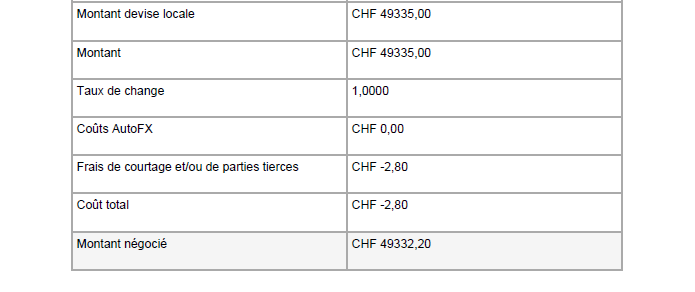
If you insist, we can fill a table here. Just put all your parameters and costs (such as the cost of reinvesting dividends) on one column, and I will try to input data on the other one.
Apparently, TERs of BNP Paribas Easy trackers such as this one didn’t change 12 months after inception. The footnotes say that charges are estimated to be paid over one year, with the current level estimated on the ETF launch date; after a year it is replaced by the realised figure.
The prospectus sets a maximum management fee but it seems like a simple legal precaution.
My view is that IRS process for Swiss residents is clear to avoid 40% inheritance tax.
But it still needs to be followed. And depending on what are the assets, they might need specific valuations too (for example unlisted assets like estate)
Assuming that nothing needs to be done is wrong.
Assuming that nothing can be done is also wrong.
The choice ends up being hassle for heirs vs 0.08 - 0.1% per annum higher cost.
2 Likes
Also keep in mind that the DA-1 tax credit depends on the tax rate in Switzerland. After early retirement, taxable income may be low enough that your income tax rate will be significantly below 15%, reducing or even eliminating the tax advantage. And if the US part of the global market cap gets smaller, the tax advantage gets smaller as well.
Switching from VT to UCITS ETFs upon (early) retirement could make sense as the VT tax advantage gets smaller while the chance of leaving an inheritance with IRS hassle increases.
5 Likes
if your marginal personal income tax rate goes below 15%, you will actually lose money with VT because the 15% are also withheld on dividends from non-US companies
1 Like
Why bother with testimonials? It’s not a restaurant visit.
Even in case of early demise (before you can switch funds), you could read the 2 forms required in a moment of inspiration, pre-fill to some extend and judge whether heirs will manage to complete them.
And you could help them: Add some comments or a check list, incl. things like “add appraisal for real estate” or “notarized translation of death certificate”.
It’s a tax authority. They will focus more on formalities and not the last cent of an estimated value. Especially if the estate isn’t even close to a taxable amount of 15m * x%.
Is it worth risking the hassle* for a depot of 61 or 115k? Propably not. For a few millions? Should be manageable and worth their time.
Very worst case: heirs need to pay taxes. $$$ after tax is still $$.
*Fun fact: Thanks to the paperwork reduction act, they even provide a time estimate at least for Form 8833
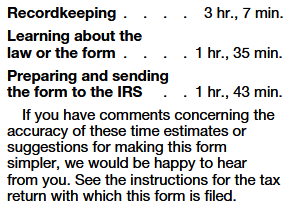
No kidding, they are even open to feedback about it. Brilliant…
4 Likes