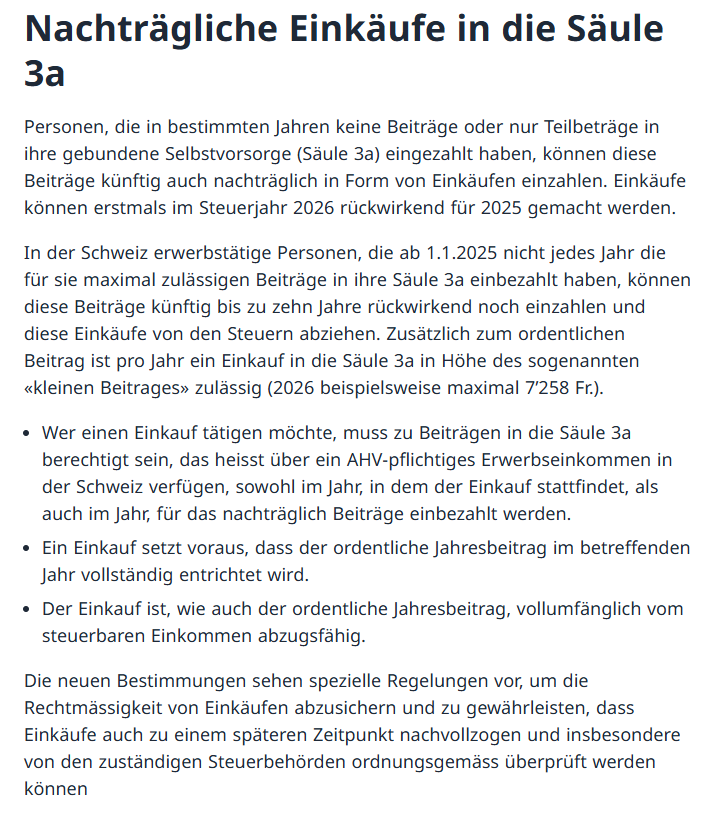
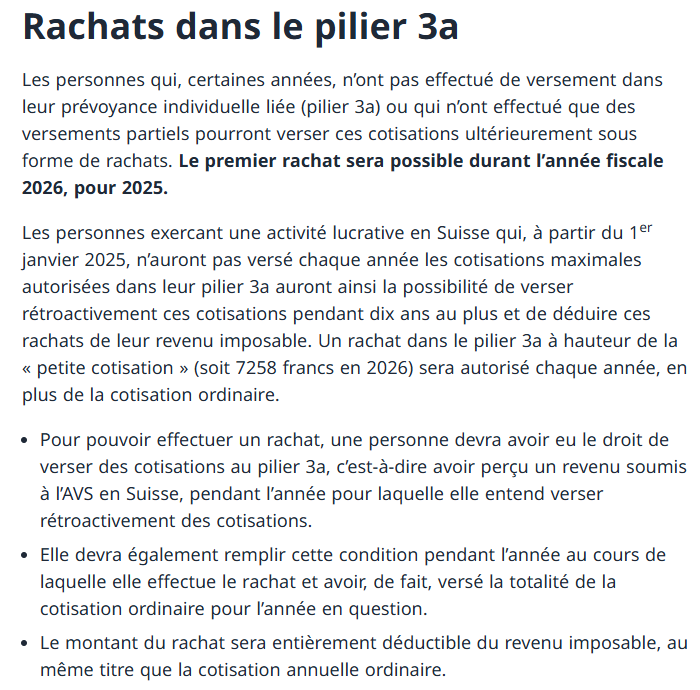
It’s a change of system that requires administrative tracking. The previous version of the law had some beautiful simplicity in that it didn’t require tracking. Checking the tax declaration of the year was all that was required. We have complicated the law and more checks are now required. Making it start only from when those checks have been able to be implemented, that is after the law is in force, seems pretty reasonable to me.
AHV income is a requirement to be able to pay into 3a. I’m not fond of how the Swiss system intermingles the 3 pillars but that is how it is made: they all go together. Buybacks are actually backfills for previous years. The requirement to have had the capacity to buy in in the given year in order to be able to backfill it is consistent with the system (I don’t like the logic used for the retirement system myself but it is the one applied by the parliament and it is consistent doing so).
This is probably for administrative reasons (easier to track) but I agree it didn’t have to be required and the implementation of the law could have been made to allow backfilling on several years.
The internal logic of the system is that when you work abroad, you participate to the pension system of the country where you are working so you can’t simultaneously contribute to the Swiss pension system. I find it logical and consistent.
To note, my remarks are in regards to the consistency of the system and the avoidance of administrative hassle. I don’t think a political right-left line has to be drawn on the topic.
Only one back contribution per year and only once for every backpaid year. Plus full regular contributions in the paying year. Also only 1 year backpaying per year.
I’m not sure I understand your post completely, but it is allowed to backpay multiple years in a single year. As @PhilMongoose asked, you can, in the year 2027, make backpay contributions to both years 2025 and 2026, as long as you:
already paid the max contribution in 2027
were eligible to pay into 3a in the years '25 and '26
Technically, yes, but not as freely as it sounds in your comment. While you’re allowed to contribute to both years, 2025 and 2026, in 2027 (under the conditions you’ve already mentioned), the maximum contribution to previous years is limited to CHF 7’258 per contribution year for all previous years together.
I.e., this only makes sense if you’ve already contributed e.g. 3.6k in each of 2025 and 2026. You can then catch up to the full amounts of 2025-2027 in 2027 by contributing 14.5k.
However, if you haven’t contributed anything in 2025 and 2026, you can fill only one of the gaps (or partially fill gaps in both years but that would be strictly worse as you’re not allowed to back-fill the same year multiple times). In which case it would be better to fill 2025 in 2027, then fill 2026 in 2028 and then you’re all caught up.
The whole point of the pillars system is to motivate people to save for old age. I don’t see the point of artificial limits to a system that encourages good behavior.
Without any limits, there would presumably be too much of a loss in tax revenue. High earners could get by with paying very low income taxes.
I’m certainly not claiming that the system is perfect or that all the limits make sense, however, I don’t think a system without limits would be sensible either.
Maximum income for pillar 2 purposes is somewhere in the 800ks. So anyone with high enough income can already save a ton through buying into P.2
This was more about getting the parliament (which includes the left) and the upper house (viz, Ständerat, cantons) to agree with the motion
Most of what you see now (can only buy in for years after 2025, can only buy in the amount you’d contribute anyway) came out of the “parliamentary process” and not the original initiative presented by Erich Ettlin.
The average amount saved in pillar 3 is quite modest. Making it possible to put larger amounts into 3a will likely benefit tax avoidance by the rich rather than increase pensions saving by the average person.
From the perspective of the left and/or cantons having to deal with budget impacts, sure they can
Remember we live in a democracy where initiatives rarely get turned into law without change; those changes satisfy the stakeholders and achieve a compromise which many related parties can support.
Mit dem Lesen und der Teilnahme an diesem Forum bestätigst du, dass du die Forum-Richtlinien gelesen hast und damit einverstanden bist sowie den Haftungsausschluss auf http://www.mustachianpost.com/de/ akzeptierst.