If you look at other countries, I wouldn’t assess personal (roof/balcony) solar on anything beyond own consumption savings. (Which with a local battery might work nicely, esp when charging cars at home)
Feeding back to the grid likely won’t be an ongoing thing at that scale.
(I think Australia is a pretty good example to look at, in practice people have personal solar+battery, and savings on your own consumption are much more valuable than the small feed in rate)
I thought for some reasons scaffolding means putting new bricks on your roof.
sorry for the missinderstanding. So if my post about this didnt make sense to you, you are absolutely right.
@nabalzbhf yes, own consumtion is interesting. Delivering it back to the grid not. From next year on thy can apply flexibel rates to pay you. So small money at peak production hours. Politics guarantees average of 6rp/kWh for installation singel home size.
The strategy should be to max out own use, I do it with vZEV which is a great tool. Afterwards a bigger battery which can ffed to the grid at night when tariffs are expected to be better. In AT they already have flexible tariffs for consumer. O think this will come also in CH. But first each EVU needs to provide the prices in a JSON file, so that electricity management system can be used to adapt your consumtion. I think there is a deadline end of the year for this
What would these certain shifts be? Got any predictions on energy prices and grid fees for the coming years?
The flexible rates are for feeding into the grid only, right? Not drawing from the grid.
For feed-in, as I understand the minimum fee applies only in comparison to a quarterly reference rate. If that is above 6rp, you’ll face the market prices, nevertheless. Meaning, you will face negative fees if you are feeding in at noon on a sunny summer day.
That aside, you’re absolutely right. If you have a combination of flexible consumption and battery storage, and even a zVEZ with more consumers than producers on top of it, you are well set.
That’s for the normal-size private PV. I think the plug-ins can still pay off after a few years, and the small production can be used easier. Even when a balcony or wall location might not get peak production, it should do well in winter months.
European industrial policy has been very naive. We spend all of our efforts with internal squabbles instead of solving problems.
We had energy dependence on Russian and the shock of the Ukraine war and are moving slowly on this. Iran happens and we still seem unprepared. We have now refined products shortages but still shutting down refineries which will increase vulnerability there too.
The one good shift is that nuclear is being considered again, but with long lead times, I will not hold my breath to see if this comes and even if it does, it will probably be massively expensive.
As for as electricity generation is concerned, renewable (incl battery storage) already won the cost race, and the prices still keep dropping (also you don’t have a permanent dependency on oil producing countries).
We got offers for around 6k CHF for 4 panels without battery or ~10k battery included. I realised quite a bit of those money would go to paying the seller who came in person to our house (and I was totally put off by the “only if you sign now” discount - wise gut).
I think Australia is a pretty good example to look at, in practice people have personal solar+battery, and savings on your own consumption are much more valuable than the small feed in rate
Although this is a bit changing as I understand with the “free energy a few hours every day” plans that are now available there. It’s getting hard to justify installing solar when the majority their production is at a time where you can get electricity for 0 (network costs included).
Batteries are getting much more valuable though.
But this is an artefact of their pricing system. I agree with your point, self consumption is the way to go going forward. Not so much because rooftop solar is cheap, but because distribution costs are exploding and will keep on increasing in the future.
Thats true for summer and the potential for more Solar is huge. Winter is a different story entirely and to make any signficant contribution, solar would need to be massively overbuilt and produce too much in summer (see germany).
Also what I think people seem to forget is to watch the overall energy mix, not only electricity. Pushing transportation, industry and heatings into electricity will increase the demand for stable power sources dramatically. Given the political situation - i dont have much hope for new nuclear powerplants anytime soon.
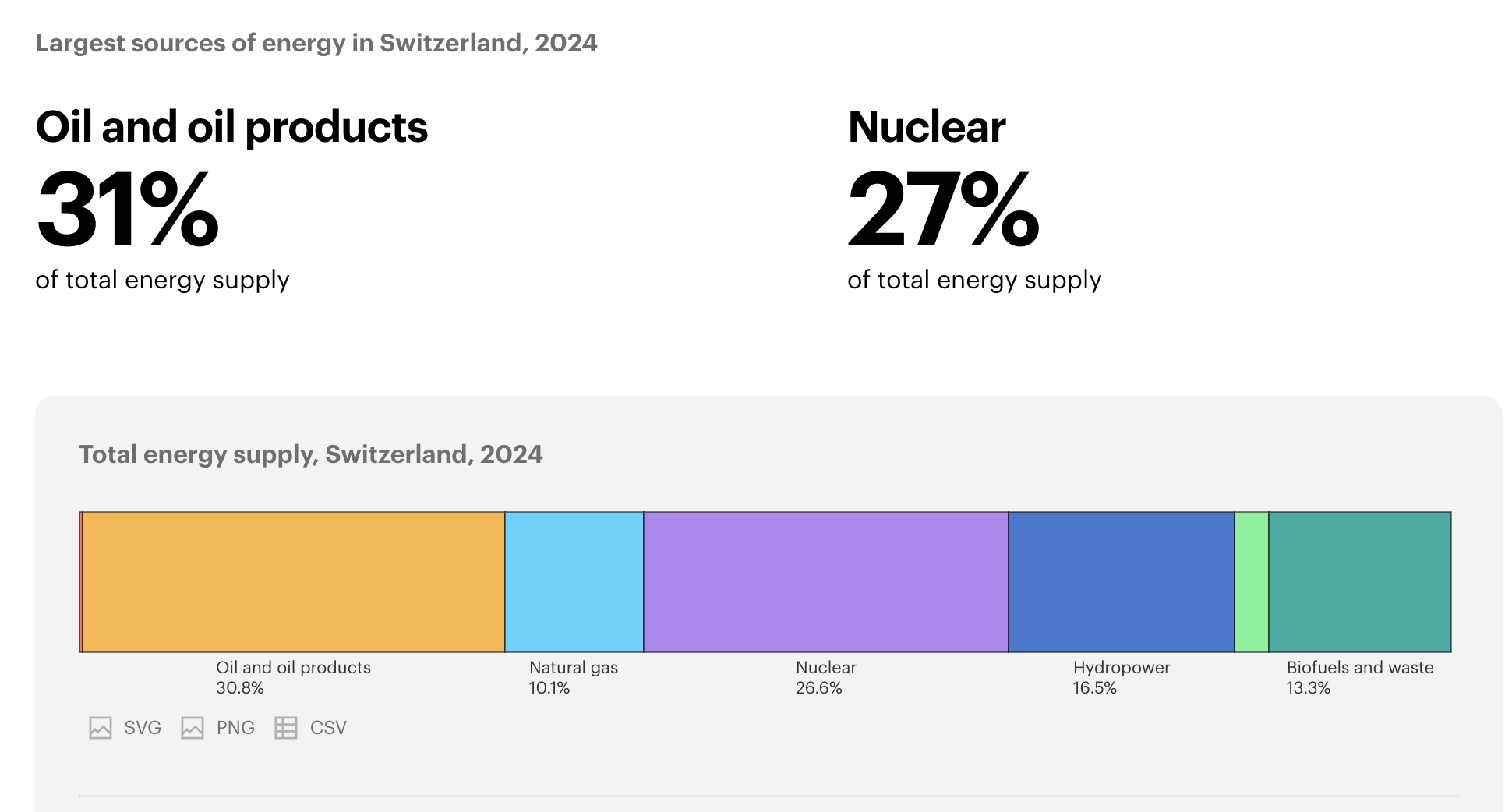
This is 2024 but the picture is not too much different today i’d assume (the small green bar is wind and solar):
In any case with long term storage and other renewables, it does seem viable (and on our latitudes is solar that bad in winter?)
This is total energy, large part of it is transportation (and there are a lot of wasted energy with oil/gas burning that you don’t have when electrifying)
Fair enough, total energy will likely drop. Nevertheless current estimates suggest that switzerland will increase electricity consumption by 50% from 60TWh to about 90TWH in 2025.
I still dont see how this can be reliable compensated in winter when the domestic nuclear capacity vanishes? (Beside hoping other countries like France will lend us some nuclear power).
Only 20% of total solar output in Switzerland is winter (less sun, lots of fog/clouds). Alpine plants are an option but difficult to do politically (see current stalled projects).
Also hydroelectric output is lower as no new water is coming in the lakes. We could do more by capping hydroelectric consumption in summer to have full reservoirs in winter but its limited.
While electricity needs will be about 40% higher in summer. (Source: same link as the other post).
So to cover winter with solar you need to build 5 to 8 time overcapacity from what you consume in summer.
So where is the needed excess winter electriciy comming from?
Kind of is where I live. As Ilpiccone writes, you’d have to go above the sea of fog, and still can’t change the position of the sun. Alpine installations got hyped, but it’s pricey and not very popular among locals, tourists, environmentalists, mountain livestock farmers and those generally not in favor of trying new things.
Current subsidies kind of address the winter issue by favoring installations above 1500m and at steep angles, as well as more dynamic pricing.
Anyway, no one seriously claims there’s a single solution. Not many alternatives to continue to add more and more storage solutions, incl. the whole power-to-x thingies that might eventually take off, imports and of course trying to lower demand in the first place.
Current laws aside, and politicians talking, is there a single utility interested in building them, without massive public guarantees and subsidies? Even then, current gen or next gen, wouldn’t it take decades?
Well, by then at least the repository for the waste might be operational and the generations to come can take care of that
Sure, solar in summer is much less expensive than power from a nuclear powerplant. But what are the costs of potential blackouts? And how much are we willing to pay for insurance against it (self controlled not imported)?
There has been quite some progress in the last 80 years. Nuclear waste is not an unsolved engineering or technical problem, but a societal and political one.
Waste long-term geological storage is proven doable in inherently save at the right locations (finaland Onkalo, France Cigeo, Switzerland - Lägern (policatlly not cleared). while it may take 100’000 years to come back to background radition levels, 99% of the radioactivity dicipates in few 100 years under ground - geologically thats nothing but hard to comprehend for our time dimensions.
Given advancements in technology, the solution might not be storage but actually reusing used fissile material. Fast breader, reprocessing, thorium etc.
I find it remarkable that Switzerland confidently operates the oldes operational reactor in the world (beznau 1) (as the energy still deemed necessary) but completly stalls when it comes to even consider building modern alternatives.
Not saying its easy and without any risks (what is?), but given the favourable C02 profile and the energy safety we can simply not ignore it, IHMO.
But i guess we are deviating a bit from the original thread
Well, the more you overbuild, the more expensive the actually useful electricity gets.
If you only use the 20% generated in Winter, CHF/kWh is x5 the “sticker” price.
As you keep on overbuilding, the worse it gets, asymptotically so.
We’re most likely not there for a while, because I believe we haven’t even closed the “summer evening” gap yet, which solar + batteries should easily be able to cover.
But winter will remain an issue.
At some point, the reality is that you need either some reliable (“base load”) or dispatchable energy sources to cover the “low” periods. That energy source will by necessity be very expensive (because on the non-CO2 emitting reliable we essentially only have nuclear we can expand, and for dispatchable utilisation rate will be dreadful).
So, from a grid production perspective, whatever approach you take will need to be subsidised if you want to match production to consumption 24/7/365. (The alternative is to force consumption to align to production via prices, it works up to a point, but when it starts reaching “people cannot afford to heat themselves” it’s a no-go.)
isn’t that more complex? PV is really really cheap, the price of electricity is usually the price of the marginal kWh (which is typically not coming from solar but at peak demand is currently coming from peaker plants / abroad, in the future battery and other storage system will likely smooth a lot of this out, similar to how the duck curve is disappearing in California/Australia in the past few years).
And having surplus is probably not an issue (I suspect we’ll figure out how to use “free” energy soon enough (e-methanol production, long term energy storage in various way, doing more energy intensive industrial processes in summer, etc.)
In any case found a nice whitepaper from eth on that topic
We probably have to assume that similar to now, CH won’t be self sufficient at every day/hour of the year, but with connection to neighbouring grids (and CH utilities are investing in renewable such as wind farms abroad as well), that is likely doable with 100% renewable / battery (short/long term) / hydro (incl. storage)
Mit dem Lesen und der Teilnahme an diesem Forum bestätigst du, dass du die Forum-Richtlinien gelesen hast und damit einverstanden bist sowie den Haftungsausschluss auf http://www.mustachianpost.com/de/ akzeptierst.