Not from “the West” I take it? I am Greek so not really either, many people lost their socks in the stock market in 1995-2005 and investing is still considered the premise of “crooks, scammers and insiders” by many.
For ETFs to “disappear”…it’s nearly unthinkable if you get any of the ones you’re likely to come across as a new investor, for the assets to “disappear” it’s a zombie apocalypse scenario. Either way there’s no other way, you need to take on some risk if you want some returns. More plainly: your money needs to be working for you, as a new one myself (merely three years in), the most important learning I got is that I won’t ever leave money idle ever again.
If I were you I’d focus on the basics: clearing of any short-term debt, emergency fund, (3A, if you don’t have it, never with an insurance company), DCA over a year in an all-world fund. You have a substantial amount of money (yes, it is!) so it has good chances of getting something great out of it in 12-15 years.
I think its important to be aware what the goal is and also a number you target…
You plan to retire, think about what your expenses will be and how much money you will need. Do you want to leave nothing or a significant amount. This matters greatly to the amount you need at the beginning of retirement.
Then see what you have in savings, how much you plan to save and what is the gap.
If the gap is tiny, you can take less risk and have a higer chance of success.
The larger the gap, the more risk you need to take and the lower your chance of achieving the goal.
If you go for a large allocation to stocks (more risk), make sure the plan is clear what you do in downturns. Write it down. Store the plan safely and take it out when the market drops and you get nervous.
I would personally go all in on a broad market index fund, like VT and not touch it until retirement.
Put as much savings in every month as you can.
Theory suggests a lump sum investment beats DCA, but then again thats a matter of risk tolerance.
Also, small allocation to gold, bitcoin, real estate funds, etc…can make sense to diversify the risk profile.
Actually i think that’s not the worst idea for most people.
You need to be very eager to get into the details and take a lot of time to take care of the finances yourself.
Everyone goes to the hairdresser to het a haircut, calls a plumber to get the water fixed, etc. But for financial decisions a lot of people feel like the need to do it by themselves. I dont understand that.
A good advisor will help to avoid a lot of mistakes. And compared to us random guys on a forum, they are liable for the recommendations they give.
I just wonder, how does a Swiss investor invest if he has a lower risk tolerance, so not 100% equity? Bonds and savings interest are really low (0-1%) in CHF so makes it less attractive. In other currencies, at least you get some interest so an allocation to bonds for USD or EUR investor makes more sense, but in CHF less so. For example 60/40 doesn’t seem very attractive when 40% is basically just cash. Also when this investor looks at his investments and sees his equity down 10-30%, investor might not think that lower risk allocation really is lower risk?
100% stocks allocation is well managed by very few because a big drawdown would make anyone panic. So non-stock portion should be expected to be very low “real” yield but it’s like a cushion. So 40% drawdown on stocks will result in 24% drawdown at portfolio level for 60-40.
For Swiss investors it’s always a challenge (psychologically) because it looks like bonds are not making any sense as yields are close to zero. With very low yields cash could be very close (but still lower) in returns indeed.
I think pension fund contribution as suggested by @PhilMongoose could be a good option because it kind of protects you against the taxes & investment costs of bonds
Another option could be Direct RE Funds but they can be very volatile in short term.
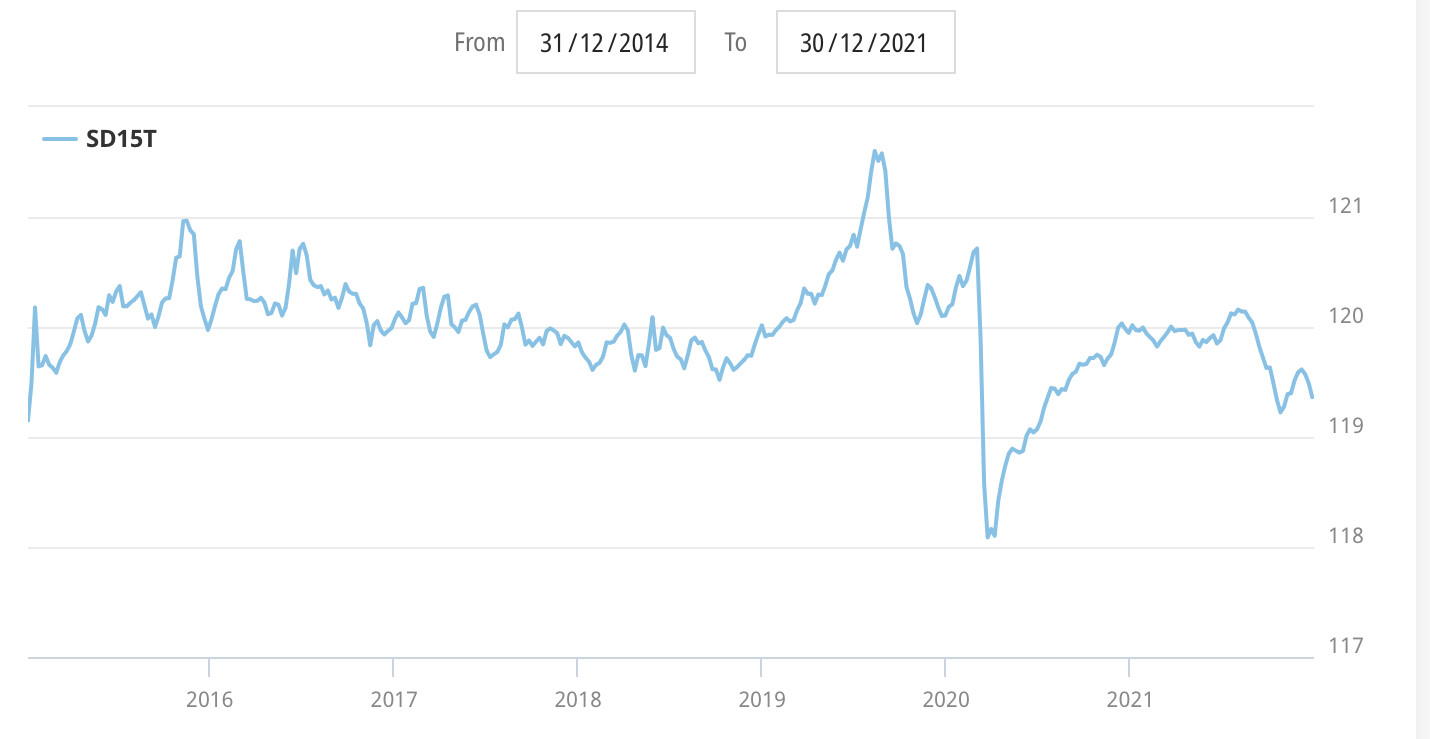
Return of SBI AAA-BBB 1-5 TR
I picked the period when interest rates were negative to see how this index returned. The index returned 0% during this 7 year horizon. However this is the index, so you need to account for TER% of funds on top & income tax on any coupon payments (if there were any coupons)
You’re right, and that’s why I highlighted talking to an independent advisor instead of an “advisor” employed by a bank who has all the incentives lined up to sell you the bank’s products.
https://finfinder.ch/ seems to be a platform to find independent advisor (can’t vouch for it, just came across it in an article).
Exactly. And I believe in all but the last drawdown bonds actually went up when equities went down (which – if you have those nerves – allows you to buy equities when they’re cheap with dry powder in a keg that just got bigger).
I’m not familiar with Swiss bond funds (I bought the Global Agg at the time when I started with 60/40), but wouldn’t you get more attractive bond rates with (high grade) corporate bonds? Nobody said that the bond portion needs to be (Swiss) government bonds, or even Swiss company bonds.
Anyway, circling back to the question by the original poster, this is to me the kind of discussion that causes the analysis paralysis in a new investor … so many different options – no pun intended! – how the heck do I start investing …
I read somewhere (on LinkedIn I think) that they opened the doors last year and now accept many more types of financial coaches. Also commission-based and those from insurance companies. Certainly suitable for searching, but I would be careful. In my region, for example, the advisors mainly come from AXA (who are then likely to sell you a life insurance policy…).
That’s true 2022 was one of those years when everything went down but I think it’s because of last drawdown was not caused by recession. It was caused by serious interest rate hikes to cause a slowdown
While it’s harder psychologically, it’s actually better tax wise (less money lost to taxable income), given you might expect the same long term return in various currencies.
Mit dem Lesen und der Teilnahme an diesem Forum bestätigst du, dass du die Forum-Richtlinien gelesen hast und damit einverstanden bist sowie den Haftungsausschluss auf http://www.mustachianpost.com/de/ akzeptierst.