For a big trade you can do direct NAV trading with the broker.
1 Like
What does the broker gain by offering NAV Trading?
Bigger fees usually (EMEA desk for ibkr is 1.5x the commission).
1 Like
What exactly it means? And is this something that can be done online?
It was discussed here: Trading Large Amounts Relative to Daily Volume – Strategy
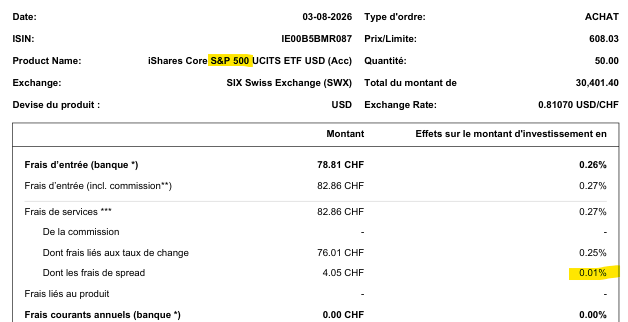
Out of curiosity, I just had a look at the most typical S&P 500 ETF traded on SIX in USD at a time when NYSE is closed.
The spread is as low as it gets: barely noticeable and certainly not higher than VT’s or other large US-domicilied funds. I am confident that for mainstream products on regular business days, SIX works pretty well.
Happy to stick to CHF-traded products though 
3 Likes
Did you find out more about this? I also find it strange that the new ETF (a more complex product based on an index they have exclusive access to and that is considered the gold standard in terms of diversification) has half the TER of their established product, which competes against 3 other companies offering identical ETFs for the same index.
Not really.
I am not investing with US fund houses these days , so didn’t bother to research more
I wouldn’t be surprised if VWRL would also see a further price cut . Or else it wouldn’t get new inflows
2 Likes
Guaranteed it‘s to keep the higher revenue of the capital gains locked-in investors, while staying competitive to new low-cost offers like WEBN/XALL.
They don‘t need new inflows, when those then go to the new product.
It‘s mire profit to keep the older product at higher cost.
4 Likes
Sounds realistic. iShares newly launched ETF suddenly looks overpriced with their 0.12%, especially with Xtrackers’ offer with 0.07%. And Invesco, a few months ago the only alternative to Vanguard’s FTSE All-World, while being a third cheaper, is now the most expensive of them all, with more than double the TER of Xtrackers.
1 Like
Who’s going to switch products for a 0.07% annual cost saving when they’re paying capital gains tax on that?