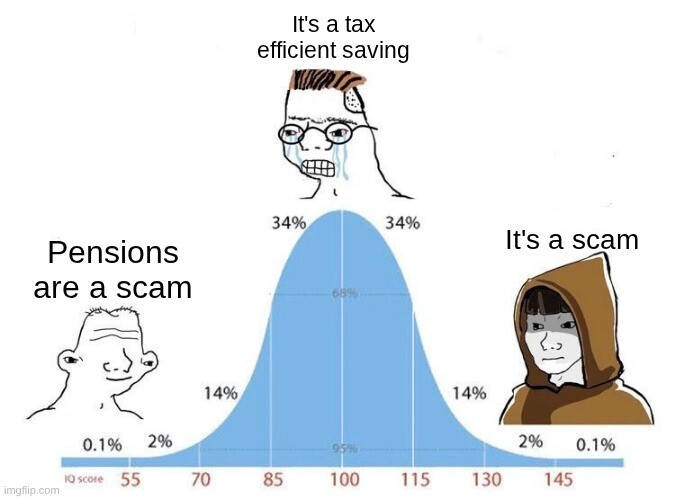
Yeah, me, too.
Does it surprise you that in 2022 37% of new pensioners chose to withdraw their entire savings as a lump sum, with another 19% choosing a combination.
I’m kind of flabbergasted that almost 4 out of 10 new pensioners have (a) enough money to lump sum retire on it and (b) apparently (think they) know how to live off that sum for the rest of their life.
Another 2 out of 10 take a partial lump sum – world trip? – and then a pension for the rest.
I’d almost bet on there eventually – and rightfully – being future legislation on regulating who and how much can be lump sum withdrawn once the numbers of lump sum pensioners requiring Ergänzungsleistungen will show up in the stats and the newspapers.
The arguments in favor of it are already being made (see below).
This risk (IMO) to savvy investors like the ones on this forum (excluding Goofy, of course) is that such regulation will overshoot, some political parties (I won’t mention any to not further anger our Dear Leaders on this forum) will absolutely pound the table that it can only be pensions, and with an at least 6.8% conversion rate both for mandatory and non-mandatory pillar 2, and … ok, I’ll stop here.
The numbers are pulled from this article: Für steigende Ergänzungsleistungen ist gesorgt | Schweizer Personalvorsorge
English summary:
The article, “Für steigende Ergänzungsleistungen ist gesorgt” (Provision is made for increasing supplementary benefits), from Schweizer Personalvorsorge (Swiss Occupational Pensions), discusses the significant and rising trend of Swiss pensioners opting for a lump-sum payout (capital withdrawal) of their occupational pension (BV) instead of a regular annuity (pension).
The core argument is:
- Rising Capital Withdrawals: A record high of 37% of new pensioners choose to withdraw their entire savings as a lump sum, with another 19% choosing a combination.
- The Consequence: This short-term “privatization of advantages” leads to a long-term “socialization of disadvantages.” By consuming their capital early, many retirees will eventually deplete their funds.
- The Outcome: This will cause a sharp increase (“explosion”) in future applications for Supplementary Benefits (Ergänzungsleistungen), placing a growing financial burden on the general public and the younger generations, as the state must then step in to ensure a guaranteed minimum standard of living.
- Underlying Issue: The dominance of the defined contribution system (Beitragsprimat) in the second pillar shifts the long-term risk (including inflation and longevity risk) onto the employee, making a lump sum withdrawal more tempting but ultimately riskier for society.
English translation:
This is the full English translation of the article “Für steigende Ergänzungsleistungen ist gesorgt” (Provision is Made for Increasing Supplementary Benefits), published on September 17, 2024, by Roman von Ah in Schweizer Personalvorsorge.
Provision is Made for Increasing Supplementary Benefits (Rising Capital Withdrawals from Occupational Pensions)
37 percent of newly retired individuals choose to withdraw their retirement savings from their occupational pension (BV) as a lump sum. This is an unprecedented number. Another 19 percent choose a combination of pension and capital (FSO 2022). Future applications for supplementary benefits will explode. But let’s take it step by step.
In the Defined Benefit (Leistungsprimat, LP) system, pension fund annuities are defined relative to the last insured salary. This offers high security for the insured. Together with the AHV (Old-Age and Survivors’ Insurance), the accustomed standard of living is adequately guaranteed, and inflation is also taken into account. However, financing the LP is demanding and heavily burdens employers. It is no surprise that they have mostly abolished these risks.
Defined Contribution (BP) Provides Insufficient Pension Coverage
The Defined Contribution (Beitragsprimat, BP) system, which dominates occupational pension provision, is the response to the risk avoidance practiced by private and public employers in the LP (while the performance goal in the original message for the BVG compulsory insurance in 1975 was still formulated in the spirit of the LP, the BP found its way into the proposal during parliamentary discussions). The accrued retirement capital multiplied by the conversion rate (UWS) defines the pension. Theoretically, the BP can generate similar benefits to the LP, but this rarely happens in practice. In the BP, the pension risk shifts to the employees.
Clash of Interests in the Sphere of Socio-Political Solidarity
In 2022, 13 billion Swiss francs were paid out as lump sums—15 percent more than the year before and 120 percent more than ten years ago.
The relevant narrative of the financial service providers is as follows: The trend towards capital withdrawal is no coincidence. Anyone with the necessary financial leeway often concludes that withdrawing capital is the more attractive solution compared to the annuity. This attractiveness includes flexibility, the possibility of fulfilling long-held (consumption) wishes, a lower tax rate, higher-yielding investment opportunities, and the inheritance of unused retirement capital.
Who Benefits from Capital Withdrawal?
1. Pension Funds
Pension funds benefit doubly from capital withdrawals: Firstly, the longevity risk disappears from their balance sheets; it is passed on to the pensioners who withdraw their capital. Secondly, the surplus coverage of benefit obligations (funding ratio > 100%) remains pro rata with the pension providers; it is not paid out upon withdrawal.
2. Financial Service Providers
The withdrawn capital is, in the best case, reinvested. Individually provided investment advice or asset management is likely 4 to 6 times more expensive than that provided collectively in the competitively organized 2nd pillar. No wonder capital withdrawal is heavily promoted.
3. New Retirees with Low Life Expectancy
Those who expect to die prematurely (in the left half of the mortality distribution) benefit from capital withdrawal (“negative selection”) at the expense of the collective.
Is Society Being Duped by Capital Withdrawal?
Life expectancy is constantly rising and is around 82 (men) and 85 (women) years. Many people expect to live longer. Healthy pensioners should plan for at least 25 to 30 years of remaining lifespan.
Private longevity risk hedging (LLR) is unlikely to be possible for 90% of the Swiss population. Anyone who thinks that withdrawing capital will improve their financial situation in old age underestimates the high cost of annuities. Furthermore, coping with additional expenses and/or leaving inheritances to descendants misunderstands the challenges.
Once the withdrawn capital is used up, unforeseen expenses, illnesses, or costs for old age/nursing homes quickly become millstones around one’s neck. The AHV does not save people from drowning; applications for supplementary benefits certainly do.
The privatization of advantages and the socialization of disadvantages occur at the expense of the general public and on the backs of younger generations.
Roman von Ah concludes:
Capital withdrawals, if permitted at all, should be strongly limited. One approach could be to allow partial capital withdrawals only if the annuity from the occupational pension amounts to at least 50,000 francs per year.