This video is a recording of the Fundsmith Annual Shareholders’ Meeting held in February 2026. Chief Investment Officer Terry Smith and Julian Robins provide a detailed review of the fund’s recent performance, their views on the “AI arms race,” and why they are sticking to their core investment strategy despite recent challenges.
Performance and Portfolio Review
Performance: Terry Smith describes the last 12 months as “poor” [02:28]. However, he emphasizes that the fund remains committed to its long-term strategy of investing in high-quality companies rather than chasing short-term market momentum [04:13].
Top Performers: Alphabet (Google), IDEX, Philip Morris, Meta, and Microsoft were the strongest contributors [04:36].
Detractors: Novo Nordisk was a major disappointment due to poor execution in the US market [06:15]. Other detractors included ADP, Church & Dwight, Coloplast, and Fortinet [07:50].
Portfolio Changes: The fund sold out of PepsiCo and Brown-Forman [11:56] while initiating or increasing positions in Intuit, Zoetis, EssilorLuxottica, Wolters Kluwer, and Magnum Ice Cream (spun out from Unilever) [12:01].
The “AI Arms Race” and Market Concentration
Speculative Bubble: Smith argues that the current AI-driven market is one of the largest speculative crazes in history [43:04]. He compares it to previous technological booms (railways, dotcom) where the ultimate winners were not clear at the start [44:05].
Capex Concerns: The fund significantly reduced its holdings in Microsoft and Meta due to concerns over massive capital expenditure on AI [53:34]. Smith questions how these companies will generate the incremental cash flow needed to justify spending hundreds of billions of dollars [54:01].
Passive Investing: Smith warns that the shift toward index funds has created a “momentum strategy” that artificially inflates the prices of a few mega-cap stocks like Nvidia [13:36].
Investment Strategy and Outlook
Sticking to the Plan: Despite underperforming the index, the fund continues to focus on three steps: only invest in good companies, try not to overpay, and do nothing (minimize turnover) [23:10].
Valuation: Smith notes that for the first time in the fund’s history, their portfolio companies are now cheaper than the S&P 500 on a free cash flow yield basis, despite having higher returns on capital [26:09].
US Dominance: The fund remains heavily weighted toward US equities (approx. 70%) because the US remains the deepest capital market for the high-quality healthcare and technology sectors they favor [01:12:08].
how does that compute, that they are cheaper with better companies, yet they massively underperformed the same index? or the “passive investors” are skewing the index upwards?
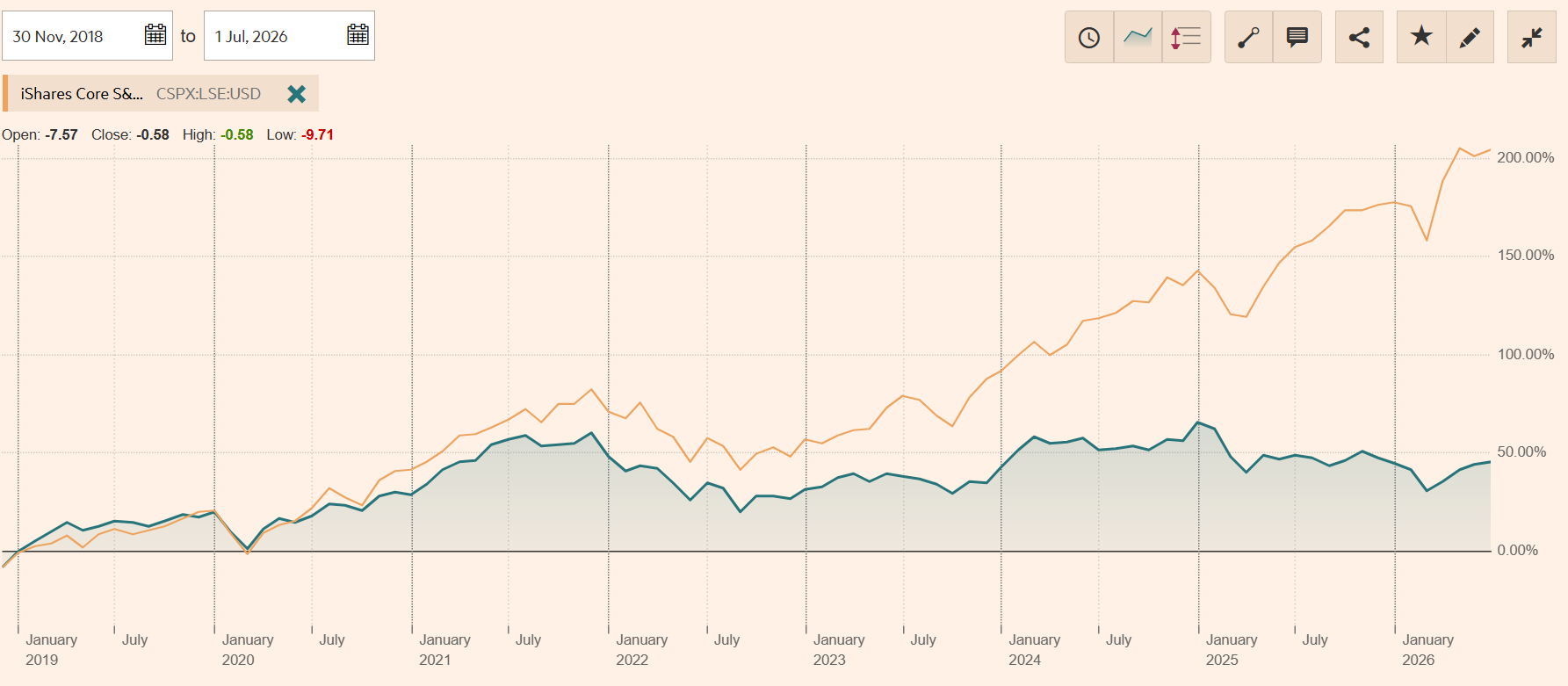
The chart contradicts yourself. It has brough about market returns for the first three and a half years. The substantial underperformance is in the last one and half.
Have you successfully done that though? Funds wouldn’t accept my Wise account (at least telling me that on the phone) for being a non-bank, and requested providing a reason for providing an account not in my home country.
The stock market doesn’t necessarily reflect companies’ profitabilities over the short to medium term.
I don‘t invest in Fundsmith, and never would. But still, what he writes and his performance talk in his favor. If I was invested, I would probably double down.
Just a few remarks:
S&P 500 is not the right benchmark for Fundsmith, FTSE All-World is
His performance was in accordance with the benchmark, or eveb better, until about 2.5 years ago
During a bubble, you EXPECT quality investments to signifficantl Fall below of Market Cap
What matters is what happens once the bubble bursts; Fundsmoth will go down with anything else - simply because in a real crash, all correlations go to one. BUT, whilst the Market will crash 50-80%, his investments will find a floor maybe 5-10% points higher (so. 40-70%). But THEN - Fundsmith will recover much faster and beat the prior all time high in 2-3 years, whereas Global Market Cap will need 7-10 years to recover.
The only question is if his open end fund will survive aka still have enough investors so that it was around 2-3 years after the crash. But he seems to be VERY aware of that risk. Now the question is of he finds a way, and had the stamina, to adress this risk. Worst case, he goes either closed end fund (which was ok) or private (which was a Problem for us ordinary investors)
Finally got rid of my whole Fundsmith position and guess what I bought instead… call me crazy but I got 1 Lindt & Sprüngli stock. Eager to see it beat Fundsmith over the next years If it tanks I can always cry over my well deserved but outrageously expensive box of Swiss chocolate from the “world’s leading premium chocolate manufacturer” (as they so nicely say on their website)
Joining the club since last week.
Got sick of moving nowhere after several years (bleeding 1% or whatever of fees), coming back to my “passive”-only principle, and consolidating line items to manage.
Honestly, if they’d just kept quiet, I probably would have done nothing. But they issued their big Mea Culpa and so I looked at what they were doing, didn’t like what I saw and sold up.
I saw they were selling what I was buying and buying what I was selling. And they were making judgements on SaaS/AI while showing they had very little knowledge in that area.
Exactly. I recall asking myself why they didn’t buy Facebook many years ago because it was obvious they had a digital advertising moat (alongside Google). Terry was actually asked this question and he deflected it as he does so well… fast forward a few years and he buys Meta. Clearly he did not understand the “internet businesses” well enough at the time. I sold my position some time ago as well
For me the main reasons are that in the mean time they have now 70%+ in US stocks which wasn’t the case when I started with them around 5 years ago and the total change of strategy this year which looks more like a change of strategy due to under-performing compared to other indices than anything else. In other words they went against their “do nothing” principle.
disappointing to see such a boat sink… I’m on the verge if I should finally dump it from 5yrs ago, still at a cumulative ~+25% which is a shame for “performance”.
To serve some defense as well - it was NEVER negative balance in the last 5 years against the opening price, so at least it was a good defensive buy.
I sold around at 10% cumulative profit but it had better times where it was around 20%. Recently it more at 0% though…
Well the “new strategy” for me looks like pretty much like dump most of the actual stocks and swap them with others hopefully performing better so changing from a “passive” investing style to a more active one. On this topic this recent video was enlightening for me (and you don’t even need to watch it all):
See for example the do nothing slide at around 15m and look at the stock swap increase since 2025.
Mit dem Lesen und der Teilnahme an diesem Forum bestätigst du, dass du die Forum-Richtlinien gelesen hast und damit einverstanden bist sowie den Haftungsausschluss auf http://www.mustachianpost.com/de/ akzeptierst.
 or the “passive investors” are skewing the index upwards?


 If it tanks I can always cry over my well deserved but outrageously expensive box of Swiss chocolate from the “world’s leading premium chocolate manufacturer” (as they so nicely say on their website)