According to the table of @PhilMongoose it’s still a crash. So most of us already experienced a crash. Still, 2022 probably had little to no impact on our investment strategy, at least for me. If anything, it was a cause to invest even more heavily in equities.
1 Like
The point is that this crash was not too big and most importantly not long lasting.
I strongly believe that most of us will really not survive a “lost decade”.
2 Likes
Lost decade- that was also part of why I started this thread
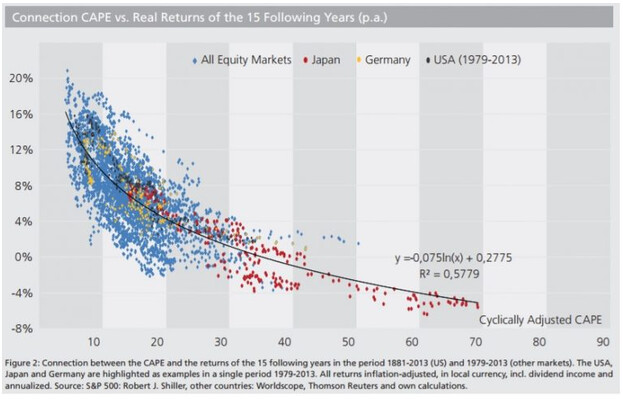
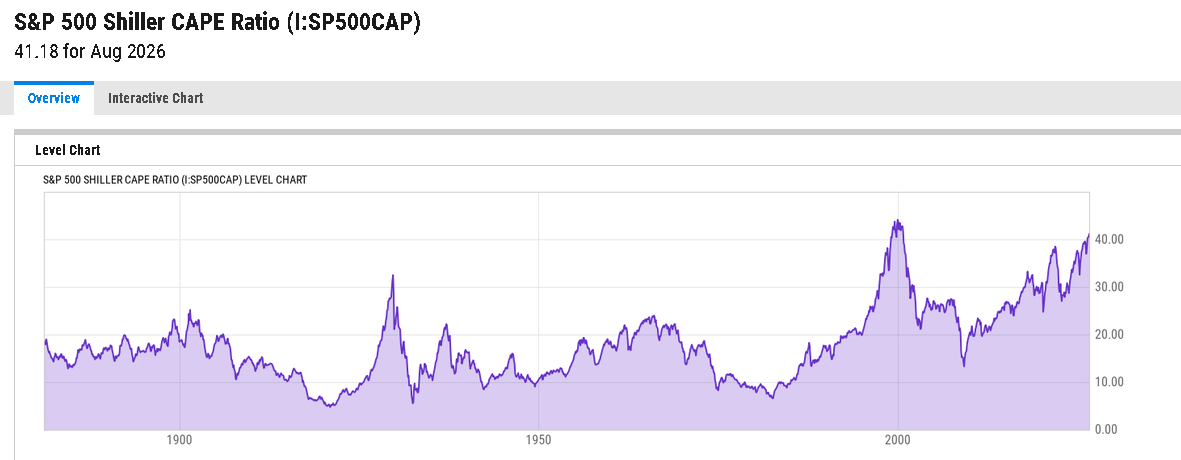
Looking at current US CAPE and how that usually correlated to 15yr real returns afterwards.
So, if that holds, then we will see weak returns in the US for quite a while.
And that relates to my other thread- US TIPS (Treasury Inflation Protected Securities). The 2041/42 (also 15 yrs) will pay you real returns of 2,6/2,7% guaranteed. But at the moment, nobody seems to care.
I’ve been through all the bubbles since dotcom. Covid really was quite different and, as a market crash, didn’t feel bad at all.
3 Likes
I’m wondering what happens if Fed/Treasury suppress yields and we end up with nominal asset price growth but negative real growth due to inflation and collapsing value of the USD?
I had looked into TIPS a while back but wondered if they would really protect in real CHF terms?
In the end, I figured buying gold/commodities and borrowing long term fixed debt against real assets might be an easier alternative.
1 Like
I sold two properties in 2021, which cumulatively was about 30% of my overall net worth and about 90% of my liquid assets (as cash), let’s say approximately 10 years of accumulated wealth.
Then it went about 30% down on IBKR in the next years, which wasn’t fun to watch, losing about one year of accummulated savings getting “eradicated” every couple of months… but I kept telling myself that compounding is going to bring it back and I need to stay invested and I kept cautiously buying.
I’m approximately 65% up on my IBKR portfolio since then on profit alone, so - not complaining. Had I just dumped everything to VOO it would be higher by now, but hey, one needs to have some learning with stock picking too. 
3 Likes
You can still rotate to currency Hedged ETFs + Gold exposure.
I guess income is another way to avoid the selling issue. If you have income stream from rental/dividends, then you can meet some/all of your post-retirement expenses from that and so reduce/eliminate the need to sell.
1 Like
correct, it’s very different pre- and post-retirement.
If your assets are covering your spending needs (either by rental yields or divvies), all good. Otherwise you see a cash pile evaporate, which still needs selling to cover your expenses. That’s a hard mental model I’m hoping to avoid in about 10 yrs when I’m due.
1 Like
How do you plan to avoid it?
I guess even if it doesn’t fully cover, if you have income, it reduces the amount you need to sell down.
My current thinking is passives (RE rental yields and dividends) plus “term money” or whatever it’s called proper. Bonds that pay “no matter what”, basically a very-low interest cash solution between intended retirement and when 1st pillar, 2nd pillar, 3rd pillar kicks in.
I intend to stop working well before 60 so I need a glide with absolut(ish) certainty for about 5-10 years (depending), in case I wouldn’t have an actual income. My passives will give me approx 50% of current needs, I will need about 50% more to covered the month.
The question is the opportunity cost of cashing out a good portion of the assets and getting them paid down into a “cash vehicle” for the sake of no risk of said payments, vs riding the whatever-wave in the stock market and seeing your asset pile grow or shrink while selling monthly without batting an eye.
2 Likes
As long as the companies invested in don’t meaningfully cut their dividends, ofc they are.
My assumption is that if I have investment time horizon of 30 years over my life, I would experience a 50% crash at least once.
Don’t know when but probability based on history is 100%. So let’s hope I am odd one out but we need to be prepared
Well. Investment strategy shouldn’t change with a crash. Investment strategy should be to ride the crash whenever it comes
So I don’t think we need to necessarily change anything. But I have to say the tolerance for crash reduces as the portfolio size to annual income ratio increases. Because the brain starts thinking about capital preservation rather than capital appreciation
3 Likes
@stojano dare to share ? 
I guess it depends on what you include as an investment strategy. For example, if you kept more cash because of the fear of upcoming crash, you can invest this cash after the crash.
I had several “busts”. Today, I just don’t care anymore.
What was your biggest drawdown in mutiples of annual income at the time?
- <1
- 1-2
- 2-3
- 3-4
- 4-5
- 5-7
- 7-10
- 10-15
- more than 15
0
voters
Would be great to get some more votes on this one. Actually suprised so far
Maximum drawdown was 32% between February-March 2020 on the equity portfolio only.
Or approximately 10% on Net Worth.
I’d say 90 votes is an extremely good sample in my opinion, shows a very active forum, and it shows that there’s a varying degree of depth of time investing, as well as most likely different investment strategies used by members, because “VT and chill” hasn’t had a 20-30% drawdown in what, 15+ years yet 35 voters experienced it - so either they’ve been investing for longer, not doing VT+chill, or both.
My own maximum drawdown was in 2022, I think around 20% (don’t even remember looking at it), but I only started investing in Jan '22, barely any skin in the game either, 20k, so I am total newbie in this. The other bumps around Trump I don’t even consider.