Just to be sure. Are you a Swiss resident ?
I have this fund but never received such message. But I also didn’t try to buy it lately
Just to be sure. Are you a Swiss resident ?
I have this fund but never received such message. But I also didn’t try to buy it lately
This month, I will finally begin diversifying into RE, with the goal of it reaching ~10% of my portfolio at some point. I’m still undecided if I should go for DRPF or use an ETF based on the SWIIT index…
What motivated people here who own DRPF to invest in it instead of going the passive way?
Passive includes lot of indirect funds too. They are less tax efficient
I tried to simply buy few direct funds and avoided passive due to this reason. I don’t own DRPF anymore because I feel for some reason it’s very much hyped after it was decided to not include in the merger
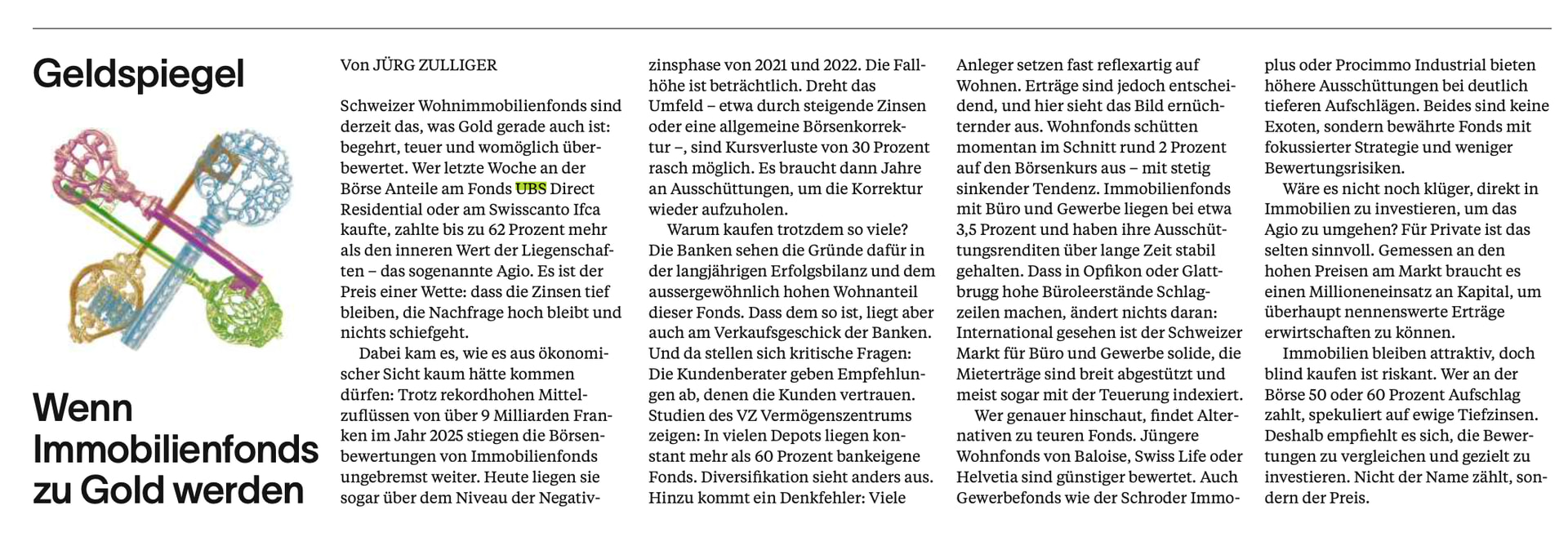
Same here. I don’t own DRPF anymore. The Agio is above 60%. Was also explicitly called out in an NZZ article the other day:
There are more reasonably priced ones - see list of swiss real estate funds (both direct and indirect) here: https://media.mvinvest.ch/immolisten.pdf
There’s a PDF with all real estate included in the fund. It’s cool to see “my own property” in real. Also, dividends & value are almost tax free and the fund performs good.
Yes, the agio is high, so only a minor part of my portfolio. Waiting for the dip.
2025 was a year to reduce such investments for me, because of the valuation, but also to get closer to my target asset allocation
I sold the rights of subscription for one fund in 2025
I sold some shares and the rights of subscription for an other fund in 2025, after selling rights of subscription in 2024
I sold progressively all my shares in a 3rd fund during 2025
I sold progressively all my shares in a 4th fund during 2025, after selling rights of subscription in 2024
Most big residential real estate funds have high agio CSLP, ERRES etc. But yes DRPF is even higher . Don’t know why
Nevertheless I try to look at the distribution yield rather than the Agio and even there DRPF is on lower side.
What would you consider « the passive way » for real estate ?
All publicly traded RE weighted by market cap.
In other news- legal challenges to the merger of STA, HOSP and CSLP have been rejected. Spread closing nicely. Still a few % points on the table. HOSP and STA jumping. HOSP still about 2% cheaper than the rest
I thought I asked this earlier but couldn’t find the answer. So just asking again
How exactly to declare the purchase of units for these funds when participating in capital raise plan?
These transactions don’t show up as buy trades in IBKR reports. There is something about them in corporate actions but they don’t look like „buy“. They have subscription, merge , etc etc.
I am asking because the number of positions at end of year is exceeding the number of buy trades and hence they need to be declared. I was thinking of declaring as „buy“ and then adding a comment „ x shares bought via capital increase“. But wanted to ask if there is any other special way to do so
I don’t find any specific option in ZH PVT tax form.
I used buy, they don’t care about the details anyway.
buy the etax report & chill ![]()
I wouldn’t mind paying 50 CHF but I don’t feel comfortable handing over personal data to 3rd party apps like datalevel.
Datalevel also does the tax report for Saxo. So if someone trusts saxo, he/she trusts datalevel.
I think datalevel might have given their tech to Saxo to create these reports rather than Saxo shipping investor data to datalevel. Isn’t it?
Does anyone know if NAV of Direct real estate funds in CH are calculated using market value of underlying properties or Discounted cash flow calculations for rent, costs and rent projections?
They are using the market value… which is based on a DCF model. These are big properties so they are valued as a investment
Given the agios situation of direct residential listed funds, I am looking at smaller unlisted funds with upcoming capital raise.
Paying a 30-60% liquidity premium for listed funds isn’t worth it when you’re looking for a long-term investment. Moreover, I am hearing that unlisted funds aren’t that illiquid anymore these days. A small shareholder can find a buyer in 3 to 6 months easily.
Also, I feel like all unlisted funds have the ambition of growing and getting listed in the medium/long term. Of course no guarantees but if this happens you get liquidity and potentially an Agio “bonus” if interest rates remain low.
Last, small funds usually have a more aggressive approach with more leverage and/or targeting more niche markets outside of tier 1 cities. Which fits my risk profile for RE better.
I am seeing 2 funds with an upcoming raise:
Both of these are direct RE tax advantaged funds.
Do I get this correctly ? Anyone has thoughts on unlisted funds ?