It’s a finger in the dike, but you’re in a world of rising interest rates, fiscal profligacy and above-target inflation, and frankly the US has been an outperformer compared with other countries’ bond markets
Btw I suspect they might not care too much about long term impact, but it might be an election play.
The mortgage rates are benchmarked on those long dated bonds, so they might be thinking about electorate reaction there if the mortgate rates do go down (they’ve been pretty high for a while, contributing to the increased cost perception).
Similar to the move today where they’re dropping tariffs on beef import to try to lower prices.
Someone on CNBC was saying that it might be a trick played by Bessent to scare of short sellers of US debt.
In my view US had a great thing going on with trade deficit which forced people to buy US debt to eventually get rid of their USDs. But now US is trying to reduce the deficit , China isn’t that keen to buy US debt (as they focus more on gold) , Japan is having their own issues, AI debt is competing against US govt debt too. So it wouldn’t be easy to sell 30 year US bonds at lower rates.
On top most likely countries who hold US bonds are trying to sell them to pay for higher costs of energy and crude.
Administration banks on stablecoin demand to soak up T-bill issuance
Maybe govt actions help AI investments if AI bonds become more attractive vs artificially lowered yields on govt bonds? Maybe credit spreads will finally widen although perhaps not in the good way I wanted.
Question for the group.
If US treasury market keeps seeing higher yields - it’s obviously bad for bonds, but is it positive for equities or is it bad for everything (bonds & equities)
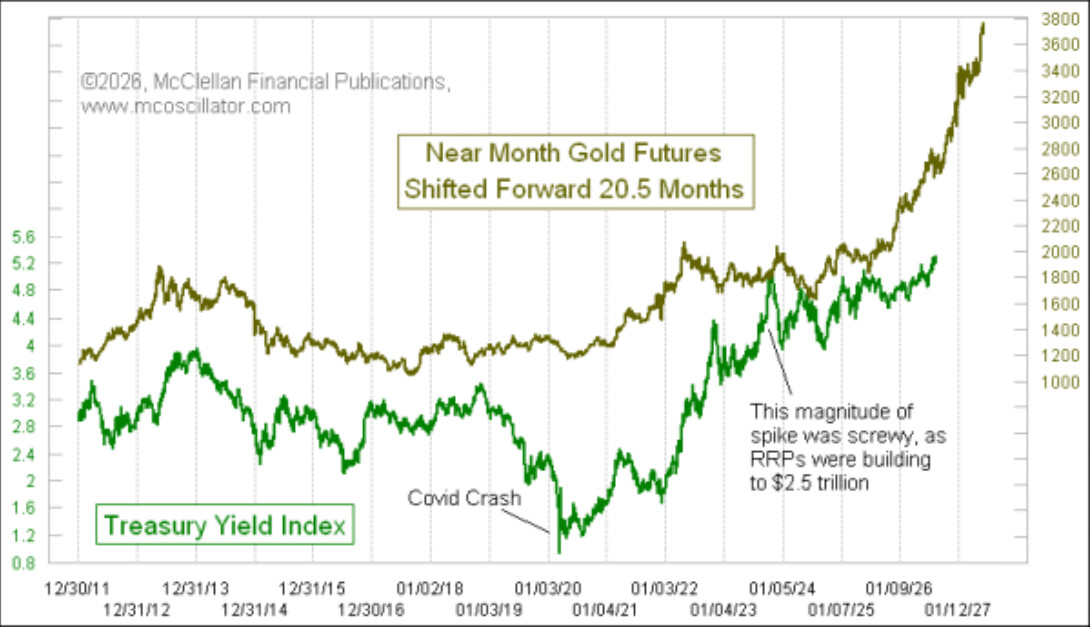
Whilst we’re on the subject of bonds, I have an interesting chart here from Tom McClellan. It shows the correlation between gold (shifted forward by 20.5 months) and US bond yields. The chart clearly points to yields continuing to rise.
And an interesting thesis about equities: JPMorgan warns of an autumn correction: Despite the intact upward trends in the major US indices, JPMorgan sees growing risks of a setback in late summer or early autumn. Strategist Jason Hunter points to a narrowing market breadth, increasing rotation into defensive sectors and waning confidence in AI shares. JPMorgan is particularly critical of the parallels between the current AI boom and the technology euphoria of 1999/2000, noting that the heavy concentration of investor capital in tech stocks increases the risk of a setback. Additional headwinds include high Treasury yields, tensions in the Middle East and signs of weaker US consumer spending.
What’s the intuition for the 20 months? Because as is it doesn’t sound like a correlation, you can probably show a lot of similar correlations between two curves when cherry picking the time period esp if you allow time shifting
To diagnose bubbles, Sharma uses what he calls the four O’s. He said the AI boom is flashing red on all four: overinvestment, overvaluation, over-ownership, and over-leverage.
Interest rates raises tighten credit and put the less profitable companies into trouble. In times of crisis, central banks tend to cut rates so it seems fairly normal that rates raises and then tops precede the crises.
I’m not sure what to think of this one. Higher rates on government bonds creates competition and tightens credit conditions but if it stems from a loss of credit by the US Treasury, it might also spur more attractivity for corporate bonds. AI debt fueled investments make that field pretty crowded too right now, though.
I’d say the raising rates situation is bad for stocks as well as bonds but I wouldn’t bet the house on any directional move. There are other effects at play and, for example, the AI craze or fall from grace can move stocks in different directions with pretty wide magnitude.
Edit: also, some/many(?) companies have US Treasuries on their book so higher yields, meaning a loss of value for already issued bonds, would also be bad for them for that reason.
Mit dem Lesen und der Teilnahme an diesem Forum bestätigst du, dass du die Forum-Richtlinien gelesen hast und damit einverstanden bist sowie den Haftungsausschluss auf http://www.mustachianpost.com/de/ akzeptierst.