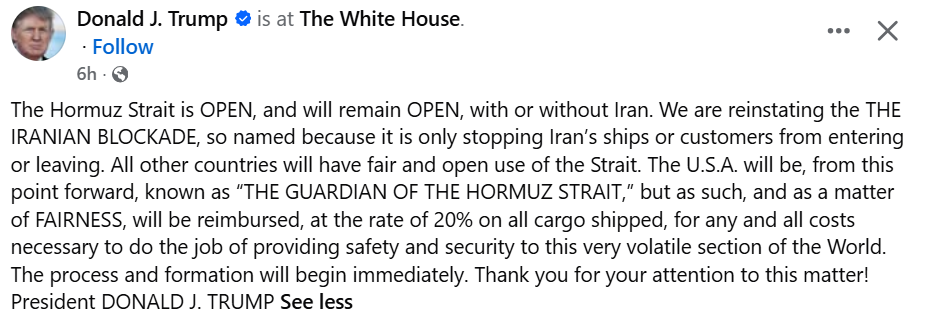
Shock is one thing. Stopping to invest is another. This is what I meant by rationalising. If a president of a country is blatantly involved in insider trading allegations and market doesn’t care then it shows something about market. I wouldn’t call it practical , I would call it hypocritical. I think as long as there is profit the investment would continue.
The key point I am trying to make is that investors always find a narrative that suits them. It doesn’t always need to have a real logic or evidence behind.
For example -: western world doesn’t trust Chinese AI because its state controlled. What about US AI? Can we conclude it’s not state controlled?
Russia invaded Ukraine, whole world stopped investing in Russia. US invaded „I don’t know how many“ countries . What happened ? Nothing. So I would not say it’s neutral. It might be pragmatic
Two points: first it’s a radically different state and societal philosophy: the US is set up for private enterprise, China is set up for state enterprise. That should, in an of itself, lead to a conclusion that US AI is extremely unlikely to be state controlled. Second point: I don’t trust US oligarchs an iota more than the Chinese government. I am sure either will do exactly what’s optimal for themselves, and only themselves.
The world stopped investing because Russian assets were made illiquid, is my understanding. I am sure there are potential high-risk plays in Russian assets at the moment that people would love to play with.
The US has invaded many countries, indeed, so did the USSR (ask Czechoslovakia, Hungary, Afghanistan post-WW2, and all their western neighbours during WW2; moreover they subjugated 10+ countries and imposed their politics so I’d call that not only invasion but colonization, forced assimilation); without the USSR there wasn’t a counterweight to US power so they did have plenty of free reign in the 90s. Russia invaded Georgia before Ukraine.
Seems we are saying same things. I agree that most large powers try to abuse their power but I think US gets free pass so far and investors brush these things aside. Maybe it’s because so far US abused power with small nations and didn’t affect directly the larger nations.
I don’t think money has much morality, meaning I don’t think many people would intentionally avoid investing in any country due to its politics/actions. Sure, some people may not get “bad” stocks like tobacco, defense but I’d think they are a very small minority. Overall I feel that money and finances are very far removed from accountability for morality to play at all on people’s minds.
The market can stay irrational longer than I can stay solvent.
The Trump rabbithole can go deeper than I can fathom.
Internal checks on Trump are more lacking than I can potentially imagine (potentially because the people who could exert checks actually get what they want out of the Trump presidency as a whole - this Iran thing hasn’t come out of nowhere, there are American leaders who want this and would support a ground invasion).
The guy has zero morality, his moral compass is “what’s good for me, my kids, my immediate supporters”, nothing else matters, not the country, not the people. I wanted to also type “not others’ opinions of him” but realised it’d be wrong. However I’m sure the first two clauses (him, his kids) trump anyone else’s opinion, unless it’s of his immediate supporters (so he can use them to get more for himself).
It will be interesting to see how our future selfs will look back at this period and these statements.
Most will be out of the market in the next big crash anyway…
Elon will be bathing in $1000 notes no matter what
It’s easy to ride the market when it delivers such exceptional returns for so long.
My impression is that under these conditions, many investors (maybe most?) become greedy—and easily disappointed, if not panicked, at even a short correction. (Check for example the messages in this forum when the US tariffs were announced)
Imagine a new “lost decade”: constant negativity, with big downturns hitting at the exact moment you start thinking, “OK, I’ve waited—now it’ll rally again.”
I don’t see many of us surviving till the next bull market.
Ever since I joined this community, which under a different User name I think was in 2018/19… i keep telling young folks that it was a mistake to be 100% stocks. Its getting difficult to keep re-iterating this message in that market. Yet, the message still holds true. I genually believ that many investors (in general, not just here) had more shares than the can stomack, had more US exposure than they can survive, and had too much Large Cap Momentum exposure.
I think you are completely right. I’m thinking to reduce the stock % in my vested benefit at VIAC. But beside that I still see TINA, because it is hard to find suitable alternatives, with Bonds still not yielding anything after inflation and yield on cash deposits at 0%.
Beside that I guess as long as the low yield from national banks over the world remains (which I guess is partially due to the level of debt) it maybe really is TINA for stocks.
Of course only time will tell but a lost decade is my big fear as well with the current global issues and focusing on a national level rather than global economy.
Most young investors have an enormous pile of ultra illiquid human capital. That can only be accessed some months into the future with very expensive loans.
100% stocks is a massive under-allocation. If you intend to build your assets over the next 30, 40 years, it just doesn’t matter if 20k go down the drain, as long as you are compensated fairly for it. You will have made it back in about a year with very reasonable savings rates on median salaries.
LETFs can be bought at very low minimums at around 100 bucks. You pay around 1.2% excess financing above cash for every unit of leverage (Return of UPRO around 2.35% below an ideal 3x S&P 500 return, attributed to the 2x leverage, before taxes). At a conservative 5% expected excess return, you are still left with around 4% expected excess return after subtracting costs.
Cheaper alternatives are available at slightly higher levels for more hassle and potential tax problems (“Gewerbsmässiger Wertschriftenhandel”).
Such leverage levels are very path dependent. But that is a problem you just don’t have as a young investor with meager liquid assets that are continuously fed by your enormous human capital (through work).
That one can not stomach that on psychological grounds is a barrier that is very well paid for those that can overcome it. Just as investing at all into stocks is very well paid vs. letting it rot on a bank account.
The issue is that in theory you’re absolutely right. Mathematically, human capital should offset equity risk.
In practice though, the behavioral aspect is so important it could remove all the benefits—and perhaps even make you broke. Theory doesn’t capture what happens during a 50+% drawdown when:
You’re watching retirement accounts halve in value while unemployed
Your spouse loses a job simultaneously
Volatility keeps hitting every 18 months, never giving peace to rebuild conviction
Leveraged positions force liquidation at the bottom due to margin requirements
…
Human capital exists until it doesn’t. Employment isn’t guaranteed, and psychological limits are real constraints—not just ‘barriers to overcome.’ The gap between optimal allocation on paper and what someone can actually stick with through 5+ consecutive losing years is where many portfolios fail.
Despite all of this, I always appreciate what the theory says. The more knowledgeable you are, the better decisions you can make. It’s just that knowledge alone doesn’t always protect you from the psychology of watching real money evaporate.
Mit dem Lesen und der Teilnahme an diesem Forum bestätigst du, dass du die Forum-Richtlinien gelesen hast und damit einverstanden bist sowie den Haftungsausschluss auf http://www.mustachianpost.com/de/ akzeptierst.