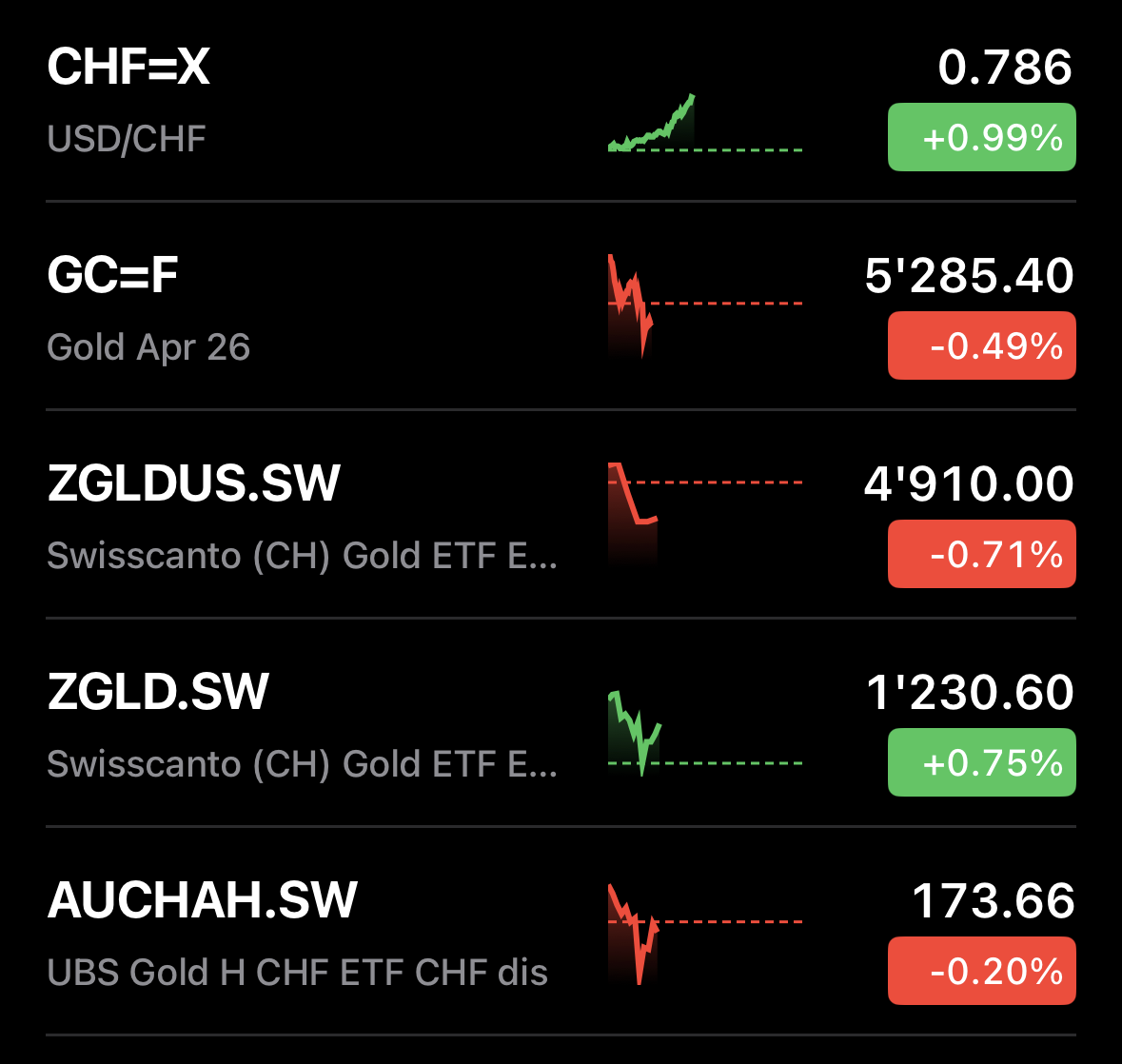
I think that’s a misleading notion. The unhedged ETFs simply follow the gold price. Gold happens to be mainly traded in USD but that doesn’t mean that the USD/CHF exchange rate is some kind of direct factor of the ETF performance.
You can buy in CHF both hedged and unhedged products. Buying in CHF does not mean hedging, that was to answer @lsnguy who seems to link both.
Unhedged product in CHF (e.g swisscanto ZGLD) performance is (gold price * USDCHF), that’s all, so that’s the exact same internal perf of Gold (USD) measured in CHF, taking into account USD/CHF variations.
Using this product, you avoid buying USD to buy the product so you save currency change markup in comparison with USD denominated Gold ETF (e.g. ZGLDUS), which is exactly the same if not for the “unit”.
Hedged CHF Gold is different (e.g. UBS AUCHAH), and that’s a bet on both Gold and CHF, at a cost.
Note that ZGLD has a TER of 0.4% and GLDM for example only 0.1% so probably it is still cheaper to go for a GLDM (or whatever other gold ETF in USD) and pay the FX conversion fees, especially if using IBKR as broker.
I have a CHF standing order on VIAC Invest for VIAC Gold. It says 0.28% fees. They say everything is included… have not calculated effective rates yet.
With hedging, it combines gold physical asset and, I guess, future contracts on usdchf.
ZGLD has no hedging. Say gold is 100 USD, then ZGLD is 80 CHF. If USD drops, and gold stay the same, ZGLD will drop in CHF. If USD drops and Gold rises in USD, it might drop, rise, or stay stable, depending on how much Gold rises and how much USD drops. It’s just currency conversion, you’re not exposed to anything else but gold, just a unit conversion. You gain nothing (but avoiding using USD when trading it). If Gold drops and USD rises, same. If both drop or rise you follow the according trend of course.
With hedging it’s quite different, if Gold makes +5% in USD, expect it to follow this trend in CHF with a CHF-hedged product, so like +4% in CHF, whatever the usdchf exchange rate is.
Where you lose: you pay for hedging, it hits the absolute performance.
It’s only a winner if USD loses continuously against CHF. -because if gold makes -10% in usd but usd gains +20% against the CHF, you’d better not be hedged.
AUCHAH will be down in CHF
ZGLDUS will be down in USD (but you’re actually winning in CHF)
ZGLD (CHF) will be up.
I would like the CHF hedged version for sure and in that sense the VIAC product also looks attractive.
Otherwise the UBS AUCHAH seems the most logical choice?
I want this position as a protection hedge for my portfolio and for my expenditure in CHF
and to do these FX bets, it would need some effort and costs (not sure if this is more or less than the interest differential), while taking this double bet with a hedged ETF solves this. At least this is what I think with a set and forget approach with recurring order.
Again happy to learn if there is a better way to manage this.
The UBS ETF also has an unhedged share class (AUUSI) with the same 0.23% TER. It’s also listed in both, USD and CHF. I.e., people who want gold that is physically in Switzerland don’t need to go with the very expensive ZGLD, even if no hedging is desired.
The interest rate differential between USD and CHF is currently ~3.5%, which makes hedging extremely expensive. With normal ETFs, hedging fees are not included in the TER. How does this work with a gold ETF? In the worst case scenario, will the provider sell gold to pay for the hedging costs? Hedging with gold seems too abstract to me, I wouldn’t use it.
in this case the underlying currency should have no impact
and with access to almost free FX conversion via IBKR, the better option would be to buy in the US?
rather than buying in CHF (unhedged) either via VIAC or UBS ETF?
Mit dem Lesen und der Teilnahme an diesem Forum bestätigst du, dass du die Forum-Richtlinien gelesen hast und damit einverstanden bist sowie den Haftungsausschluss auf http://www.mustachianpost.com/de/ akzeptierst.