Beyond vt and chill: protection against draw downs and sequence of return risks

Long time we have not heard on what/how/how much/results about these.

Diversification of MF funds: is this because we can doubt about one’s future ? If yes even if you diversify, a fund going to 0 (could be fraud or whatever) will erase any gain you expect in the global portfolio. But you may think of different strategies / performance expectation across different funds.

This is quite an infinite hedging loop, and high maintenance, and high conviction that should not fade - at least this was my feeling in the end.

Can you share examples, Mr Pickaxe?

For this “Tortoise” sleeve I’d probably look at DBMFE (the UCITS version of DBMF, iMGP DBi Managed Futures) and Man AHL Trend Alternative as core examples: both are diversified, systematic trend / managed‑futures funds that can go long or short across equities, bonds, FX and commodities, they tend to shine in big crisis or strong trend periods but can be pretty meh or even down for years when stocks just grind up, so I’d personally woul cap them together at maybe 10–20% of the portfolio at most and only if you’re really ready to sit through long boring stretches – and to be honest I still don’t have enough conviction myself to actually pull the trigger on this kind of sleeve, I’m still reading up and curious what others here think about whether the extra complexity is actually worth it long term

1 Like

Thanks, I thought so but when I looked I said to myself “it can’t be!”

of 25mn AUM? I’d not even look at something with less than 150mn AUM, preferably 500mn.

This, or 20% performance fee and 1.7% TER?

Me neither, few years back KLML was the darling for having provided alpha in 2022 so I spent a long time pretending to try to understand what these are, until realising my ignorance and leaving them alone.

Depends on what funds, what you want them to do and your overall strategy.

Core property of basically any fund in the managed futures/liquid alt category is that it‘s goal is to be uncorrelated to equities, while still achieving high returns. Most of these funds target volatilities around 10-15% and achieve Sharpes around 0.3-0.5+.

My personal expectations are close 0 correlation to equities, and a 0.3 Sharpe to be conservative (about a 3% return above t-bills is a reasonable conservative expectation imo).

DBMF for example is on an absolute tear when looking at its risk metrics and equity correlation. Basically any combination of DBMF + VT has way better Sharpe than VT alone since it launched. 75-95% VT + rest DBMF even better total returns.

Where it really starts to shine is using leverage. You get the same risk metrics as straight equities, but higher total return. Historically and since live launch as well.

Back test of live funds with 5/25 rebalancing bands (rebalancing is absolutely crucial with these, and we have the very big advanatage of being able to sell tax free, so we can heavily abuse the rebalancing premium): https://testfol.io/?s=as39UYpxJ7A

Backtest of simulated funds going further back:

https://testfol.io/?s=6ZtEiFLg6vr

Now that‘s just dbmf, the aggregate of the SG CTA index basically (They use a replication alogorithm to capture the aggregate of the 10 fund sthat make up the SG CTA index, so I a way acts liek a MF index product, and they have been successfull in that). Main strategy here is trend following, very simple, very effective, and an academically/statsically robustly supported risk premium.

Some other strats like carry are mixed in as well.

Last year was quite bad for pure trend funds during the tariff turmoil, due to whipsaws and before waaot that good. Since then however have been on a tear. Funds like “CTA” have been doing extremely well throughout however. CTA is also a mix of several strategies. trend, carry, mean reversion, and defensive. Main strategy trend. I personally hold this one among others.
The performance has been insane, and improvements on the risk metrics are really good:

https://testfol.io/?s=cafXGF0JFO8

There is more alt strategies that are uncorrelated, such as l/s stock strategies, that basically use factors and go equally long and short on a set of stocks and being market neutral as a result (and achieving that 0 correlation to stocks as a result). AQR doe sthis best. There are ucits mutual fund versions of these as well.
Their standalone l/s strategy would be QMNIX:
Same backtest, see again a major improvement on risk metrics:

https://testfol.io/?s=9yQunw1Nv34

AQR alo has multi-staretegy funds, where they combine multiple sub staretgie sinto one including their managed futures. Their top strategy is called APEX, which I perosnally hold. They have it as a mutual fund. performance has been really good (even though with the classic hedgefund 2/20 fee scheme). No US ticker for backtest available, but you can see the standalone performance here (again low correlation to equities):

Now put all 3 backtested US strats together in a single portfolio for example:

https://testfol.io/?s=lKokE6uxly0

With the others as single strats in the same timeframe startin 2022-03-08, to make an apples to apples comparison:

DBMF:

CTA (same as above, as that is the youngest fund and sets the start date):

QMNIX (has been on an insane run the last years as we can see):

The vol. and drawdown reductions, and improvements to risk adjusted returns have been really good in all cases.


4 Likes

That’s just the newly launched etf share class of that fund. The ucits mutual fund has multiple 100M in aum.

Hopefully not. That fund is trash due to the insane fees, while having low juice (low volatility).

There is AHLT as an US fund, which is also from MAN.

KMLM is basically the purest form of trend. It just uses a moving average going long or short. It’s always equally invested in it’s differnet buckets though, and doesn’t lean in on specific single trends, which i don’t like a smuch, and why it hasn’t done so hot the last years.

2 Likes

Join me in this club but at least it was interesting spending this time.

Thanks @Tony1337 I did not expect that much, now I have material to spend time on the topic again! And backtest my ignorance one more time. I’ll go through your text and sims several times for sure, I’ll try too.

That’s quality content anyway :folded_hands:

2 Likes

Amen!

Wow, thanks! thats quite an analysis!
Seems like 75/25 might be a good starting point.

What have you implemented in your portfolio?

QQ what is your experience with tax considerations on these products? I understand that US products (like CTA) will distribute all their gains eoy. Are these classified as capital gains under swiss tax law? Or rather consider UCITS versions for these kind of strategies?

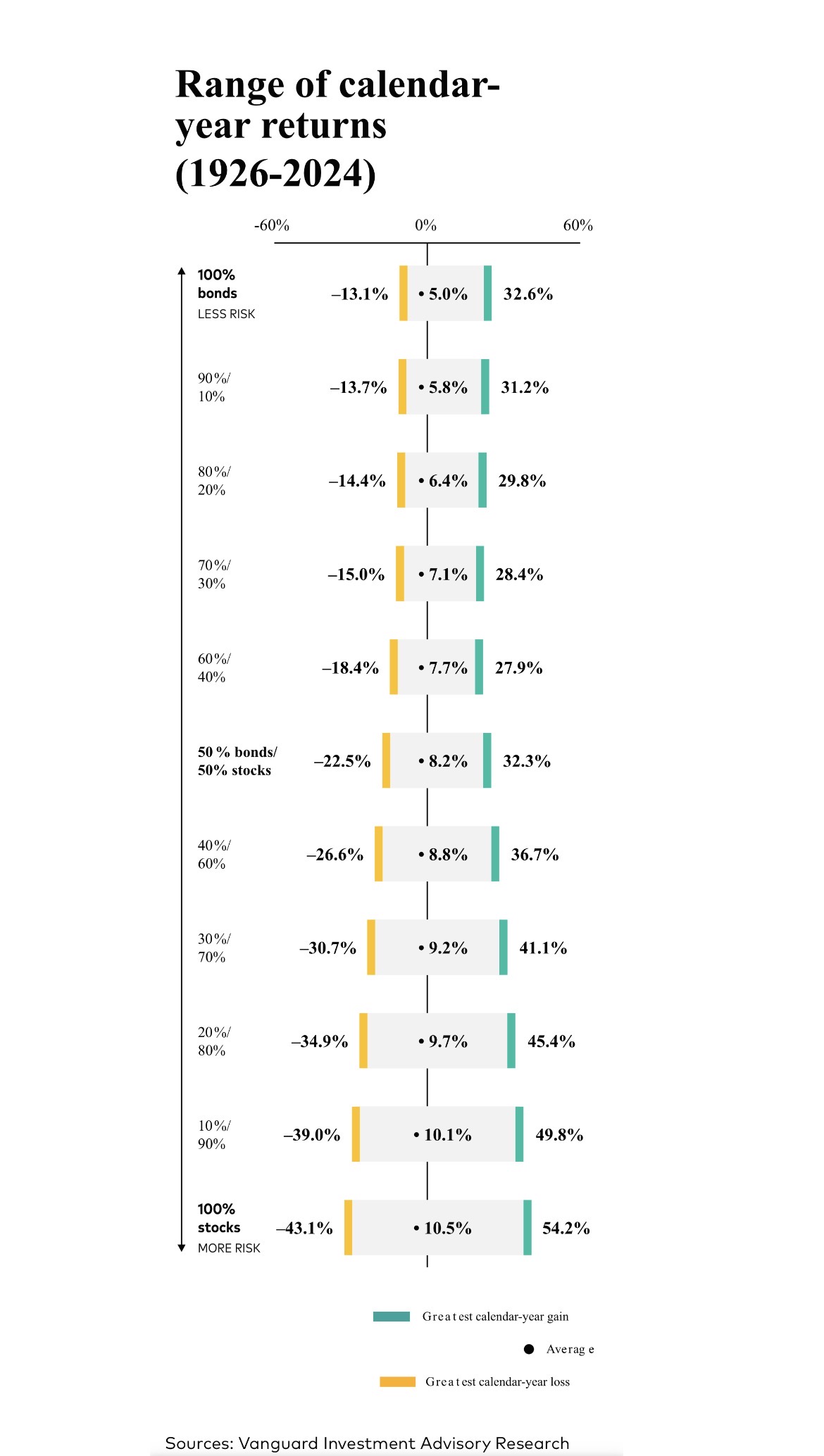
This chart shows that even though there is a difference between performance of 100% equity versus lower equity portfolios, the difference is not that huge as one might imagine in their head.

So maybe that can be a way to protect partially against severe drawdowns

1 Like

What a time, when bonds returned 5% a year :melting_face: . Also shows that in the whole dataset, 70/30 was actually the best for risk-adjusted returns.

This is all in USD terms. I think for CHF everything should be reduced b 4-5%.

I’m at 60/40, which I guess is 84% of the return for 62% of the max drawdown.

If you take the current Situation of a Swiss Investor:
Bonds (>0.5%) vs SMI >5%.
Thats not just 4-5% less.
Thats >10x the return for equities vs bonds.
If you had you invested 10k in 2015 in bonds you would have slightly more than 10k (nominal), probably less than 10k inflation adjusted. While you would have probably have over 20k for an smi investment (with dividends reinvested).

So the equity return must even compensate for the slightly negative real return of the bond part. I can see the stabilising effect but any return of such a portfolio comes only from the equity part..

It just doesn’t feel very sustainable for driving compounding growth, honestly? I guess current Swiss pendant to bonds is might as well be cash? Am I missing something?

Point is that in the end inflation adjusted returns matter. So if you bring down both numbers (in USD or CHF), you will end with 0-1% real return for bonds and maybe 4-5% for stocks. That’s about it.

But the 60-40 wouldn’t be mathematical average of these numbers due to benefits of rebalancing etc.

ideally it’s not good to be 100% in bonds unless the main goal is capital preservation.

1 Like

I agree that in the end inflation-adjusted returns matter and I think they are more suitable for such comparisons. That said, inflation-adjusted bond returns also tend to be lower in Switzerland, at least in recent decades.

If I remember correctly, the long term historic average of inflation adjusted returns was 5% p.a. for stocks and 1.7% p.a. for bonds (CS Yearbook 2023). I would expect lower returns in the future, though, at least on the bond side and especially in CHF.

Edit: Just read in the 2025 yearbook summary that the average real return on gov bonds was 0.6% p.a. across 21 countries 1900-2024 (0.9% p.a. if Austria is excluded).

I‘ll send you a DM with my current portfolio.

Tax considerations are definitely an important aspect. I try to use ucits mutual funds where I can, as there only the collateral interest yield is taxable. For US funds that distribute, it depends. Mist of the distributions should be capital gains and therefore tax and withholding tax free. There are nuances though. Sometimes ictax classifies short term cap gains as taxable for example (I personally will do these funds manually in my tax declaration and consider any stcg as tax tree). Commodity future‘s distributions from US funds however, are considered income in the US, due to them being from cayman subsidiaries (weird US tax code rules). And these income distributions als have wht applied then of course. And the collateral distributions are also taxable with wht. So it will vary year over year on how much are taxable distributions. Overall I expect it be something like 2/3 over the long term tax free cap gains for US funds. So not too bad.

Still ucits funds should be the first choice to avoid that headache.

Overall of course still take what I showed in these backtests with a grain of salt and do your own due dilligence. These funds have looked great in the past and I hope they will continue to look great. But I‘d be conservative and tamper my expectation.

There is also huge dispersion in this space and why I like using funds like RSST and DBMF to combat that dispersion.

2 Likes