Me and my partner were not thinking about making 2nd pillar buy-ins, but seeing our recent tax bill got us reconsidering. Here are more details:
we arrived in Switzerland later in our careers (35+). Our pension statements show a combined buy-in possible over 100k+ CHF.
Pillar 3a: we fully max out every year for both of us.
Other investments: typical investment strategy of mostly VT ETF, and some company shares. Not much exposure to bonds or secure assetts. (so wouldn’t mind having more investment in other secure/non-stock assets)
Let’s say we will not buy property in 2-3 years (i.e. 3-year withdrawal lock-up isn’t a blocker).
With tax data in cantonal software already filled, I was trying to understand the benefits from 2nd pillar contributions. I simply filling in the Rachats d’années d’assurance (2ème pilier) and I saw the following tax reduction estimates:
CHF 10k buy-in: ~4,300 CHF
CHF 20k buy-in: ~8,700 CHF
CHF 30k buy-in: ~13,100 CHF
CHF 40k buy-in: ~17,500 CHF
This works out to a ~43% relief for buy back, which seems significant? I would like to understand if there are any caveats here:
If all other tax data accurately set up, does simply testing numbers in the 2nd pillar buy-in field give a good estimate of actual tax savings? Or, are there any caveats?
I read staggering across 2–3 tax years is usually best. Is it better to split buy-ins equally between spouses or prioritize the higher earner / better pension fund?
How the buy-in process work? For 2026 taxes, in the remaining 3 months, I can just reach out to pension fund and make the buy-ins?
Any guidance or past experiences from people who made similar buy-ins in their 30s/40s would be helpful.
Check your cantonal (and potentially federal) tax tables, if you’re at the top marginal tax rate I would only do buyin to reach the limit on your taxable income (eg ZH is around 270k for single).
Other than that it’s as you say, reach out to your pension fund before end of year, wire the money and declare it in your taxes when you file next year.
This will work just fine. Any online calculator would do, as well, just compare taxes paid on 100% vs. 100% - x with 100% being your taxable income.
No caveats. Maybe withdrawal taxes, eventually if you plan to withdraw. Obviously higher 2nd pillar means higher withdrawal taxes.
Depends. If you are way above the marginal amounts, it doesn’t matter. If you are below, makes sense due to the progression.
Legally, it doesn’t matter.
If you want to buy-in 100k the next 0-3 years and then be done with it, it doesn’t really matter.
If you expect higher buy-ins for a couple of years, then it depends on your numbers and plans for the future. Things to consider include your current and future buy-in limit, eventually the salary split once individual taxation arrives and pillar 2 performance. On a more detailed level also regulations e.g. in case of death.
Possibly, also some emotional factors
Just reach out to pension funds. They might even have an online form that provide the limit to pay-in or describe the process. It does come down to wire the money and attached the buy-in confirmation to your tax return, much like 3a.
They might have some time limit so don’t wait until Dec. 30.
To add to that, and while in the end the amount in CHF matters, I’d still recommend doing that @mrmustin, just to understand the tax progression and get your sweet spot.
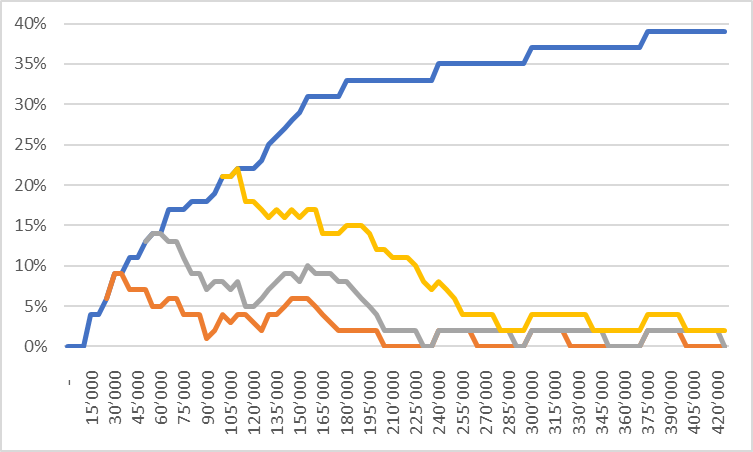
As example, here’s ZH, married (I only have that one), here set to 100%. Blue’s the marginal rate, for that example maxed at 39% at some 371k taxable income. Depending on your zip code, might as well be 35% or 42%.
The other lines is the difference in steps of 25, 50 and 100k respectively, for that case basically the difference between the first and last CHF bought in.
Depending on where you are in that range and how many years you want to split your buy-ins, splitting over years can make a big difference.
A good first step is to calculate the total return. This is done by calculating the total compound interest for the full term, and adding the tax savings (income tax reduction minus retirement capital withdrawal tax).
The second step is to compare that total return with the total return of the interest-bearing instruments you currently use for the bond/interest component of your portfolio. If the total return is higher, then replacing your current interest-bearing instruments with a extra-obligatory pension fund benefits via a buy-in is profitable.
It’s not a fool-proof calculation, as the interest rate on extra-obligatory benefits is variable. And, of course, there is always a risk that capital withdrawal tax rates will change between the start and end of the term. But it’s the best way to calculate whether a buy-in is advantageous, in my humble opinion.
Of course, if you do not have and do not want a bond/interest component, then there’s no point bothering with the question at all.
It is more than just tax optimization. It is also asset allocation/ market exposure mitigation. I view pillar 2a as bonds, and use it in my portfolio as such, with bonus of a tax rebate. Again most attractive for HHI above 280-300k chf
Mit dem Lesen und der Teilnahme an diesem Forum bestätigst du, dass du die Forum-Richtlinien gelesen hast und damit einverstanden bist sowie den Haftungsausschluss auf http://www.mustachianpost.com/de/ akzeptierst.